Non-Competitive Markets
 Call Kai
 Learn
Learn Practice Test
 Spaced Repetition
 Match
Match Flashcards
 Knowt Play
1/81

There's no tags or description
Looks like no tags are added yet.
Name | Mastery | Learn | Test | Matching | Spaced | Call with Kai | Chat |
|---|
No analytics yet
Send a link to your students to track their progress
82 Terms
What is a non-competitive market?
When at least one firm has influence over the price (market power), for this course, the supply side has market power.
What is market power?
The ability to set the price above the marginal cost.
Why does market power generate deadweight loss?
Sets price above MC (for more profit), P>MC → Q<Q* → DWL>0. Basically less is produced than the efficient scale of production.
Monopoly
One firm, many consumers
Oligopoly
Few firms, many consumers
What does the monopolist set the price as?
First find the quantity where the profit function peaks, and then use the demand curve to find the corresponding price.
Profit function maximisation
Pi (Q) = TR-TC(Q)
the derivative of this with respect to quantity is
MR-MC
and at the max dpi/dq = 0
MR-MC=0 → MR=MC
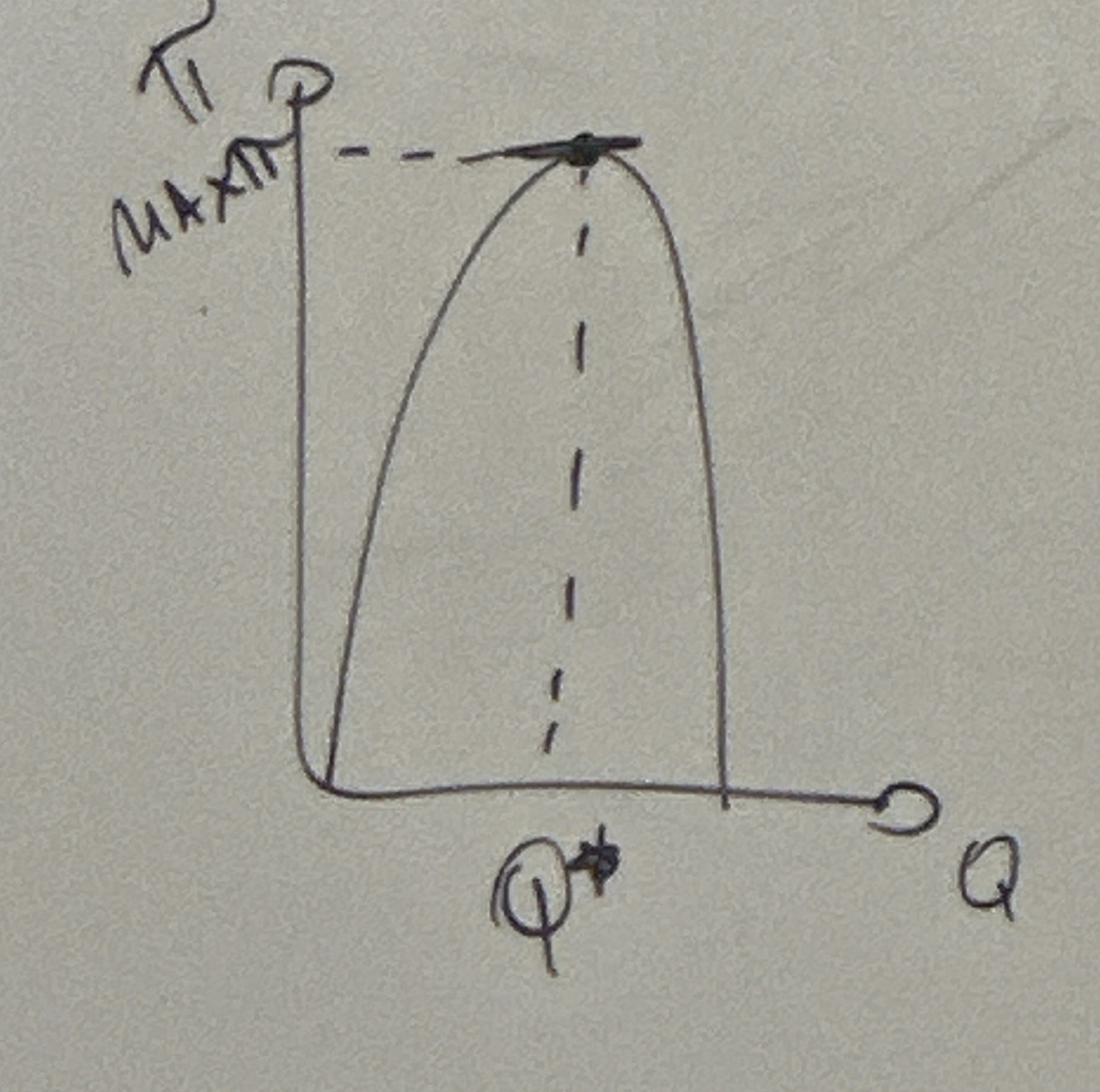
Optimality condition for profit function maximisation
MR=MC
What do we assume about a monopolist’s production capacity?
The assumption is simply that the monopolist can produce the same total output at the same cost as the competitive firms combined.
Short-run monopolist
The monopolist has existing factories and equipment. Increasing output may stretch that capacity and raise MC.
Long-run monopolist
It can change factory size, equipment and the number of plants, choosing the cheapest way to produce each quantity.
Monopolist cost-structure
Sum of the supply curves of all firms
Short-run MC v Long-run MC
So short-run MC reflects existing capacity, while long-run MC reflects the best choice of capacity for each output level. Long-run MC is not necessarily always lower than short-run MC, and the two can coincide.
When do long-run and short-run MC’s coincide?
When the existing factory size is already the best size for that output.
Is long-run total cost ever greater than short-run total cost?
No, in the short run, you must use your existing factory. In the long run, you can keep that factory or choose a cheaper setup. Keeping it is still an option, so choosing the cheapest option cannot cost more—for the same output and input prices.
Cost function
total cost not profit
Monopolist cost function
The sum of the TC in competitive markets. The monopolist owns N production units.
VC
wages x labour
labour is inverse of quantity produced labour function
What is true about Jeff in our model of non-competitive monopolist market factories?
Factories are identical, so \(Q^{eff}\) is the same for every factory. The subscript \(i\) just identifies which factory we mean. Qi = Qieff
What is total quantity produced for a monopolist considering all of its factories?

n x q efficient
How does N change the production?
If we are holding total output fixed and choosing how many factories share it. The efficient scale tells us how many units a factory produces at its most efficient, and then we choose how many we need for th total (assuming it divides neatly).
TC (Q) in long-run
Price x Q = AC min x Q
When is min AC compared to MC line
minimum when ac = mc

Is MR = P in monopolies?
No, P is not given, so P is chosen so that profit is maximised, MR=MC.
What is MR?
Marginal revenue is bu how much TR changes when you increase Q by little
Two effects when you increase quantity by little
Output expansion effect
Price Reduction Effect
The net change in total revenue depends on which effect is larger.
Quantity increase, Output expansion
Total Revenue increases because you sell more TR = PQ
Quantity increase, Price Reduction effect
Total revenue decreases because you to sell more, you need to decrease the price
what effect is stronger when quantity increases? output expansion or price reduction?
Elastic demand: Output effect beats price effect; total revenue increases.
Inelastic demand: Price effect beats output effect; total revenue decreases.
Unit elastic demand: Both effects cancel out; total revenue stays flat
The total rectangle is Total Revenue

MR in terms of output expansion effect and price reduction effect
MR = output expansion effect - price reduction effect
Increase in TR when we go from Q1 to Q2 units
MR > 0: total revenue goes up so output expansion > price reduction effect
MR < 0: total revenue goes down so output expansion < price reduction effect
How is MR<0
Because for a monopoly, selling one more unit often requires lowering the price of ALL the units it sells.. Sometimes, selling that additional unit forces such a large price reduction that total revenue falls.
MR mathematically
TR = P x Q
MR = dP /dQ x Q + P
Why is MR<P for monopolies?
Price decreases and quantity increases, so dP/dQ < 0. Therefore dP/dQ Q < 0. So MR = P + dP/dQ Q < P
In MR what component of the equation represents the price reduction effect?
dP/dQ x Q
the decrease in price and quantity removed as a result
What component of the MR equation represents the output expansion effect?
P, the revenue from the extra unit
Why does MR = P in perfect competition?
Price does not change so dP/dQ Q = 0, and thus, MR = P, where P is the market price that cannot be changed.
MR curve versus linear demand curve?
MR starts at the same vertical intercept as demand but is twice as steep, so x intercept is Q/2.
MR is below the demand curve because as we established MR<P

Why does TR peak at the moment the MR line crosses the axis?
When MR = 0, then we are at the point after which TR will start to decrease. Therefore this is the TR max and the max profit point.

How does the value o MR affect TR?
MR>0, TR increasing
MR = 0, TR at max
MR<0, TR decreasing

elasticity of demand > 1
Elastic demand. This means the percentage increase in quantity is greater than the percentage decrease in price. So, when you lower price, the gain from selling more units dominates the loss from the lower price. So TR increases, MR>0.

elasticity of demand = 1
unitary elastic. The percentage effects perfectly balance, so nothing changes and TR is at its maximum, it will no longer increase. MR = 0.

elasticity of demand < 1
inelastic. The percentage increase in quantity is smaller than the percentage decrease in price, so TR decreases. MR < 0.

What point of a demand curve is unitary elastic?
|epsilon| = horizontal distance remaining to Q-intercept/horizontal distance from 0 to current Q
so at the mid point it always = 1, before that price is greater so is is greater than 1 as chang min price is smaller percentage wise than change in quantity

Profit maximisation
MR = MC gives you Q_maxpr
Then find the Price at max profit by using Pˆ-1(Q^M)
What is profit on the graph with MC and demand curve for a monopoly equilibrium?
This square. We don’t count the bottom because under neath that is marginal cost. the point chosen is max Q and max P when profit is maximised.

Why is MR = P in perfectly elastic?
Perfectly elastic demand means price doesn't change. A perfectly elastic demand curve facing the firm is horizontal, so price can not be changed and we are in perfect competition.. The monopolist has little market power. If price increases, quantity demanded decreases a lot.

What is markup?
How much a firm charges above its marginal cost, it is a measure o market power.
Learner index / markup mathematically
that gap as a proportion of the price: Markup = P-MC/P. How much percentage extra is being charged.
Markup amount
When P=MC, markup = 0. When P> MC, Markup >0.

Markup in terms of elasticity
P-MC/P = - 1/Elasticity of demand

Makrup in perfect competition
Elasticity = infinity, so - 1/ininity = 0, and markup is 0 so P =MC

If demand is inelastic then what happens to markup?
Then - 1 / a smaller number means that markup is high in absolute value, so it is very inefficient. The - value is because elasticity is - so it makes markup positive.
Perfect Competition vs Monopoly Welfare
Monopoly CS = A
PC CS = A + B + C
Monopoly PS = B
PC PS = 0
Monopoly Total surplus = A + B
PC Total Surplus = A + B + C
Monopoly DWL = C
PC DWL = 0

If FC change does profit or equilibrium change?
MC = MR is the same, so the profit maximisation point is the same. The change in fixed costs with respect to change in quantity = 0. But the actual profit does change.
How does FC affect profit and ATC?
FC increases = Profit decreases
FC increases = total cost increases and Average total cost increases
How can a monopolist maximise producer surplus and gain the entire triangle?
Through price discrimination
Is producer surplus large in PC or in Monopoles?
PS Pi > PS PC
What is price discrimination?
The ability of the monopolist to set different prices for different consumers or for different units of the same good. This allows the monopolist to increase profits.
When is price discrimination possible?
When the firm has market power (monopolies/oligopolies), the firm has information on the willingness to pay of different consumers, and when there are no arbitrage conditions (the good cannot be resold).
Why do arbitrage conditions prevent price discrimination?
Because price discrimination only works if the firm can stop customers who get the low price from reselling to customers who are charged the high price.
First degree price discrimination
Every unit of the good has a different price
Two parts Tariff
Entrance fee + Pay per usage
Bundling
Fixed packages at a total price
Third degree price discrimination
Different prices for different groups
What is the price of each unit in First Degree Price Discrimination (perfect discrimination)?
The price of each unit is exactly equal to the willingness to pay that the agent has for that unit. The total revenue or total price paid for a specific quantity Q is equal to the integral of the inverse demand function up to that quantity until the point with marginal cost = mr.
What does the monopolist need or First Degree Price Discrimination?
Needs to know the willingness to pay for each unit
It must be legal to price discriminate (depends on what kind of information you need
Few cases in reality (usually taxation follows this pricing scheme)
What type of taxes are based on First Degree Price Discrimination?
University taxes (especially in the US)
PS CS AND TS AND DWL in First Degree Price Discrimination
CS = 0
PS = Total surplus
DWL = 0
Q ^PI = Q ^PC
MC versus Demand Curve
Demand curve comes from consumers → how much consumers are willing to buy/pay.
MC curve comes from the firm's production costs → how much it costs to produce one additional unit.
Two part Tariff what is the size of the entrance fee?
Size of the entrance fee = Consumer surplus

What is Consumer Surplus in Two Part Tariff?
It becomes Producer Surplus, so CS = 0
DWL is also zero
Producer Surplus is the whole triangle
Efficiency as Q Pi = Q PC
mc = p to find maximise total surplus at total surplus = producer surplus
Why is Two part Tarriff used more often in real life?
Because it is much easier than first price discrimination?
Bundling what is the price of the package?
The difference between marginal cost and the max price willing to pay multiplied by the quantity where profit is maximised /2. SO the entire total surplus becomes producer surplus. You cannot buy less than this quantity. The price of the package is set so that PS = Total surplus.
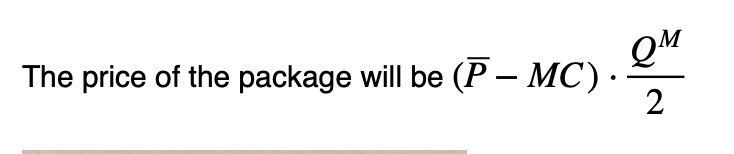
CS and Del in Bundling
CS = 0
DWL = 0
Third Degree pRice Discrimination (Imperfect Price Discrimination)
The monopolist has the possibility of dividing the demand into smaller groups for which there is an observable characteristic that is a proxy of willingness to pay (have different willingness to pay based on these groups)
Based on what does the monopolist sell the good in third degree price discrimination?
Different groups who have observable characteristics that are informative of the willingness to pay
MR = MC of each market of each group (optimal price and quantity are different per market ore each group as they have different demand curves)
What groups pays the higher price?
The group with more inelastic demand as this allows the monopolist to have more market power through markup

Why is third degree price discrimination imperfect?
PS = PSs + PSA
aka the sum of the producer surpluses
CS + CSA + CSS
DWL = DWL S + DWLA → there is inefficiency still just less

WHy is third degree price discrimination better than just perfect competition?
PS third degree discrimination > PS no discrimination
DWL third degree discrimination < DWL no discrimination
CS third degree discrimination < CS no discrimination
best price discrimination in terms of producer
1st, then 3rd, then no

As groups tend to infinity what happens to third degree discrimination?
It approximates 1st degree discrimination, as each unit is then priced to each agent with n = infinity.