VOCAB Chapter 7: Nerve Cells and Electrical Signaling
 Call Kai
 Learn
Learn Practice Test
 Spaced Repetition
 Match
Match Flashcards
 Knowt Play
1/65

There's no tags or description
Looks like no tags are added yet.
Name | Mastery | Learn | Test | Matching | Spaced | Call with Kai | Chat |
|---|
No analytics yet
Send a link to your students to track their progress
66 Terms
central nervous system (CNS)
consists of the brain and spinal cord

Peripheral Nervous System (PNS)
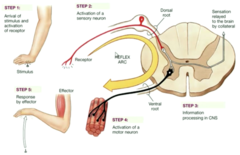
the sensory and motor neurons that connect the central nervous system (CNS) to the rest of the body.

afferent division
carries sensory information from PNS sensory receptors to CNS

efferent division
carries motor commands from CNS to PNS muscles and glands

effector organs
Muscles and glands which respond to impulses from the nervous system.
somatic nervous system
the division of the peripheral nervous system that controls the body's skeletal muscles

autonomic nervous system
the part of the peripheral nervous system that controls the glands and the muscles of the internal organs (such as the heart). Its sympathetic division arouses; its parasympathetic division calms.

sympathetic nervous system
the division of the autonomic nervous system that arouses the body, mobilizing its energy in stressful situations

parasympathetic nervous system
the division of the autonomic nervous system that calms the body, conserving its energy

neuron
a specialized cell transmitting nerve impulses; a nerve cell.

glial cells
cells in the nervous system that support, nourish, and protect neurons

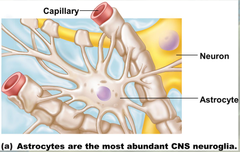
astrocytes
Provide structural and metabolic support for neurons.
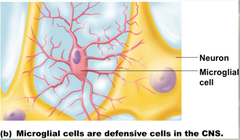
microglial cells
extremely small glial cells that remove cellular debris from injured or dead cells
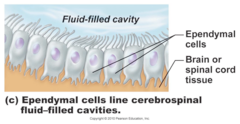
ependymal cells
line cavities of the brain and spinal cord, circulate cerebrospinal fluid
oligodendrocytes
Type of glial cell in the CNS that wrap axons in a myelin sheath.

Schwann cells
Supporting cells of the peripheral nervous system responsible for the formation of myelin.

dendrites
a neuron's bushy, branching extensions that receive messages and conduct impulses toward the cell body

soma
cell body

axon hillock
Cone shaped region of an axon where it joins the cell body.

axon
the extension of a neuron, ending in branching terminal fibers, through which messages pass to other neurons or to muscles or glands

collateral axon
branch of an axon

axon terminal
The endpoint of a neuron where neurotransmitters are stored

synapse
the junction between the axon tip of the sending neuron and the dendrite or cell body of the receiving neuron

presynaptic neuron
neuron that sends the signal

postsynaptic neuron
transmits impulses away from the synapse

bipolar neuron
a neuron with one axon and one dendrite attached to its soma

pseudo-unipolar neuron
appears to have an axon and no dendrites

multipolar neuron
A neuron with a single axon and multiple dendrites; the most common type of neuron in the nervous system.

afferent neuron
Neuron that conducts impulses toward the CNS from the body periphery.

interneuron
a neuron that carries nerve impulses from one neuron to another

efferent neuron
Neuron that conducts impulses away from the CNS to muscles and glands.

myelin sheath
A layer of fatty tissue segmentally encasing the fibers of many neurons; enables vastly greater transmission speed of neural impulses as the impulse hops from one node to the next.

nodes of Ranvier
Gaps in the myelin sheath to which voltage-gated sodium channels are confined.

leak channels
channels that are always open and allow ions to move along their gradient
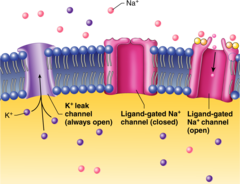
ligand-gated channels
open in the presence of a specific binding substance, usually a hormone or neurotransmitter
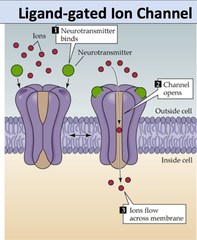
voltage-gated channels
open and close in response to changes in membrane potential

resting membrane potential
the electrical charge of a neuron when it is not active

potassium equilibrium potential
the membrane potential at which the net movement of K+ ceases

potassium equilibrium potential
the membrane potential at which the net movement of K+ ceases

sodium equilibrium potential
an equilibrium potential value of +65 mV.

Na/K pump
Active transporter that moves three Na+ out of a cell and two K+ into the cell against their respective concentration gradients.

repolarization
Return of the cell to resting state, caused by reentry of potassium into the cell while sodium exits the cell.

hyperpolarization
The movement of the membrane potential of a cell away from rest potential in a more negative direction.

graded potentials
small changes in membrane potential that by themselves are insufficient to trigger an action potential

electrotonic conduction
passive current flow through neurons that accompanies activated electrical currents
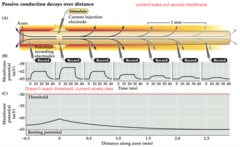
threshold
the level of stimulation required to trigger a neural impulse

depolarizing graded potentials
make a neuron more likely to fire an action potential

hyperpolarizing graded potential
polarization that is more negative than the resting level

temporal summation
A phenomenon of neural integration in which the membrane potential of the postsynaptic cell in a chemical synapse is determined by the combined effect of EPSPs or IPSPs produced in rapid succession.

spatial summation
A phenomenon of neural integration in which the membrane potential of the postsynaptic cell is determined by the combined effect of EPSPs or IPSPs produced nearly simultaneously by different synapses.

action potential
a neural impulse; a brief electrical charge that travels down an axon

voltage-gated sodium channels
membrane proteins that open sodium channels in response to a sufficient voltage change, and initiate and transmit the action potential as Na+ enters through the channel
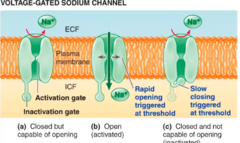
activation gate
part of the voltage-gated Na+ channel that opens when the membrane voltage reaches threshold

inactivation gate
part of a voltage-gated Na+ channel that closes when the membrane potential reaches +30 mV

voltage gated potassium channels
Allow K+ to flow out of the cell, moving the potential back towards the negative equilibrium potential of potassium.

positive feedback
A physiological control mechanism in which a change in some variable triggers mechanisms that amplify the change.

negative feedback
A type of regulation that responds to a change in conditions by initiating responses that will counteract the change. Maintains a steady state.

after-hyperpolarization
The hyperpolarization that follows strong depolarization of the membrane; the last part of an action potential, also called undershoot.

all-or-none principle
the law that the neuron either fires at 100% or not at all

absolute refractory period
The minimum length of time after an action potential during which another action potential cannot begin.

relative refractory period
A period after firing when a neuron is returning to its normal polarized state and will fire again only if the incoming message is much stronger than usual

frequency coding
the degree of depolarization at the axon hillock is signaled by the frequency of action potentials

unidirectional propagation
Action potentials propagate in one direction due to refractory periods

unmyelinated axons
also called type C, fibers include both nonpeptidergic (for mechanical sensitivity) and peptidergic (for heat/cold sensitivity) C-fiber axons. They lack the myelin envelope completely, with Schwann cells surrounding them forming the Remak fibers in bundles within peripheral nerves

myelinated axons
axons covered with myelin sheaths

saltatory conduction
Rapid transmission of a nerve impulse along an axon, resulting from the action potential jumping from one node of Ranvier to another, skipping the myelin-sheathed regions of membrane.
