29/9 - Personality
 Call Kai
 Learn
 Practice Test
 Spaced Repetition
 Match
 Flashcards
 Knowt Play
1/38

There's no tags or description
Looks like no tags are added yet.
Name | Mastery | Learn | Test | Matching | Spaced | Call with Kai | Chat |
|---|
No analytics yet
Send a link to your students to track their progress
39 Terms
What is personality?
The characteristics or blend of characteristics that make a person unique.
Why is personality important?
It shapes how an athlete trains, copes with pressure, interacts with teammates, and sustains long-term career progression.W
Why is it important for sport psychologists?
What is the structure of personality
Work with athletes in a more optimal fashion
Use info to try and explain what it determining behaviour in a situation
Understand athletes more throughly to work out the a way of working with them or influencing them
But it is a scientific pursuit in its own right as research is ongoing

Structure of personality - What is the psychological core?
‘The real you’ remains constant and stable.
The most basic and deepest attitudes, values, interests, motives, and self- worth of a person—the real person
Deeper understanding of person
Internal determined
Structure of personality - What is the typical responses?
The way one typically adjusts or responds to the environment. Also environmental influences.
Good indicator of your core
Slightly more adjustable
Environment has forced the core to be presented
Mixture of both internal and external determined
Structure of personality - What is the role-related behaviour?
How one acts in a particular social situation
Example: Behaviour as a student, parent, or friend
Changes relevant to environment
Therefore most changeable
Externally determined
Major approaches to understanding personality
Trait approach
Psychodynamic approach
Situational approach
Interactional approach
Phenomenological approach
They are used to research approaches of personality. Different perspective software research think of the efficacy or quality of research.
What is Trait Approach?
Behaviour is determined by relatively stable traits that are fundamental units of personality
These traits predispose one to act in a certain way, regardless of the situation.
E.g. competitive = play hard at all times
What is the most common example of adopted trait perspective of personality?
Big 5 Model of Personality Components
What is the Big 5 Model of Personality Components?
Ways to measure the trait of personality and exploring what that might mean in terms of behavioural terms
Neuroticism (vs stability) (nerves, anxiety, depression and anger)
Extroversion (vs introversion) (enthusiasm, sociability, assertiveness and high activity)
Openness to experience (originality, need for variety, curiosity)
Agreeableness (amiability, altruism, modesty)
Conscientiousness (constraint, self discipline)
Research Support of Trait Approach
Current Impact: Has Little Influence
Weaknes: Knowing traits will not always help predict behaviour in particular situations
Contribution: Emphasises the importance of traits and the
Measurement of such dispositions
What is Psychodynamic Approach?
Behaviour is determined by several unconscious, constantly changing factors.
Instinctive drives (ID), superego and ego.
E.g. aggressive instincts mix with ego to produce violence
Emphasis is placed on understanding the person as a whole rather than identifying isolated traits.
Childhood plays a role - Unconscious elements - little consideration for environment
This approach builds on the trait approach bt placing emphasis on understanding all parts of people that try and generate a personality type
Example of Psychodynamic Approach in terms of personality
Aggressive instincts (sort of trait characteristic) might mix with your ego to generate the final behaviour of behaving violently on the sport field.
Research Support of Psychodynamic Approach
Current impact: Has little influence and hasn’t been adopted by most contemporary sport psychologists.
Weakness: Focuses almost entirely on internal determinants of behaviour, but it does give a more complex view of what those internal determinants of behaviour are but it giving little attention to the social environment
Contribution: Has increased awareness that unconscious determinants of behaviour exist. Particular those that have merged from learning early in life and the way that personalities and behaviour response have been tailored by our experiences early in life.
What is Situational Approach?
Behaviour is determined largely (triggered) by the situation or environment.
Social learning (observation) and reinforcement (feedback)
E.g. Shy off field, but sport makes them aggressive
The situation is a more important determinant of behaviour than particular personality traits.
The situational approach is not as widely embraced by most sport psychologists. But does offer the potential for intervention
Research Support for Situational Approach
Current impact: Has little influence
Weakness: Situation will not always influence individual behaviour. For example the same situation doesn't cause every person who experiences that situation to behave the same way
Limit as it isolates one component but…
Contribution: Limit as it isolates one component but it allow us to emphasises the importance of the situation
What is the Interactional Approach?
Behaviour is determined by both the person and the situational factors as well as by their interaction (trait and situational)
Independent effect of each (trait and situation), but also unique mixes
E.g. hostility at an event (role of significant others)
The majority of contemporary sport and exercise psychologists favour the interaction
Research Support for Interactional Approach
Current impact: Has considerable influence and has been adopted by most contemporary sport psychologists
Weakness: Few because it broad and flexible as it allows you to think of the behaviour of the athlete by determinate who they are and what situation they face.
Contribution: Emphasises the consideration of both trait and situational variables and their interaction lead to a complex and detailed understanding of what makes an athlete tick
What is the Phenomenological Approach?
Phenomenology is the study of subjective experience
Also suggests that behaviour is best determined by accounting for situation and personal characteristics
However, not fixed traits or situations
A person’s understanding and interpretation of one’s self and environment are critical
How you experience the world! How you view yourself!
The phenomenological view is often stressed by today’s sport psychologists
Research Support for Phenomenological Approach
Current impact: Has considerable influence and has been adopted by many contemporary sport psychologists
Weakness: Few because of flexibility
Contribution: Emphasizes the contribution of a person’s interpretation of one’s self and environment while considering both trait and situational variables and their interaction
How are the approaches of personalities determined?

Selected Findings - What are the relationships like between personality traits and state with sport performance?
Relationships exist but they are not perfect or precise.
Psychologists do not agree on this some believe they are key personality characteristics associated with being a high level level athlete while others are a bit more critical.
Selected Findings - What did Weinberg and Gould suggest about the relationships like between personality traits and state with sport performance?
No single definitive personality profile has been found that consistently distinguishes athletes from non athletes.
Selected Findings - What did Allen et al suggest about the relationships like between personality traits and state with sport performance?
Personality does distinguish athletes from non athletes, but these effects are small.
Also cause the causality of those findings suggesting that while it might not be that certain personality types are causing those people to be good athletes.
It might be that certain personality are simple drawn towards certain sports. Leading to this grouping of athletes being of one type and non-athletes being of another type
Selected Findings - What does Morgan’s (1980) research show?
The relationship between mental health and positive mental status of athletes and those athletes levels of performance
Selected Findings - What did Morgan’s (1980) research find?
Successful athletes exhibit greater positive mental health than do less successful athletes.
However, precise predictions have not been achieved and should not be used for team selection. Suggest to us how weak these findings are.
Selected Findings - What did Morgan’s (1980) research test the athletes on?
Six constructs:
Tension
Depression
Anger
Vigour
Fatigue
Confusion

Selected Findings - What does Morgan’s (1980) research show in the first finding?
All 3 Olympics sports that he focussed on in this particular study there was very similar profiles of very successful athletes .
Athletes that scored pretty high in terms of their level of performance success or depicted the same iceberg profile for the six constructs of the mental health questionnaire. Later referred to as the iceberg profile
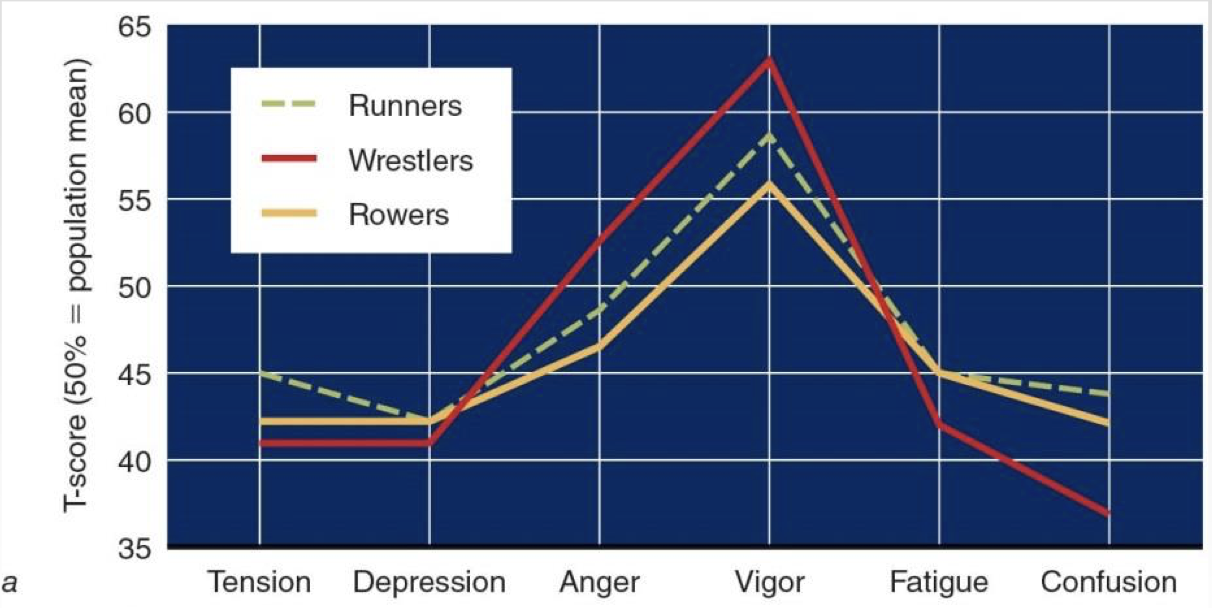

Selected Findings - What does Morgan’s (1980) research show in the second finding?
When a comparison was made between less and more successful athletes there was a clear difference between the profile of those athletes on those 6 constructs.
Successful athletes displaced the iceberg profile (red).
Less successful athletes showed a reduction in the level of all of these particular constructs. But not withstanding fatigue which you would expected

Selected Findings - What does Morgan’s (1980) research concluded?
Morgan was the first one to suggest that
Successful athletes in all different types of sport may have similar personality profiles and that successful athletes are slightly different in some way to unsuccessful athletes
Selected Findings - What is Weinberg critiques of Morgan?
Type A behaviour patterns (particularly the anger–hostility component) are associated with cardiovascular disease and appear to be altered via exercise and heath lifestyle
There is findings to suggest that relationship between personality and performances is by directional. the lifestyle of exercise and increased fitness appear to be associated with increases in self- esteem especially in individuals with low self-esteem.
How can we measure personality?
There are general versus situation-specific (sport-specific) measures.
Situation-specific trait tests predict behaviour more accurately than do general trait measures.
Often more effective to compare your own personality test scores to a person’s own previous test results than to group norms
Measure personality - an example of different between general and situation- specific trait tests
Traits related to the big five would be less predictive than if you adopt a sport specific scale e the were developed by sport psychologists.
Specificity is really important
Measure personality - an example of compare own personality scores
Utilise findings it best to compare on time point to another in the same person or from one situation to another in the same person.
Rather than seeing these as normal values
Measure personality - How should be view personality?
There is no set characteristic of personality, we look at personality as a series of behaviour that might change over time due to training might change as a result of shifts in situations and environments you face. Rather than being comparisons between people (how can I be like my favourite athlete’s personality)
Measure personality - What is type of tests ‘General versus situation-specific (sport-specific) measures’ & ‘Situation-specific trait tests’
Projective Tests
Measure Personality - What are the limitations of Projective Tests?
Difficult to score
Difficult to interpret
Dangerous in the context of drawing comparisons between things that shouldn’t be compared
Dos and Don’ts in Personality Testing
DON’T use clinical personality tests that focus on abnormality to study an average population of sport and exercise participants.
DON’T use personality tests to decide who makes a team or program and who doesn’t.
Do keep people informed about what you are doing.
Do combine personality tests with other data and facts