Flashcards stats 2C-2D
 Call Kai
 Learn
 Practice Test
 Spaced Repetition
 Match
 Flashcards
 Knowt Play
1/45

There's no tags or description
Looks like no tags are added yet.
46 Terms
probability model
a description of a random process that consists of two parts: a list of all possible outcomes and the probability of each outcome.
A valid probability model must obey two common-sense rules:
The probability of any event is a number between 0 and 1, inclusive.
o All possible outcomes in the sample space must have probabilities that add up to 1.
The list of all possible outcomes is called the______
sample space
event
a subset of the possible outcomes from the
sample space of a random process.
an event is usually denoted by_____
capital letters
A probability model does more than just assign a probability to each outcome— it allows us to_____
find the probability of an event.
The complement rule equation
P(A^c) = 1 - P(A)
A^c
Complement of A (event A does not happen)
Two events A and B are mutually exclusive if____
exclusive if they have no outcomes in common and so can never occur together
Two events A and B are mutually exclusive if P(A and B) =______
0
The addition rule for mutually exclusive events
P(A or B) = P(A) + P(B)
Venn Diagram
consists of one or more circles surrounded by a rectangle.
The region inside the rectangle of a venn diagram represents the
sample space of the random process
each circle in a venn diagram represents an
event
If p and s are any two events resulting from the same random process, the general addition rule says that—
P(A or B)= P(A)+P(B)-P(A and B)
The event "A and B" is called the ________________________________________ of events A and B.
intersection
all outcomes in the sample space of events A and B that are common to both events, and is denoted
A∩B
The event "A or B" is called the ______________________________ of events A and B.
union
all outcomes in the sample space that are in event p, event s, or both, and is denoted
A∪B
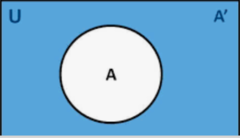
complement of A
A ∩ B

A or B
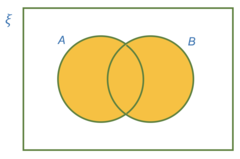
P(A∪ B) =
P(A) + P(B) − P(A ∩ B)
The probability that one event happens given that another event is known to have happened is called a____
conditional probability.
probability. The conditional probability that event p happens given that event s has happened is denoted by________
P(A | B)
Is there a connection between conditional probability and conditional relative frequency?
yes
A conditional probability is just a conditional relative frequency that comes from a______
a random process
P(A|B) =
P(A and B)/P(B)
Events p and s are independent if knowing whether or not one event has happened______
does not change the probability that the other event will happen.
P(A|B) =
P(AIB^c) = P(A)
If events p and s are NOT independent, then the occurrence of one event ______change the probability that the other
event will happen,
will
Multiplication Rule
To determine the probability, we multiply the probability of one event by the probability of another given the first one
multiplication rule equation
P(A and B) = P(A) x P(B I A)
P(AIB = P(A ∩ B)/P(B) → P(A ∩ B) =
P(B) x P(A I B)
A tree diagram shows the sample space of______
a random process involving multiple stages.
tree. All probabilities after the first stage are______
conditional probabilities
The multiplication rule for independent events says that if p and s are independent events, the probability that p
and s both occur is—
P(A ∩ B) = P(A) ∙ P(B)
The multiplication rule for independent events is just a special case of the general multiplication rule, in
which P(A | B) =
P(A)
The multiplication rule for independent events q(p ∩ s) = q(p) ∙ q(s) gives us another way to determine whether
two events are
independent.
Is there a connection between mutually exclusive and independent?
Yes
Two mutually exclusive events with non-zero probabilities can _____be independent,
never
for two mutually exclusive events with non-zero probabilities, if one event happens, the other event is ________ not to happen.
guaranteed
General addition rule:
P(A or B) = P(A) + P(B) - P(A and B)
Mutually Exclusive Events
P(A or B) = P(A) + P(B)
General Multiplication Rule
P(A and B) = P(A) * P(B|A)
Independent Events
P(A and B) = P(A) ∙ P(B)