Learning and Behavior Exam 3
 Call Kai
 Learn
 Practice Test
 Spaced Repetition
 Match
 Flashcards
 Knowt Play
1/73

There's no tags or description
Looks like no tags are added yet.
74 Terms
Phylogeny
The evolutionary history of organisms. Inherited behavioral relations are capacity for operant conditioning and capacity for respondent conditioning
Thorndike’s Law of Effect
We engage in behaviors that have positive consequences and don’t engage in behaviors that have negative consequences
Contingency
The occurence of one event depends on the occurrence of another event
Stimulus-Stimulus Contingency (pairing)
IF this stimulus occurs, THEN another stimulus follows
IF the bell rings, THEN food is presented
Behavior-Consequence Contingency
IF I do behavior, THEN I get this consequence
IF I raise my hand, THEN the teacher calls on me
IF I pinch another kid, THEN I get their toy
Behavior-Behavior Contingency
IF I do behavior, THEN I get to do different behavior
IF I do my work, THEN I can watch TV
Contingency and Functional Relations
The more contingent a relation is, the more likely it is a functional relation
Reinforcement
Stimulus change maintains or increases behavior
Extinction
No stimulus change decreases behavior
Punishment
Stimulus change decreases behavior
Do all rewards function as reinforcement?
All that matters is if it increases behavior. A reinforcement for one may be neutral to another.
Does intention to change a behavior mean that it will work?
No, just because you intend to change behavior a certain way, doesn’t mean it will. Something is a reinforcer or punisher based on outcome, not intent
Respondent Categories for Unconditioned
Physiological (unlearned): food, sex, oxygen, water, temperature
Respondent Categories for Conditioned
Safety, love/belonging, esteem, self actualization (learned): praise, good grades, attention, hugs
Factors affecting reinforcement effectiveness
Immediacy, quality, effort of behavior, context
Immediacy
How quickly a behavior is reinforced (1 sec VS 1 min VS 5 min)
Quality
High or low preference? (giftcard VS sticker)
Effort of Behavior
How much is being asked in comparison to the reinforcer
Context
Location or time in which a reinforcer is given (Kisses from mom at home VS in front of friends)
Unconditioned Reinforcer Symbol
S^R
Conditioned Reinforcer Symbol
S^r
A trainer is wanting to train their horse to bow. The trainer want to use a clicker as a conditioned reinforcer instead of relying only on unconditioned reinforcers like carrots. The click does not function as a conditioned reinforcer initially. Diagram what the trainer should do in order to make the click into a conditioned reinforcer
NS (click) / S^R (carrot) (paired repeatedly, no behavior necessary)
NS (click) becomes an S^r
Diagram what the trainer should do to determine whether the click is truly a conditioned reinforcer
R (horse bows) → S^r (click)
If R (horse bowing) increases in frequency, the NS (click) has become an S^R
Reinforcement Categories
Unconditioned, conditioned, automatic, socially mediated
Automatic
Behavior itself produces the consequence
Socially Mediated
Someone else produces the consequence
Reinforcement Types
Positive (Behavior → Stimulus is added)
Negative (Behavior → Stimulus is removed)
Escape
Terminating the current aversive stimuli (negative reinforcement)
Ex: Loud Noise → Person puts in earplugs → Noise goes away ( - )
The person is more likely to put in earplugs when it’s loud
Avoidance
Consequently prevents a potential aversive stimulus (negative reinforcement)
Ex: Before concert starts → Put in earplugs → No loud noise ( - )
Extinction
When behavior results in absence of reinforcement
Side Effects of Extinction
Extinction burst, emotional responding, behavior variability, resurgence (behavior eventually decreases)
Shaping
Reinforcing successive approximations of target behaviors. Uses differential reinforcement, which uses positive reinforcement for desired behaviors and extinction for undesired behaviors (eventually, smaller steps are extinguished)
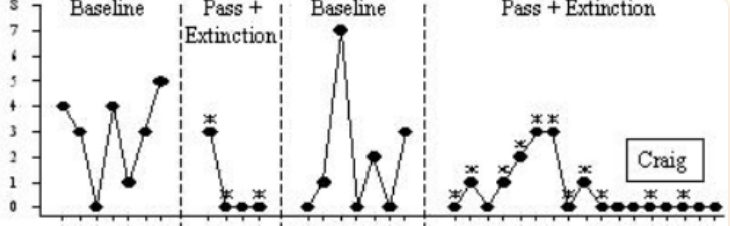
Bedtime Pass Example
Bedtime resistance is a common occurrence within toddlers
R (come out of bedroom) → S^r+ (stay up with parents)
R (come out of bedroom) → S^r+ (stay up with parents)
Friman designed a bedtime pass system
R (use bedtime pass) → S^r+ (stay up with parents) (Only one pass so only get to stay up once per night)
R (come out of bedroom) → S^r+ (stay up with parents) (extinction)
Greatly reduced bedtime resistance and extinction burst
Cumulative Recorder
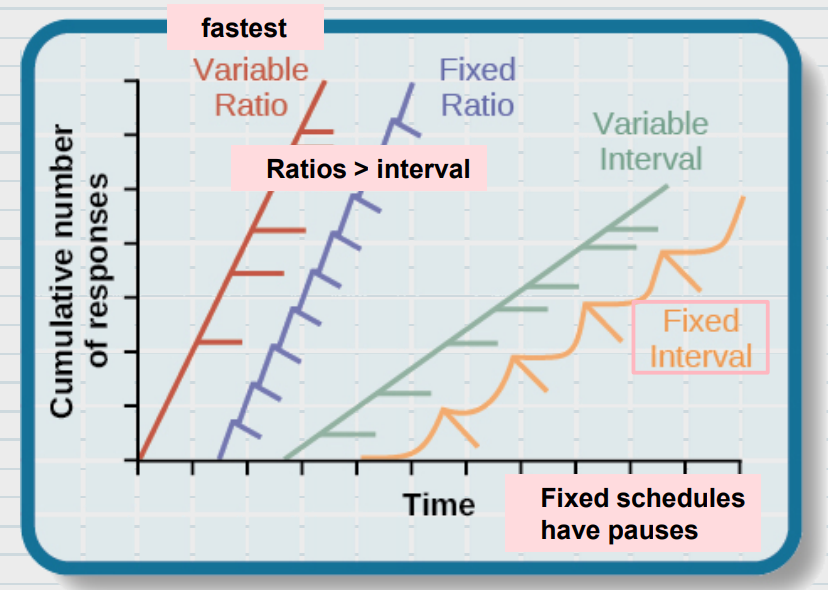
A tool for recording the rate of operant behavior using time and cumulative frequency. A real-time measure of behavior rate. The faster the rate of behavior, the steeper the slope (more vertical = faster, more horizontal = slower)
What do schedules of reinforcement do
Indicate the contingency for when responses will be followed by the reinforcer. Schedules have characteristic patterns of responding
Continuous Reinforcement (CRF)
Every response is followed by the reinforcer
Intermittent Reinforcement (INT)
Some but not all responses are followed by a reinforcer
Intermittent Schedules of Reinforcement
Fixed: Specified number of responses
Variable: Average number of responses or time interval
Ratio: Based on responses only
Interval: Based on responses after a period of time
Time: Based on time only
Fixed ratio, variable ratio, fixed interval, variable interval, fixed time, variable time
Fixed Ratio Schedules
Reinforcer after fixed number of responses
Example: 5 responses → S^R+, 5 responses → S^R+, 5 responses → S^R+
Produces high-rate behavior with pose-reinforcement pause

Variable Ratio Schedules
Reinforcer after average number of responses
Example: 3 responses → S^R+, 8 responses → S^R+, 4 responses → S^R+
Produces high-rate behavior; no pausing

Fixed Interval Schedules
Reinforcer after responding after waiting a fixed period of time
Example: FI 1 minute:
- wait 1 minute, then respond → S^R+
- wait 1 minute, then respond → S^R+
- wait 1 minute, then respond → S^R+
- wait 30 secs, then respond → No S^R+ Didn’t wait long enough
- wait 1 minute, no response → No S^R+ Didn’t emit response
Lower to moderate responding, scalloped pausing

Escape contingency
Studying immediately decreases the existing aversiveness

Variable Interval Schedules
Reinforcer after responding after waiting an average period of time
VI 1 minute:
- wait 80 secs, then respond → SR+
- wait 30 secs, then respond → SR+
- wait 70 secs, then respond → SR+
Lower to moderate responding; no pausing
Schedules in Comparison
Using schedules of reinforcement
When trying to teach new behavior, use continuous reinforcement (CRF or FR1). Once reliably occurring, thin schedule from continuous to intermittent reinforcement (gradually reduce reinforcers)

Operant Behavior
Behavior influenced by antecedents and consequences; however, ultimately the impact of consequences affects operant behavior. Additionally, remembering operant behavior primarily involves movement of the skeletal muscles
Reinforcer
A consequence that increases operant behavior above its baseline level. It is different from a reward because rewards are beneficial consequences that we think will function as reinforcers; however, we don’t yet know if they will
Practices with Reinforcement
More frequent, smaller reinforcers
Check if behavior is actually increasing
Ensure behavior is in control of the learner
To decrease the likelihood of “choking under pressure,” smaller rewards should be arranged
Reinforcement can increase undesired behaviors like cheating, so it’s important to ensure the desired behavior produces the reinforcer more easily than undesired means to avoid this.
Primary (unconditioned) reinforcers
Primary reinforcers are consequences that function as reinforcers because they are important for sustaining an individual's life or the continuation of a species. An example of this is sleeping when your body is tired (S^R+) or stepping out of a room that is extremely hot or cold (S^R-)
Secondary (conditioned) reinforcers
Conditioned reinforcers are consequences that function as reinforcers only after learning occurs. An example of this is receiving money (S^R+) or a check engine light (S^R-)
Template for diagraming conditioned reinforcers
NS ([ ])/SR ([ ]) (repeat several times, NO behavior necessary)
NS ([ ]) becomes Sr ([ ])
R ([ ])----->Sr ([ ])
If R([ ]) increases in the future, then the NS ([ ]) has become a Sr ([ ]).
Advantage of S^r over S^R for Animal Trainers
Animal trainers use clickers or whistles (S^r) rather than food (S^R) because S^rs can be provided more immediately after behaviors, do not interrupt the behavioral sequence, and prevent satiation.
Punisher
A contingent consequence that deceases the future probability of a behavior below its pre-punishment level
Six guidelines of effective punishment
Focus on reinforcement first
Combine punishment with extinction and/or differential reinforcement
Deliver punishers immediately
Deliver punishment contingently
Punish every time
Use a punisher in the Goldilocks zone (not too aversive and not so benign that it does not decrease behavior)
Differential reinforcement
Reinforcing one response and extinguishing other previously learned responses
Unconditioned VS Conditioned Punishers
Unconditioned punishers are biologically innate and require no prior learning, whereas conditioned punishers acquire their aversive properties through learned association with other punishers
The role of reinforcement in the act of punishing
When a person applies punishment (such as a scolding, a timeout, or a reprimand) and the annoying or harmful behavior temporarily stops, the removal of that aversive behavior negatively reinforces the punisher. Because the punisher gets immediate relief from the stressful situation, the act of punishing is reinforced and more likely to be used again in the future.
Schedule thinning
A procedure for gradually reducing the rate of reinforcement while maintaining the desired behavior. By thinning the schedule of reinforcement, we can ensure that the adaptive behavior can be maintained outside the clinic, where it will not be reinforced every time
Do continuous or intermittent schedules demonstrate higher resistance to extinction?
Intermittent schedules demonstrate higher resistance to extinction as it undergoes a partial reinforcement extinction effect, which is the direct relation between prior reinforcement rate and how quickly behavior undergoes extinction
Extinction Burst
Temporary increase in the frequency, intensity, or duration of a behavior when the reinforcement that previously maintained it is abruptly removed
Emotional responding
Emotional behavior and extinction-induced aggression when an expected reinforcer is suddenly withheld
Behavior variability
When an individual tries new actions when a previously reinforced behavior stops producing a reinforcer
Resurgence
The reappearance of a previously extinguished behavior when a newly learned replacement behavior no longer receives reinforcement
Resistance to Extinction
The persistence of a learned behavior even after the reinforcement that maintained it has been removed
Studying: What behaviors are you engaging in? What’s the reinforcer for studying? What schedule of reinforcement? Get a low grade for bad studying?
What behaviors are you engaging in?
Reading, highlighting, listening
Reciting definitions aloud, completing practice questions
What is the reinforcer for studying?
Escape from aversiveness
Conditioned reinforcers: getting it correct
What schedule of reinforcement?
Continuous Reinforcement
Get a low grade for bad studying?
Extinction for studying (need that behavioral variability and resistance to extinction)
Are good grades a reinforcer for studying?
They can be, but its usually driven by rule-governed behavior. There is also a delay between studying and getting a grade
Fixed Time
Reinforcement is provided after a specific time period has passed. There is NO response requirement
Variable Time
Reinforcement is provided after an average time period has passed. There is NO response requirement
Superstitious Behavior
Behavior that occurs because it has been followed by a reinforcer even though the behavior does not produce the reinforcer (adventitious, non-contingent)
Contingent VS Adventitious/non-contingent + Schedules
Contingent reinforcement is provided after a specific behavior. Used for FI, FR, VI, VR
Adventitious reinforcement is provided without any relation to a specific behavior. Used for FT and VT
Response Cost
Negative punishment, some amount of reinforcer is lost. Examples are fines, fate fees, and point loss
Side Effects of Punishment
Emotional responding, avoidance of punisher, countercontrol, and models punishment for the learner
Learned Helplessness
A phenomenon that occurs when an organism exposed to inescapable aversive stimuli fails to acquire typical escape responses. Immunization to learned helplessness incudes increasing resistance to extinction and teaching escape responses
Intermittent VS Differential Reinforcement
