Biology Lecture Exam 2
 Call Kai
 Learn
Learn Practice Test
 Spaced Repetition
 Match
Match Flashcards
 Knowt Play
1/144

There's no tags or description
Looks like no tags are added yet.
Name | Mastery | Learn | Test | Matching | Spaced | Call with Kai | Chat |
|---|
No analytics yet
Send a link to your students to track their progress
145 Terms
Moss Embryo
Immature sporophyte, nurtured by gametophyte at some point
Liverworts
Has 5200 species, small and inconspicuous, Sporophyte is very tiny compared to large gametophyte
Gemma Cups
Small cuplike structures on surface of gametophytes, responsible for asexual reproduction (fragmentation)
How do plants breath
Through stomata
How do liverworts breathe
Breathe through pores that can’t open or close
Antheridia (sperm) and Archegonia (eggs)
Specialized reproductive structures made by gametophyte in bryophytes, Antheridia produces sperm and Archegonia produces eggs
Elaters
Helical shaped cells that aid in spore dispersal and increase in size when damp
How much can moss absorb
Can absorb 20x it’s dry weight
What are the two types of cells in moss
Dead
Living
Dead moss cells (Hyaline cells)
Absorbs and holds water
Living moss cells
Perform photosynthesis
Why is the fossil record for bryophytes poor
Because bryophytes are soft-bodied and lack vascular tissue
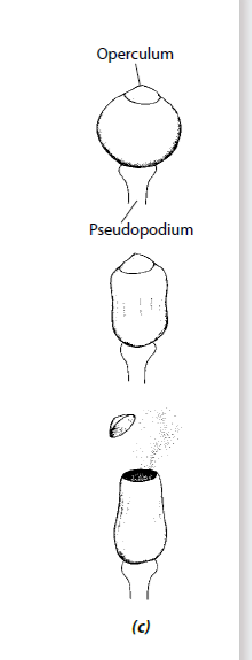
Sphagnum moss spore launch
Sporophyte connected to gametophyte, dries out, pressurizes, and explosively pops open the operculum(cap) releasing spores
How fast can the sphagnum launch spores
60 mph
Who did research on plant movement
Joan Edwards
Moss Gametophyte
Helically arranged leaves, conductive tissue consists of hydroids and leptoids
What are the two types of conductive tissue in moss gametophytes
Hydroids and Leptoids
Hydroid
Carry water
Leptoid
Carry sugars
How many guard cells do Moss have
1 used for the pore
Dung Moss (Splachnum Rubrum)
Moss that grows where dung is
Disjunct Distribution
Occurs when the same species is found in two or more widely separated geographic areas.

Who proposed that dung moss species was separated by birds
Lily Lewis
Why did Winona Welch study moss
She felt bad for them
Longest cryogenic suspension for plants
20 years
Longest cryogenic suspension for animals
10 years (Tardigrade)

Can you freeze bryophytes and reanimate it
Yes bryophytes have amazing regeneration capacity, an example being in Antarctica
Oldest regrowth of moss
1500 years (millennial timescale regeneration)
Amount of Moss species
10,000
Amount of Hornwort species
300 (least diverse bryophyte group)
Why is Hornwort Anthoceros a puzzling group
Has Photosynthetic sporophyte
Basal Meristem
Like a vascular plant
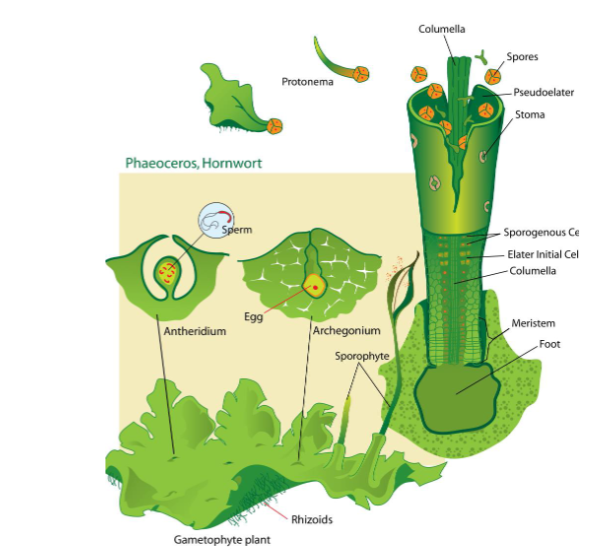
Basal Meristem
Growth tissue at the base that makes new cells
Why are hornworts considered free-living
Stomata ( Does not open or close)
Photosynthesis
Basal Meristem
Has pyrenoid that enhances photosynthesis by concentrating co2

Why are spores in tetrads
They are in tetrads because of meiosis

Pseudo-elaters
cells in hornworts that twist as they dry, helping disperse spores, not true elaters because they develop differently
Closest bryophyte to vascular plants
Hornworts
Most seedless vascular plants are
Ferns
Characteristics of Seedless Vascular Plants
Heteromorphic AOG
Dominant Sporophyte
Xylem Phloem
Roots, Leaves and Stems
Tissue Systems ( Dermal, Vascular, Ground)
Primary and Secondary Growth
Three tissue systems of seedless vascular plants
Dermal
Vascular
Ground
How do we use seedless vascular plants everyday
We use it for energy, the 60% of coal we use is mostly seedless vascular plants
How did plants stand so tall back then
Vascular Tissue System (Xylem, Phloem)
Production of Lignin
Xylem
Moves water and minerals from roots to rest of the plant
Phloem
Moves sugars produced by photosynthesis to other parts of the plant
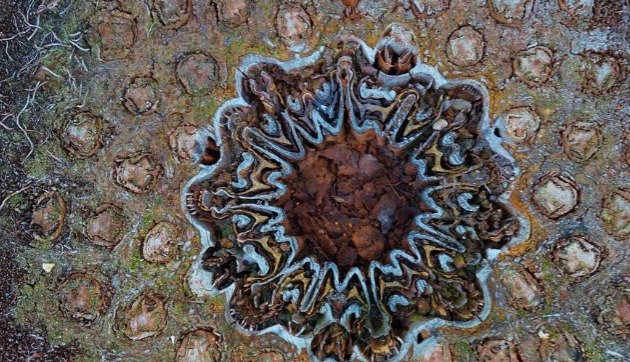
Why are tree fern cross sections different
For more efficient transport, leaf traces, no secondary growth
Primary Growth
Comes from apical meristem, increases tree height and produces primary tissues, what most seedless vascular plants do, produce herbs
What type of growth does seedless vascular plants do
Primary Growth and Secondary Growth
Secondary Growth
Comes from the cambial meristem,
increases stem root and diameter,
produces secondary tissues and secondary xylem (wood)
Create tree rings,
Tracheids
Transport water and minerals, give plant structure and allows it to not be crushed during transport (apart of xylem)
Heterospory
Adds another layer to AOG, sporophyte produces microspores and megaspores
Microspore
Makes a microgametophyte(pollen) that produces sperm
Megaspores
Makes a megagametophyte that will produce eggs
Homospory
Plant produces only one type of spore
Can seedless vascular plants be either heterospory or homospory
Yes
What happens to antheridia and female gametophyte if plant is heterosporous (seedless vascular plants)
Antheridia disappears, Female gametophyte is reduced(can be found in megaspore wall)
Germination
A spore or seed starts growing

Suspensor
Grows in embryo, pushes the developing embryo into nutrient-rich female gametophyte tissue, helping the embryo obtain nutrients during development.

Whisk Ferns (Psilotum)
Tiny Leaves
No Roots
Rhizome and arial stem
Very Reduced
Psilotum Gametophyte
Subterranean (underground)
Mycorrhizal relationship - Gets help with nutrients by fungi

Fiddleheads
Fern leaves that starts tightly coiled and unravels due to circinate vernation
Sori
Groups of sporangia
1/3 of Ferns are epiphytic meaning?
They grow on trees
What are the 4 extent phyla of Gymnosperms
Conifers (Coniferophyta)
Cycads (Cacadophyta)
Ginkgos (Ginkgophyta)
Welwitchia (Gnetophyta)

Progymosperm Archaeopteris had everything but what
The seed

Gymnosperm
Seed isn’t in ovary, sporophyte produces ovule, extreme heterospory

Structures of an Ovule
Integument (2n) - Seed coat
Nucellus (2n)
Megasporocyte (2n) - creates megaspores(n)
Micropyle - Integument opening
Gymnosperm characteristics
Megaspores remain in the megasporangium
Megagametophyte develops in megaspore(non-free-living)
Development of the embryo inside the megagametophyte

What is a seed
Embryo (sporophyte) (2n)
Megagametophyte(n) - Stored food
Seed Coat (2n) - Old sporophyte
Out of the species we talked about which is the most endangered?
Gymnosperms are the most endangered

Structures of Leaf
Waxy Cuticle
Sunken Somata
Epidermis
Hypodermis - Under epidermis
Endodermis
Mesophyll

The endodermis in a leaf does what
Connects the vascular tissue to the mesophyll

The mesophyll in a leaf does what
Photosynthetic area, also increases surface area
Why needles for gymnosperms?
Low surface area to volume ratio (For water retention and easier maintenance)
Adaptations to cold and drought
Almost every major period of plant growth is followed by what
An Ice age

How are gymnosperms adapted to fire
Serotinous cones (Fire opens them)
Thick Bark
Self Pruning Branches

Center part pine stem and function
Pith, for storage
Why do gymnosperms not require water for fertilization?
because pollen(microspore) transports the microgametophyte to the megaspore, microgametophyte digest a pollen tube that connects to the egg, and the sperm once their generates to fertilize
What does each microspore develop into
One pollen grain
How much sperm is created by generative cell
2 are created
Pollen grains are how many cells
4 cells
Cones take how long to mature
2 years, 12 months for pollen tube to reach egg

How much seeds per scale in a cone
2 seeds per scale
Uses of gymnosperms
Wood building material and paper, Turpentine and Pitch

First thing that is hit by pollen in Gymnosperms
Micropyle

First thing that is hit by pollen in Angiosperms
Stigma on the style
Two types of Agniosperms
Monocot and Dicot

Monocot
Single Cotyledon
Parallel Veins
Flower Parts in multiples of three

Dicot
Two cotyledons
Broad Leaf
Flower parts in multiples of 5 or 4
Types of ways Agniosperms get food
Autotrophs (Main way)
Parasitic
Mycoheterotrophic (Fungi nutrients)
Gionecium part of flower
Female part of flower that consist of Ovary, Stigma, Style

Flower receptacle
Where everything on the flower attaches to
Androecium part of flower
Male part of flower, Consist of multiple appedanges.
Filament and Anther

Inflorescence
A cluster or arrangement of flowers

What type of inflorescence is this
Spike, Flowers are directly attached to main stem
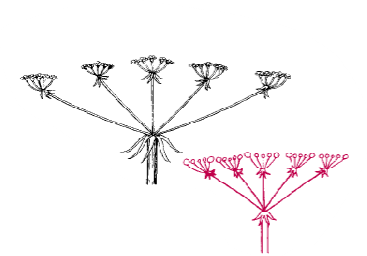
What type of inflorescence is this
Umbel, all flower stalks arise from the same point

What type of inflorescence is this
Panicle, Side branches come of main stem, and those branches bear flowers

What type of inflorescence is this
Head, many tiny flowers packed into one flower-like structure

What type of inflorescence is this
Catkin, look like fuzzy tails hanging from tree
Largest Infloresence
Amorphophallus titanum (Titan Lily)
Largest single flower
Rafflesia Arnoldi (Stinking corpse lily)

Hypogynous flower
Ovary located above flower parts