Genetics Lesson 10: Regulation of Gene Expression in Eukaryotes
 Call Kai
 Learn
 Practice Test
 Spaced Repetition
 Match
 Flashcards
 Knowt Play
1/26

There's no tags or description
Looks like no tags are added yet.
27 Terms
Similarities and differences between eukaryotic and prokaryotic regulation example
similarity: DNA binding regulates transcription of RNA polymerase
Differences: DNA must unwind from histone protein before transcription, each structural gene has its own promoter
Chromosomes
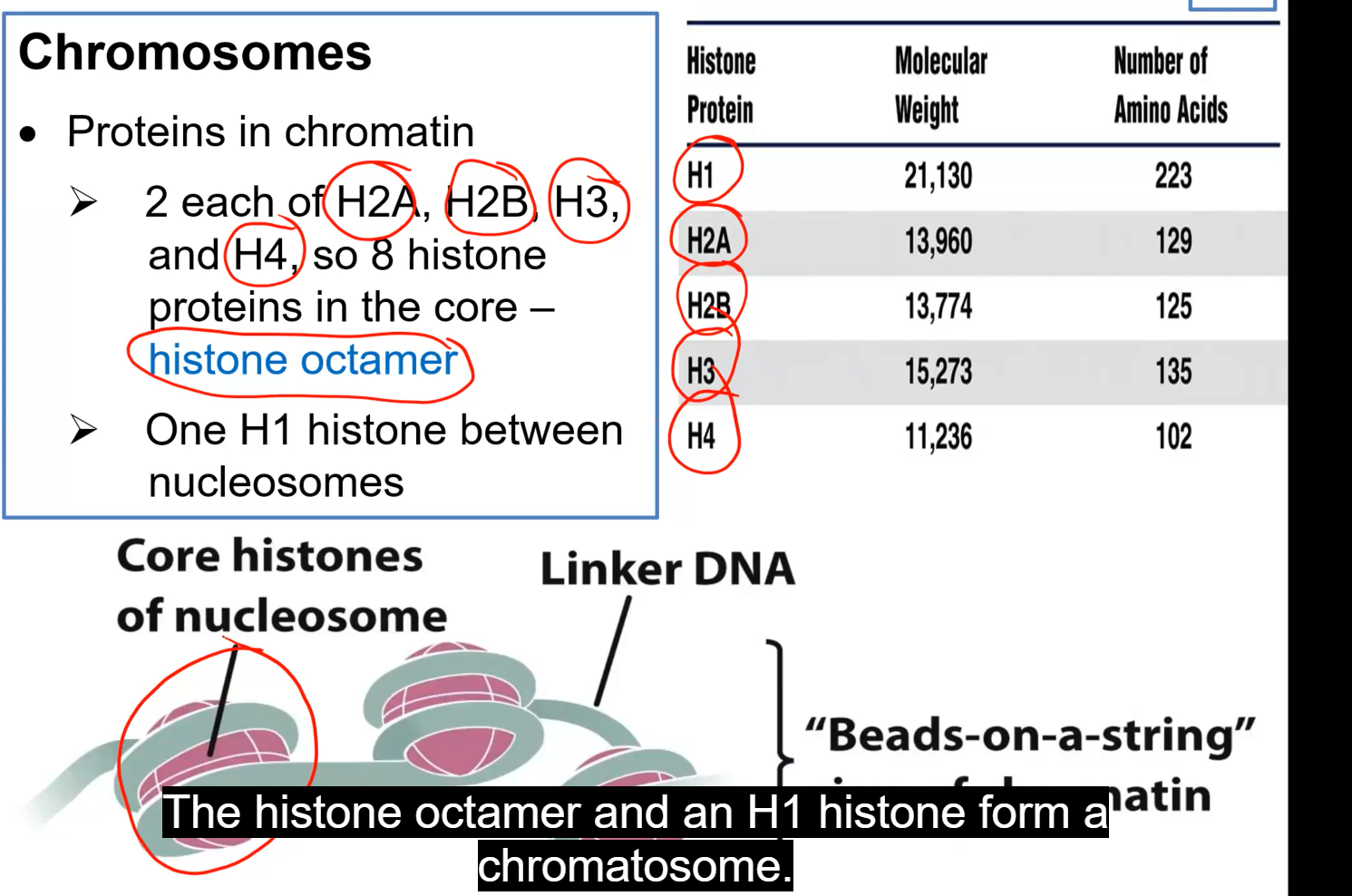
Consist of DNA and histone proteins which form a nucleosome
Histones have positive charged and attract negatively charged phosphate on DNA. This can reduce length of DNA to about 1/3
Nucleosomes fold up and compress to become a chromatin fiber.
Chromatin fibers form chromatids which build/constitute a chromosome
Proteins in chromatin
2 each of H2A, H2B, H3, and H4 in the core, making a histone octamer
There is one H1 histone between nucleosomes
Interaction between histone positive amine group and negative DNA keep them tightly bound to eachother
DNA packed into all levels step by step into chromosome
Chromatin is simplest level of double helix.
This is complexed to become nucleosomes whcih have 8 proteins, DNA wraps 1.65 times around the nucleosome core
These fold up to produce a fiber and form loops which then compress to make a thicker fiber then there is tight coiling of the fiber producing the chromatid of a chromosome.

Euchromatin
Deconsensed chromosome regions
constitutes the majority of the chromosome material and includes most of the genes
Heterochromatin
Condensed chromosome regions containing mostly noncoding DNA.
Also is the centromere and telomere regions and has long sequences of tandem repeats
mRNA decay in eukaryotes vs prokaryotes
Eukaryotic mRNA has a much longr half life because it was processed.
Chromatin structure alteration for regulation
Chromatin structure repressed gene expression: condensed and coiled DNA is inacessible for RNA polymerrase
Chromatin structure is opened and exposes the promoter region
The processes affect gene regulation by alterin chromatin structure:
Chromatin remodeling
modification of histone proteins
DNA methylation
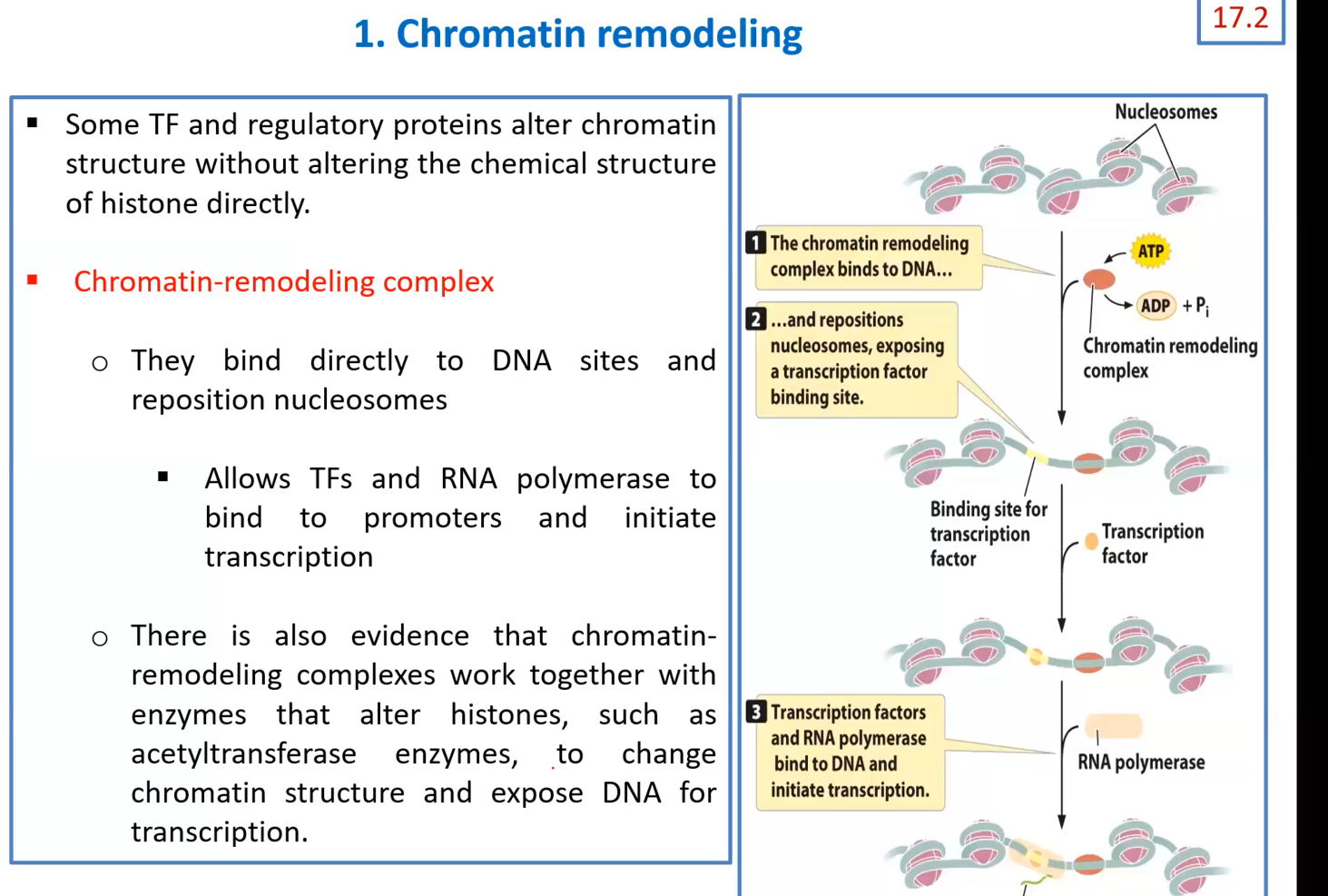
Chromatin remodeling definition
Some transcription factors (TF) and regulatory proteins alter chromatin structure without altering chemical structure of histone directly
Chromatin remodeling complex
Binds directly to DNA and repositions nucleosomes, allowing TFs and RNA polymerase to bind to promoters and initiate transcription.
Chromatin remodeling complexes work together with enzymes to change chromatin structure and expose DNA for transcription
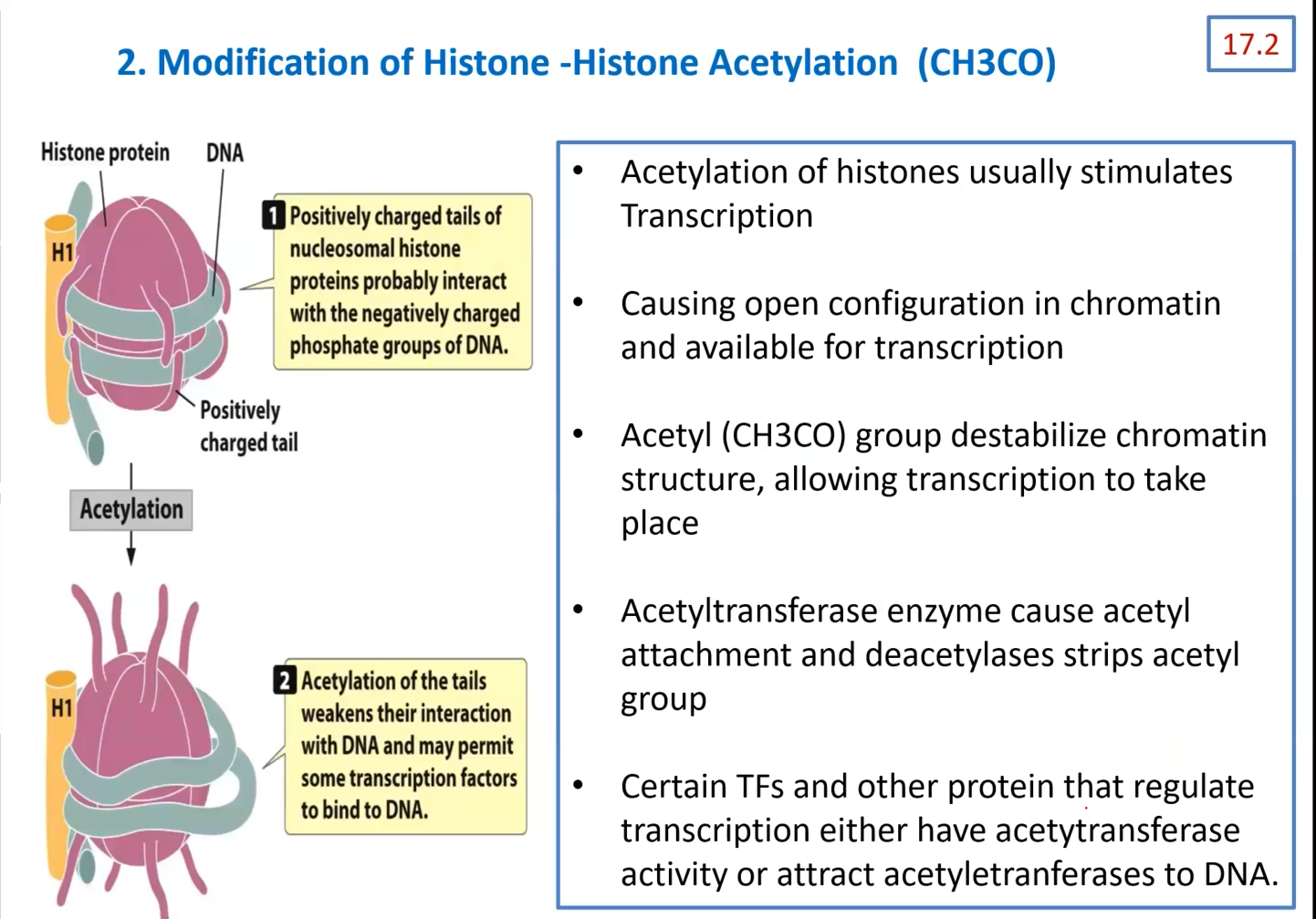
Modification of Histone Histone Acetylation
Acetylation stimulates transcription as it causes open configuration of chromatin
Acetyl group destabilize chromatin structure
Acetyltransferase enzyme adds acetyl, deacetylases remove it
Acetylation of histone tails weakens their interaction with DNA phosphate and permit transcription factors to bind
Step by step histone protein acetylation
Acetyl groups destabilize chromatin
Regulater protein is encoded because it is transcribed.
Once it is translated it encodes a deacetylase enzyme that removes acetyl groups and restores structure, stopping transcription of regulator protein

DNA methylation
Most common on cytosines that are adjacent to guanine.
Methylation of DNA represses transcription

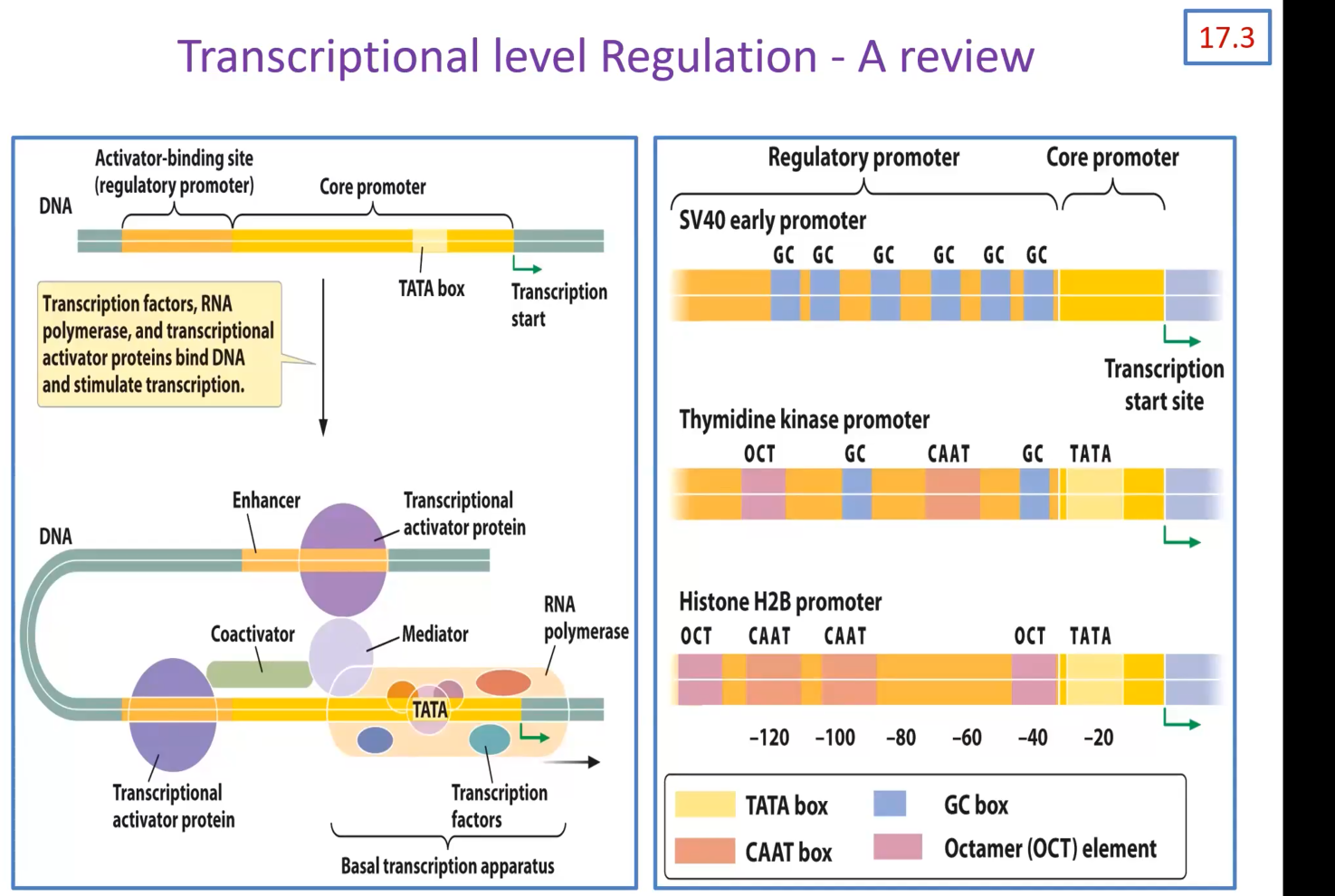
Transcriptional level regulation, what on DNA stimulates transcription normally?
Transcription factos, RNA polymerase and transcriptional activator proteins bind to DNA to stimulate transcription
Basal transcription apparatus: TFs, and RNA polymerase bind to core promoter TATA box downstream of transcriptional activator protein
GAL4 in Yeast (transcriptional Activator)
Regulates transcription of genes whose products metabolize galactose.
Binds to upstream activating sequence (UAS) (enhacner)
When there is no galactose, GAL80 binds to GAL4 causing no transcription
When theres galactose, GAL4 stays unbound and transcription is stimulated

Inducible vs repressible systems
Inducible systems transcription are turned ON by an inducing signal; repressible systems transcription are turned OFF by a corepressor
Transcriptional Repressors
Bind to SILENCERS
Insulator: DNA sequence that blocks or insulates the effect of enhancers

Gene regulation at mRNA processing level
mRNA alternative splicing: Variation in which exons are put together depending on the tissue, developmental stage or sex
Offers flexibility since one gene can encode different variants of a protein
T antigen gene of the mammalian virus SV40
One gene encodes two different proteins: large T and small T antigens
Splicing Factor 2 enhances the mRNA splicing of small T antigen

RNA interference for Gene regulation
RNA interference (RNAi) ALA RNA silencing and post-transcriptional gene silencing are tiggered by microRNAs and small interfering RNAs which are only about 22 nucleotide RNA
30% of genes regulated by RNAi
Origin and target of siRNA
Origin: mRNA, transposon, or virus
Target: Genes from which they were transcribed
origin and target of miRNA
Origin: RNA transcribed from a distinct gene
Target: Genes other than those from which they were transcribed
miRNA and siRNA step by step origin
Inverted repeat, the sequence between them is transcribed, the repeat bind to eachother to make a double stranded RNA which is cleaved by enzyme DICER to produce mi or siRNAs
siRNA can arise from RNA viruses or long hairpins

4 mechanisms of RNAi for gene regulation and general info for each
Cleavage of mRNA: a RNA induced silencing complex (RISC) is formed by mi or siRNA with protein “slicer” and cleaves mRNA, decreasing amount of protein.
Inhibition of translation: miRNA in RISCs match the mRNA imperfectly and inhibit the translation of targeted mRNA
Transcriptional Silencing: some siRNA form complex called RNA induced transcriptional silencing(RITS) and binds to DNA causing methylation and stopping transcription
Degradation of mRNA: miRNAs regulate gene expression and mRNA degradation required DICER and RISC
siRNA cleavage of mRNA
RISC pairs with complementary sequences on mRNA, cleaving mRNA, later degrading the RNA

miRNA inhibition of Translation step by step
miRNAs combine with RISC complex, pairing imperfectly with mRNA and lead to inhibition of translation

siRNA transcriptional silencing
siRNA in RITS attaches to complementary DNA sequence and attracts methylation which inhibit transcription
