Optics Lec 10 - Photonic Crystals
 Call Kai
 Learn
 Practice Test
 Spaced Repetition
 Match
 Flashcards
 Knowt Play
1/24

There's no tags or description
Looks like no tags are added yet.
25 Terms
Pigmentary coloration
Angular independent - color is same regardless of angle
Static - cannot change due to external stimuli
Based on absorption - color determined primarily by the chemical composition of the material
Structural coloration
Angular dependent - color can change as a function of the viewing angle
Tunable - external stimuli can change the lattice spacing or RI and induce color variation
Based on interference - reflected color is a result of the interference of visible light with a structure with periodic variation of the RI at the nanoscale
Photonic crystals
Dielectric structures in which the RI changes periodically at the nanoscale, strongly interacts with visible light; have a periodicity that is comparable to the wavelength of light; have a band gap that forbids propagation of certain wavelengths of light within the material
Crystal
highly ordered microscopic structure, forming a lattice that is repetitive in 3 directions
Abilities of photonic crystals
Can control, localize, and trap light by appropriate design of their crystal lattice; can be tuned and change their optical response as a function of stimuli (pH, temp, etc.)

How does light interact with N periodically arranged obstacles?
Transmittance - when λ is different from a (periodicity constant), light propagates w/o scattering in the crystal → transmittance
Reflectance - for some wavelengths (the bandgap: λ ~ a), forward scattering events interfere destructively in the crystal → reflected wavelengths and material is an optical insulator
Photonic crystal arrangement
Photonic crystal is a medium with differing index of refraction that generates a periodic dielectric function; certain frequency values the photons cannot propagate (photonic bandgap)

Electronic crystal arrangement
Crystal is a periodic potential to an electron propagating through it; some energy values cannot propagate in the structure (the electronic band gap)

Photonic crystal dimensionality
The RI ni is periodically modulated in either 1, 2 or 3 directions
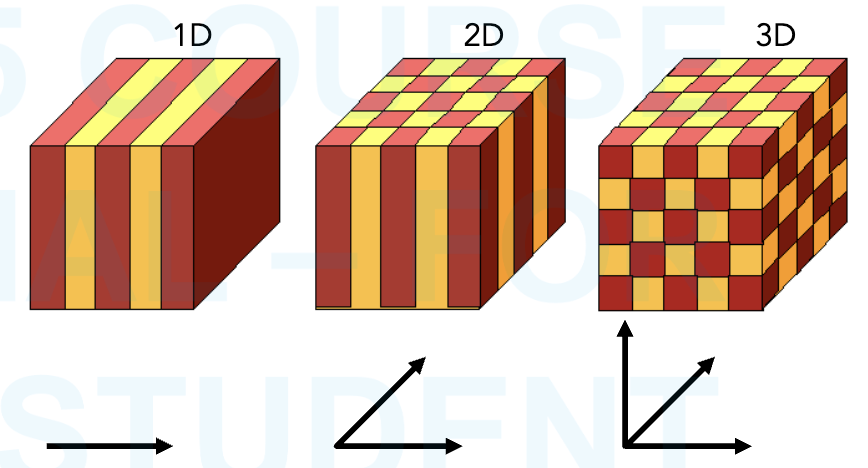
1D photonic crystals
light reflects off the top surface of a film (wave 1) and from the bottom of a film (wave 2) → two waves interfere and the overall effect depends on the extra path of wave 2

1D photonic crystal cases
na < nb < nc → both phases flip so they cancel out: Constructive interference - 2nbdcos(θb) = mλ, Destructive interference - 2nbdcos(θb) = (m-1/2)λ
na < nb > nc → only one phase flips: Constructive int. - 2nbdcos(θb) = (m-1/2)λ, Destructive int. - 2nbdcos(θb) = mλ
Thin film interference ex. - anti-reflective coatings
Goal is to minimize unwanted reflections, anti-reflective coatings increase transmission from ~96% to ~99%
Thin film interference and phase change
Multiple reflections at each interface occur → Reflectance = R = |r²| where r = rab+tabrbctbaeiϕκ; transmittance = T = (nc/na)|t|2; the total reflectance from an interface is the square sum of the reflectance from each of the multiple reflections

Thin film interference - building up intensity
Reflectivity is directly proportional to the refractive index n of the film through the variable ϕ → if the refractive index of the film increases, the reflectivity increases
Additive color mixing principle
Mircoscale: single colored regions can be individual resolved when imaged with a microscope → macroscale: single colored regions are optically merged when viewed by the naked eye
Multilayer interference: What if we have N layers instead of 2?
Bragg-Snell law: 2(nAdAcosθA+nBdBcosθB) = mλ; if nAdA = nBdB, this is an ideal multilayer that allows minimum # of layers to achieve maximum reflectance
Multilayer interference relationships
Number of layers increase → reflectivity increases, bandwidth decreases
Refractive index contrast (Δn) increases, # of layers fixed → reflectivity and bandwidth increase

Iridescence
The change of color with the viewing angle; strong angular dependence is observed for ordered photonic systems only
Broadband multilayer reflector
Structure that reflects several wavelengths simultaneously (ex. golden bugs)
1D photonic crystal ex. - chiral cellulose
Hydroxypropyl-cellulose (HPC) is a liquid crystal that can self-assemble in a helicoidal arrangement → upon compression the periodicity decreases and it reflects blue light → can act as a reversible colorimetric pressure sensor
Order-disorder interplay
variation of length distribution, width of ridges, height displacement of ridges (ex. morpho butterfly)
2D photonic crystals
The refractive index ni is periodically modulated in 2 directions (ex. ctenophores, comb jelly → have hexagonally packed cilia)
3D photonic crystals
The refractive index ni is periodically modulated in 3 directions (ex. brown algae → in low light the ordered opal scatters light laterally onto the chloroplasts to enhance light capture, while in high light it is inactive)
Random photonic structures
Ex. Cyphochilus beetle → randomly arranged chitin fibers surrounded by air, scatters strongly inelastically all incident light → white, matte diffuse coloration
Tunable photonic crystals
Ex. Reindeer’s eyes → golden eyes in the summer, blue in the winter → winter eyes have higher internal scattering at wavelengths to which rhodopsin (photoreceptor) is sensitive (~510nm)