Pain Recognition and Assessment
 Call Kai
 Learn
Learn Practice Test
 Spaced Repetition
 Match
Match Flashcards
 Knowt Play
1/19

There's no tags or description
Looks like no tags are added yet.
Name | Mastery | Learn | Test | Matching | Spaced | Call with Kai | Chat |
|---|
No analytics yet
Send a link to your students to track their progress
20 Terms
What does pain being a “multidimensional experience” mean?
• Sensory - discriminative (where, when, how intense, etc)
• Motivational - affective (disturbance of feelings of well-being to a greater or lesser degree of unpleasantness)
• Cognitive - evaluative (influence of previous experiences on how pain feels)
Describe pain recognition in animals?
• Gold Standard in humans is 'Self Report'
- In animals we infer the presence of pain from behaviour (via an observer)
Absence of normal behavior
Presence of new 'pain behaviours'
Behavioural responses following palpation/manipulation
• No single behaviour/parameter is pathognomonic for pain
Why is pain a subjective experience?
• Pain is always subjective. Each individual learns the application of the word through experiences related to injury in early life
• Dynamic - changes with activity
Describe ACUTE pain behaviors in cats and dogs.

Describe CHRONIC pain behaviors in cats and dogs.
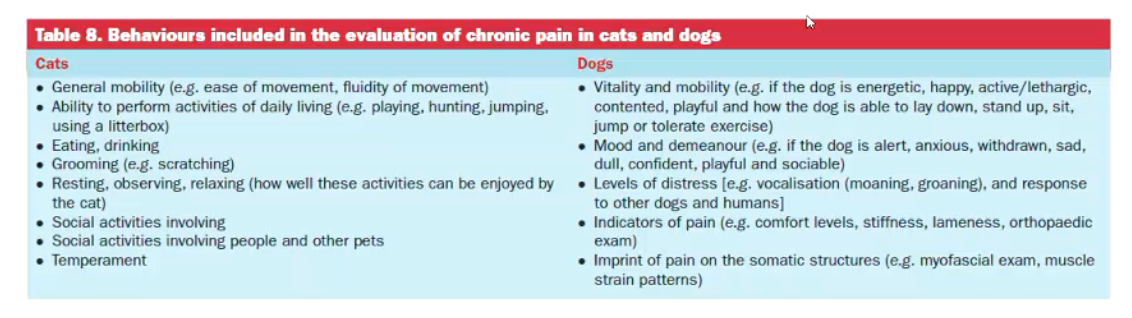
What are some ways we can recognize and assess pain in a clinical context?
Many Ways and Scales
Objective Measurements: Not exactly correlated to pain, does not work well.
Heart Rate
Respiratory Rate
Blood Pressure
Pupil Size
Plasma Control
Uni-Dimensional Scales: look at animal, based on clinical scale and rank pain based on prior experience
Numerical rating scales (0-10)
Simple descriptive scale (Mild/Moderate/Severe)
Visual Analogue Scale (DIVAS)
Look at animal, draw a line from no pain to pain, do this by looking at the animal first, draw a line, examine animal, draw a line, palpate the animal, and draw a line (Reinforces the look then interact)
Composite Scale
Colorado State (Numerical 1-4): With descriptors and scoring system, engaging and colorful
Unesp-Botucatu Scale: different domains with scoring, adding up the scores = composite, but takes a very long time, BP is not always accurate
Why are we biased when it comes to evaluating pain?
Everyone is biased due to their own experiences.
• Personal pain experience
• Clinical experience
• Decade of graduation
• Perception of severity
• Orthopaedic vs soft tissue
• Gender
What are the advantages of composite tools in evaluating pain?
• Consistent between observers
For monitoring of patients
Gives everyone a 'stake'
Easily incorporated into clinical practice
• Educational value
• Prioritise pain
5th vital sign!
For pain measurement, the evaluation should have what three main principles?
• Validity - ability to measure what it's supposed to measure
• Reliability - ability of a scale to give repeatable results
• Responsiveness - ability to measure change when change occurs
AND HAVE UTILITY
What is a psychometric approach to pain measurement?
A psychometric approach to pain measurement is a scientific method used to design tools that evaluate complex, subjective states like pain by turning observable behaviors into structured, measurable data.
Asking MANY people what pain is to them (Item selection)
Get words back —> send them back —> ranking these words in groups —> questionnaire construction —> test it to see what works
Is therefore not a biased “expert opinion”
What is the CMPS-SF?
Short Form Composite Pain Scale for Dogs
• Validated tool for acute pain measurement in dogs
• Score out of 20 or 24
Intervention level of 5/20 or 6/24
Short Form Composite Pain Scale for Cats
• Recently developed feline pain scale
• Incorporates facial expression - tension in muzzle, ear position
• Intervention 5/20
How can facial expression guide pain scoring?
Very documented in humans, but also documented in mice and horses
Scored in cats as well, combined with other scales can be accurate, probably not used on its own

When is post-op pain scoring useful?
What determines frequency?
• Useful to ensure analgesic plan is adequate
• Exact frequency of scoring depends on animal/procedure/protocol
• Initial scoring after recovery recommended
• Pain vs anxiety can be difficult
Test doses of analgesics useful here
What are some tools that have been developed to measure chronic pain for cats and dogs?
Tools to measure Chronic Pain have been developed (not an exhaustive list! - see WSAVA for more!)
• Dogs
Canine Brief Pain Inventory (CBPI)
VetMetrica
Liverpool Osteoarthritis is Dogs (LOAD)
(Client specific outcome measures (CSOM))
System where client tells you what is most important
• Cats
Feline Musculoskeletal Pain Index (FMPI)
Montreal Instrument for Cat Arthritis Testing - Caretaker (MICAT-C)
What is CBPI?
The CBPI (Canine Brief Pain Inventory) is a validated veterinary questionnaire used by dog owners and veterinarians to measure and track chronic pain—particularly from osteoarthritis—in dogs.
What is VetMetrica?
Online questionnaire to assess quality of life
Scored in domains
Energy/Enthusiastic; Happy/Content;
Active/Comfortable; Calm/Relaxed
Vitality; Comfort; Emotional wellbeing (EWB)
Generates graphs to monitor the animal in those domains over time
Why is measuring chronic pain so important?
• Routine monitoring of health status
Allows continuous assessment over time
Measures health improvement or decline
Alerts - early warning system
Gives owner confidence between visits
• Clinical monitoring
Efficacy of treatment
OA et al
• Identification of humane endpoints
What are some methods used to evaluate equine pain behaviors?
Behavioral measures
Facial Expressions
What are some methods used to evaluate cattle pain behaviors?
• Challenging - Stoicism of a prey animal!
• Both disease and management may cause pain!
Not as talked about - many of our management procedures may indeed cause pain
But scales do exist
What are some other approaches to pain evaluation?
• Effects on production
• Physiological measures (Cortisol)
• Automated activity monitoring
• Threshold testing (reflexive measures)
• Pladigmerence
• Neural signatures
• Electroencephalography/Functional MRI