Science 9 - Q1
 Call Kai
 Learn
Learn Practice Test
 Spaced Repetition
 Match
Match Flashcards
 Knowt Play
1/39

Earn XP
Description and Tags
This subject is covered by the lessons, consisting of Electricity, Ohm's Law, and Law of Resistor
Name | Mastery | Learn | Test | Matching | Spaced | Call with Kai | Chat |
|---|
No analytics yet
Send a link to your students to track their progress
40 Terms

Thales of Milethus
He is studied such ability of amber

William Gilbert
He is known as the discoverer of rubber materials

Static Electricity
A type of electricity that has buildup of an electric charge on the surface of an object
Electrostatics
It is a branch of physics that is described all charged bodies at rest
Electric charge
A physical property of matter, causing it to experience a force

One-Fluid Theory
A theory that is proposed by Benjamin Franklin by 1741
Two-fluid Theory
a theory that is proposed by Charles Du Fay

Coloumb’s law and electric force
Proposed by Charles Augustin de Coloumb
Alternating (AC) Battery
A type of battery that is flowed by back-and-forth movement of electrons, and is presented through sinusoidal / sine wave
Direct (DC) Battery
A type of battery that is directly flowed through a conductor; and is classified into three: the voltage, current, and resistance — a triangle of Ohm’s Law, usually used to solve and find them
Insulator
a substance that allows the electrical charge to flow easily
Insulator
A substance that is opposed to conductor, and cannot be flowed easily

George Simon Ohm
a German physicist who proposed the Ohm’s law, and a triangle of this law as well.

Series circuit
A circuit that is directly connected more than one load

Parallel Circuit
A circuit that has such loads / bulbs, but it is flowed side-by-side or independently has a designated switch or breaker
Electric circuit
A general circuit that is combined a source of power and wire
Load, Electricity, Conductor
___, ____, and ____, are the parts of electric circuit

Representation of resistor

Representation of cell

Representation of battery
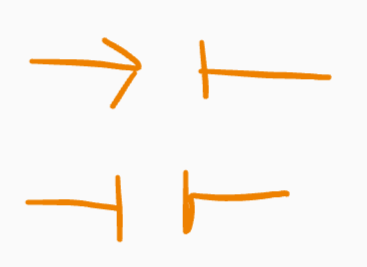
Representations of capacitor
V = IR / Voltage = Current x Resistance
Formula of voltage
I = V/R or Current = Voltage over Resistance
Formula of current
R = V over I or Resistance = Voltage over Current
formula of resistance
Acceleration
is a fundamental concept
in physics that describes how the
velocity of an object changes over time. It also pertains to a vector quantity, meaning it
has both magnitude and direction.
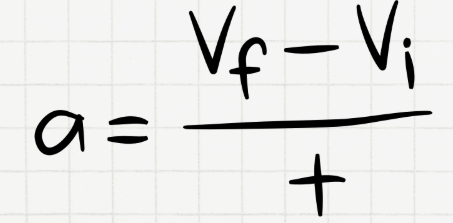
formula for acceleration
m/s²
unit for acceleration
m/s
unit for velocity
Positive acceleration
This acceleration occurs when an object speeds up.
Negative acceleration or Decceleration
This acceleration occurs when an object
slows down. It has another term aside from this acceleration.
Uniform acceleration
means the rate of acceleration stays constant,
such as an object in free fall near Earth's surface. It accelerates at approximately 9.8 m/s² due to gravity.
Zero acceleration
occurs when an object's velocity remains constant
over time — that is, there is no change in speed or direction.

formula for the following if at rest
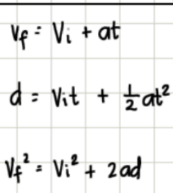
formula with initial velocity
Newton’s Law of Motion
. A set of three fundamental principles that describe the relationship between the motion of an object and the forces acting upon it.
. It was formulated by Sir Isaac Newton in 17th century
Law of Inertia
This law states that an object at rest will remain at
rest, and an object in motion will continue to
move in a straight line at a constant speed
unless acted upon by a net external force.
Law of Acceleration
This law defines the relationship between force, motion, mass, and this law.
Law of Interaction / Action and Reaction
This law states when one object exerts a force on another object, another object exerts, too, a force of equal strength.
Vector
direction and magnitude
Scalor
magnitude only