Quality and Patient Safety 2
 Call Kai
 Learn
 Practice Test
 Spaced Repetition
 Match
 Flashcards
 Knowt Play
1/10

There's no tags or description
Looks like no tags are added yet.
11 Terms
Risks to Nurses
• MSK injuries
• Back, joints
• Injuries related to standing long periods of time, little to no bathroom breaks at times
• Exposure to bloodborne pathogens, chemo toxins/radiation, chemical hazards
• Psychological exhaustion
• Nurse fatigue
• Second victim
• Emotional and moral distress, PTSD
Errors will occur –
Note from IHI:
• The reality is that patients and family members are not the only people harmed by medical error. Clinicians suffer, too. Blaming people who are doing their best does not solve the problems that lead to error, and it makes health care less safe. As Dr. Leape has often said: “The single greatest impediment to error prevention in the medical industry is that we punish people for making mistakes.”
• Delivering the right care — for every patient, every time — requires a different way of thinking about error in medicine and a new approach to preventing harm
• Focus on culture of safety
• Focus on improving systems to prevent error
→ Quality Improvement

Quality in Health Care
• Quality – degree to which health services for individuals and populations increase the likelihood of desired health outcomes and are consistent with current evidence and knowledge (National Academy of Medicine, 2018
STEEP:
Safety
Timeliness
efficiency
effectiveness
equity
person-centered
How is Quality Measured?
• Measures are used to assess and compare the quality of health care organizations
• When comparing to internal or external standards, it’s called Benchmarking
• It’s like comparing apples to apples
• **There are many reasons why errors are still occurring, but a notable problem is the LACK of reliable standardized reporting systems and mechanisms**

Quality Measures
Quality Measures- NDNQI
• Nursing-specific measures
• ANA developed a National Database of Nursing Quality Indicators (NDNQI) to collect and analyze nursing data to improve quality of care and patient outcomes
• Data is organized in three categories:
1. Structure: How well does an org’s capacity, system, and process support high-quality care? E.g., adequate facilities, staff, resources
2. Process: How well does an org serve pts within recommendations and evidence-based guidelines E.g., diabetes care, patient falls
3. Outcome: How does an org positively or negatives impact the health status of
its population? E.g., CAUTI, CLABSI, surgical complications
Quality Measures: Patient & Quality Indicators from AHRQ
• Patient Safety Indicators
• Ex: Rate of pressure ulcers, retained surgical item or unretrieved device
• Quality Indicators
• Prevention
• Perforated appendix, UTI, HTN admission rates
• Inpatient
• Hip replacement, HF, stroke mortality rate
• Pediatric
• Neonatal mortality, pressure ulcer, postop issues
Quality Measures – Core Measure from CMS
• CMS Quality Measures Inventory
• Use to improve quality of care for common conditions
• EX: Stroke – received med to prevent blood clots; HF – received BB therapy for LVSD; Readmission rates
Data Sources
Administrative data
• Data gathered from claims, encounters, enrollment, providers, etc
Patient medical records
• Limited to HIPAA restraints
Patient surveys
• Self-reported data from patients
Standardized clinical data
• Data reported to governmental compliance entities
Patient feedback
• Data from third party organizations that seek testimonials from pts about their experience
Quality Improvement Defined
Quality Improvement Defined
• Definition: Use data to monitor the outcomes of care processes and use improvement methods to design and test changes to continuously improve the quality and safety of health care systems (QSEN, 2007)
• A framework used to improve patient care and outcomes systematically and continuously
“Most of the problems in health and healthcare are not due to mistakes by uninformed or lazy people, but, rather, can be traced to problems with the systems In which they have to operate.” Dr. Goldman, IHI
QUI & The ANA
QI & The ANA
• The ANA considers QI one of the five core competencies of all healthcare professionals (and meeting quality care standards)
• In addition to the quality domains (STEEEP), the ANA includes other competencies for nurses:
• incorporating EBP into practice to improve outcomes
• enhancing nursing through creativity and innovation
• recommending strategies to leadership to improve quality of nursing practice
• engaging in data collection to monitor care quality
• participating in QI initiatives
• collaborating with other disciplines to implement QI
QI Initiatives
• Goals may include enhance patient safety; improving clinical outcomes; optimizing operational efficiency
• Rooted in the belief that there is always room for growth, even well-established practices can benefit from continuous improvement
• Quality initiatives that repeatedly asks, “How are we doing?” and “Can we do it better?”
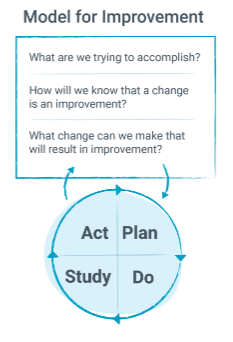
• The Model for Improvement
• A few common methods

Lean/Six Sigma
Lean/Six Sigma
• Combines principles of Lean, which focuses eliminating
waste and optimizing flow (How much time do we waste
doing the wrong thing and having to correct it? How much
money do we waste when we make mistakes?)
• With Six Sigma, a data-driven approach to reducing
variation and defects (so that the same thing happens safely
EVERY time)
• May hear the term “Kaizen” used with this methodology
(Japanese words for “change” and “good”)
• Utilizes a collaborative team effort to improve performance
by systematically identifying root causes of problems

PDSA
PDSA
• AKA PDCA, Deming Cycle or the Shewhart Cycle
• Simple and versatile
• 4 iterative steps
• Gives a way to quickly test changes on small scale – observe what happens, tweak changes as necessary & test again (rapid testing & learning)


RCA
RCA
• Structured method used to analyze serious adverse events
• An error analysis tool
• Uses system approach to detect active and latent errors
• May see this process named “systems analysis” instead
• Follows a protocol
Addressing the Complexities in Quality & Patient Safety
Addressing the Complexities in Quality & Patient Safety
• Reduce distractions
• Avoid overriding safeguards
• Alarm fatigue! Overstimulation
• Improve communication among the healthcare team
• Speaking up or questioning orders can be intimidating!!
• Report all types pt safety events
• Stay current with new procedures and equipment.
• Be involved in improving processes!
• Fall prevention!!
• Workplace violence prevention*
Key Words
Quality (in health care)
Patient Safety
Patient Safety Events - types
National Patient Safety Goals/The Joint Commission
National Quality ForumLinks to an external site.
Quality and Safety Education for Nurses (QSEN)Links to an external site.
Quality Improvement (QI)
Quality Measures
National Database of Nursing Quality IndicatorsLinks to an external site. (NDNQI)
Institution for Healthcare Improvement (IHI)
Incident Report
Mandatory Reporting
Culture of Safety
Incivility, bullying
Workplace violence
Model for Improvement
P-D-S-A
RCA