5 Random Variables and Distributions
 Call Kai
 Learn
 Practice Test
 Spaced Repetition
 Match
 Flashcards
 Knowt Play
1/12

There's no tags or description
Looks like no tags are added yet.
13 Terms
random variable
A random variable is a function
X : Ω → R
that has a (well-defined) cumulative distribution function, FX : R → [0, 1],
defined as
FX (x) := P({X ≤ x}), for all x ∈ R.
The set of values that the function X can take is called its range and is
denoted by RX .
Cumulative distribution
Fx
Probability x is less than or equal to a given value
discrete random variable
random variable X
which can assume at most countably many values is called a discrete
random variable
probability mass function for a discrete random variabl x
For a discrete random
variable X, the probability mass function (pmf) is
pX (x) := P({X = x}) for all x ∈ R

if 2 discrete random variable x and y have the same distribution then
they have the same pmf
X ∼ Y (“X distributed like Y ”) if pX (x) = pY (x) for all x ∈ R
joint probability mass function
pX,Y (x, y) = P({X = x} ∩ {Y = y}) for x, y ∈ R
Px(x)

pY(y)

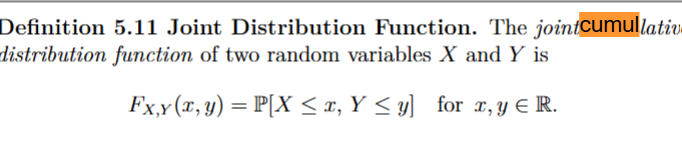
joint cumulative distribution function
when are discrete random variable indepedenet
pX,Y (x, y) = pX (x) × pY (y) for all x, y ∈ R.
when is a family of discrete random variables independent

The graph of the pmf of the sum of two die roll

cumulative distibution function
robability of being less than or equal to that value