CVA Lecture Exam 2
 Call Kai
 Learn
 Practice Test
 Spaced Repetition
 Match
 Flashcards
 Knowt Play
1/98

There's no tags or description
Looks like no tags are added yet.
99 Terms
What are 5 functions of the integument?
protection against microbes, heat regulation, respiration, coloration, reception of external stimuli
What are the 2 layers of the integument?
Epidermis - derived from ectoderm, protective/glandular function
Dermis - derived from dermatome, connective function, holds hair/feathers, pigment, nerves, dermal scales
What are the 2 layers of the epidermis?
stratum corneum = dead, upper layer that has lots of keratin which helps skin protect from water loss and bacteria
stratum germinatum = basal layer made of cuboidal cells that differentiate as they move into the stratum corneum.
What are the 2 types of cells in the stratum corneum?
1) those that synthesize keratin, flatten, die, and fall off
2) those that form multicellular glands
What membrane separates the epidermis and dermis?
The basement membrane
What are the 2 layers in the dermis?
stratum laxum = lies directly below the basement membrane, loosley packed cells
startum compatum = below stratum laxum, tightly packed cells
What are the 3 major types of hard tissue associated with skin?
Enamel, Dentine, Bone
Enamel characteristics
hardest tissue (3% organic), made of hydroxyapatite, generally most superficial hard tissue, made in layers and found in teeth, scales, & dermal armor
Dentine characteristics
Softer than enamel (25% organic), has tubules occupied by mesodermal cells, under enamel when present
Bone characteristics
25% organic, deepest layer, may have osteons and may undergo reorganization unlike enamel and dentine
What were extinct agnathan scales made of?
Deep→superficial
lamellar bone, spongy/vascular bone, dentine, ganoine (which is like enamel)
Chondrichthyes skin, when covered with scales, is covered in what type of scales? Shark teeth are also derived from this scale type.
placoid scales
What are the layers in placoid scales (deep → superficial)?
lamellar bone, dentine, enamel
What new function of the integument is introduced in bony fishes?
help maintain water balance by secreting mucous through unicellular glands
What are the 3 types of scales that osteochthyes can have?
cycloid = thin, round and smooth
ctenoid = thin comb-like processes and serrate margin
cosmoid = thick, embedded in skin and act as bony armor
What type of scales do caecilians have?
Tiny osteoderms. Only extant amphibian to have scales
What derived traits did amphibians bring to skin glands?
multicellular glands now secrete into a chamber so that it can be secreted all at once. And now have peratid (poison) glands
Amphibian skin is much like ______ skin.
fish (think catfish)
What new integument characteristics evolved in reptiles which aided them being less dependent on water?
more keratinized epidermal cells, scutes (belly scales) in snakes, plated scales for turtles, and shedding.
What is the difference between snake and lizard shedding?
snake → one piece, lizard → several pieces and eat it
What is the basic structure of a feather?
Calamus (base that’s embedded in skin), Rachis (shaft), Vane, Barb (hooks vanes together)
What are pterylae
The tracts where feathers grow. They don’t grow over the whole body, just in certain areas and lay over bare skin
What are the bare spots where feather don’t grow called?
aptera
Down feather characteristic/function
in babies, no barbs, thermoregulation
Filoplumes function
display
Bristle feather function
focused around the mouth for catching prey
Like scales on reptiles, feathers are _______.
Shed annually
What is the only gland present in avian integument?
*Only present in some species
Sebaceous = produce oil to cover feather for water-proofing
What is unique about the mammalian epidermis?
it’s thicker and has follicles to root hair which will grow through mitosis at the root.
What is the process that causes hair to be shed?
What mitosis at the root stops
What are the layers of hair?
1) medulla at the center
2) cortex surrounding medulla
3) cuticular scale surrounding cortex
*presence of certain layers may vary depending on species (e.g. our baby hairs don’t have a medulla
What are the different types of hair?
Vibrissae = whiskers
guard hairs = protect undercoat
blubber = subcutaneous fat acts as insulation and nutrient resource
What are the different types of glands in mammals?
Eccrine = sweat for cooling
Apocrine = sweat for odor
Mammary = milk
Nail characteristics
grow from nail bed in epidermis. Cornified in ungulates (hooved) but elongated/thickened in claws
Horn characteristics
supported by basal bony structure and surrounded by keratinized epidermal layer. Generally permanent
Antler characteristics
Shed annually during non breeding season and develop under velvet which is lost as they mature.
What are unique about a rhino’s horn?
they are made of keratin fibers that are woven together without a bony core
What’s the scientific name for pigment cells?
chromatophores
What are the different types of chromatophores?
Melanophores = (mammals/birds)contain melanin (red and/or black) and show slow color change
Iridophores = reflect light with platelets of guanine pigment
Xanthophores/erythrophores = yellowish pteridine pigment and reddish carotenoid pigments
Dermal = rapid color change
What is it called when the coloration is in warning (normally for poison)?
aposematic coloration
Is there an animal that has a skeleton completely made of bone?
no
What are the 4 types of cartilage?
Hyaline = clear matrix
Elastic = have elastin fibers
Fibrocartilage = have collagen fibers
Calcified = contain calcium deposits
What is the primary difference between bone and cartilage?
bone has more minerals, calcium-phosphate matrix, deposited in osteons
What are osteons?
ordered units of bone
What is the haversian canal system?
a series of concentric rings made of bone cells forming layers around a central canal through which pass nerves
What are the 2 layers that make up bone tissue?
cortical = Upper is hard/compact
cancellous = lower is spongey/soft
What’s the main difference between reptilian and mammalian bone?
mammalian bones have more canals in the compact bone and have osteons.
What are the different bone cells?
Osteoblasts = produce new bone
Osteoclasts = break down old bone
Osteocytes = maintain equilibrium between minerals and organic material in fully formed bone
What are the 2 methods of skeletal development?
1) Membrane/dermal bone = calcium and osteoblasts deposited within connective tissue near skin surface and trabeculae (rods/tubes) form through that connective tissue and will fuse together for bony tissue to form around it.
2) Cartilage replacement bone = endochondral bone forms within embryonic cartilage while perichondral bone forms around that cartilage. The trabeculae form internal network and spaces between form bone marrow. Ossification process starts from middle to end of bone.
What does epiphysis mean?
end of bone
What does diaphysis mean?
middle of bone
In which general group does the epiphysis remain cartillagenous until adulthood?
Anamniotes
What are epiphysial plates and who has them?
= spaces between diaphysis and epiphysis; birds and mammals have them and are cartilagenous until full-sizedto allow for growth
What is hemopoietic tissue?
bone marrow that produces what/red blood cells and is replaced by yellow bone marrow later in life
What are synarthroses joints?
joints that have little movement but room for growth
What are the 3 types of synarthroses?
Sutures = where 2 dermal bones meet
Synchondroses = sheets of cartilage ossify but remain separated by plate of cartilage
Symphyses = 2 bone halves meet but separated by cartilage
What are diarthroses joints?
Joints that have more movement bc they’re connected by ligaments and collagen sheets and have synovial fluid between bones
What type of bone do some tendons have (tendons that go around corners)?
sesamoid bone
Which is more variable, ligaments or tendons?
ligaments
What is a nuchal ligament?
holds head and neck without muscular effort. the ligament holds the head rather than the muscle
What’s the difference between the chondrocranium, splanchnocranium, dermatocranium?
Chondrocranium = internal support/encase for sensory organs
Splanchnocranium = jaw structures
Dermatocranium = plates surrounding the head
Chondrocranium characteristics
most visible in primitive species and smaller in most derived
Chondrocranium development
1) cartilage forms around brain starting at notochord
2) Cartilaginous rods run from back to front and meet to form basal plate
3) Cartilage surrounds sense organs to form optic, nasal, and auditory capsules
Splanchnocranium choaracteristics
7 Visceral arches composed of cartilage/cartilage replacement bone. Upper jaw detached from skull in primitive vertebrates.
What is the jaw derived from?
1st visceral arch and renamed mandibular arch
What are the different jaw types?
Hyomandibular = Supports jaw in primitive cartilaginous fishes.
Hyostylic = upper jaw that direct connection with chondrocranium
Autostylic = upper jaw articulates/fused to chondrocranium however jaw is unsupported by hyomandibular
What are the 6 groups of the Dermatocranium?
1) Facial series = encircles external nares form snout
2) Orbital series = circles eyes and defines orbit
3) Temporal series = behind orbit
4) Vault series = roofing runs across top to cover brain
5) Palatal series = roof of mouth
6) Mandibular series = encase mandibular cartilage
What was the first vertebrate class to have a brain case?
chondrichthyes
What are 4 things in the skull that changed with Osteichthyes?
1) introduction of a palatoquadrate
2) The optic capsule encloses the ear
3) The lower jaw is only composed of Meckel’s Cartilage which is encased by dermatocranium
4) Hyoid apparatus (which supports floor of mouth and gills) derived from 2nd gill arch.
What are 5 changes that happened in the skull as tetrapods developed?
1) reducing number of separate bony elements through fusion or elimination
2) Autostylic jaw attachment
3) gills→lungs required internal nostrils
4) Function of visceral arches changes from gill support to Hyobranchial apparatus, larynx cartilage, auditory ossicles
5) Dermatocranium moves deeper to be closer to chondrocranium.
How did development of the dermatocranium change with the rise of tetrapods?
includes a stage with temporary gaps between bones (fantanelles) and fusion. May cause the production of intermediate Wormian bones (islands of bone between structures)
Amphibian skull characteristics
chondrocranium mostly cartilage, broad/flat shape
Reptile/bird skull characteristics
introduction of a completely ossified skull and diapsid fenestrae that allowed for stronger jaw
What’s the difference between Diapsida, Synapsida, Euryapsida, and Anapsida?
Diapsida = 2 holes (birds/reptiles)
Synapsida = only bottom hole (mammals)
Euryapsida = only top hole (plesiosaurs/Ichthyosaurs)
Anapsida = no holes (turtles)
What are 4 main differences between a bird and reptiles skull?
1) reptiles had much heavier dermatocranium
2) birds have sclerotic bones (surround the eyes and do not articulate with skull)
3) birds have larger brain:body ratio
4) birds have beaks was modified scales
What are 4 derived traits of the mammal skull?
1) lose sclerotic bone
2) develop turbinate bones in the nasal cavity (spiral shape increase surface area allowing for better olfactory sense) and branchial arches modified into auditory ossicles
3) Hard (anterior) and soft (posterior) secondary palate and epiglottis (food sorting flap)
4) Heterodont, thecodont
What 2 general areas is the postcranial skeleton split up in?
Trunk (vertebral column) and appendicular (limbs)
What is the notochord made of and what happens to it in more derived vertebrates?
Made of vacuolated cells surrounded by fibrous sheath. It gets constricted in high vertebrates because vertebral development
What are the 5 main parts of a vertebrae?
centrum, hemal and neural arch, hemal and neural spine
What are the 5 different centrum types?
Amphicoelous = socket-socket, leaves room for notochord
Opisthocoelous = socket-ball, some reptiles/mammals
Procoelous = ball-socket, reptiles/amphibians
Acoelous = flat-flat, reptiles/mammals
Heterocoelous = saddle-saddle (2 lego hands interlock) only in birds, better support and movement
What’s the difference between Aspidospondyly and Holospondyly?
Aspidospondyly = vertebral elements separate
Holospondyly = vertebral elements fused into one piece
What are the 5 vertebral regions?
Cervical, thoracic (with ribs), lumber (w/out ribs), sacral, caudal.
What are the 2 ways ribs can develop?
1) Intermuscular = develop in myosepta and connects to centrum (fish)
2) Subperitoneal = Ventral ribs form between ventral muscles and lining of coelom (tetrapods, fish)
What are the 2 types of sternum that birds have?
Ratite = no keel → runners
Carinate = massive keel → flyers
What are the 2 articulation points for mammals ribs?
Tuberculum = dorsal, Cupitulum = ventral
What are the 2 ways mammal ribs can articulate with the sternum?
as either true ribs (directly attached by cartilage) or as false ribs (indirect, or not attached)
What is unique about reptilian ribs?
Have gastralia (belly ribs)
What are the 2 general regions of he appendicular skeleton?
Anterior and Posterior girdles
Characteristics of the fish pectoral girdle
include cartilage and dermal bones. Cartilagenous fish have scapulocoracoid while teleost fish have cleithrum
What are the differences in the clavicles in primitive tetrapods, aves, carnivores, and ungulates?
Primitive → interclavicles added
Aves → clavicles fuse into furcula
Carnivores → clavicles reduced
Ungulates → clavicles lost
What is unique about the tetrapod pelvic girdle?
has the obturator foramen (largest foramen)
What is the purpose of fins (not tail)?
control pitch, drag and roll
What are the different types of fish tail?

What are the different types of paired fins?
fin-fold (only in chondrichthyes), ray fins (actinopterygii), Lobed fins (sarcopterygii)
What are the 5 sections of the tetrapod limb?
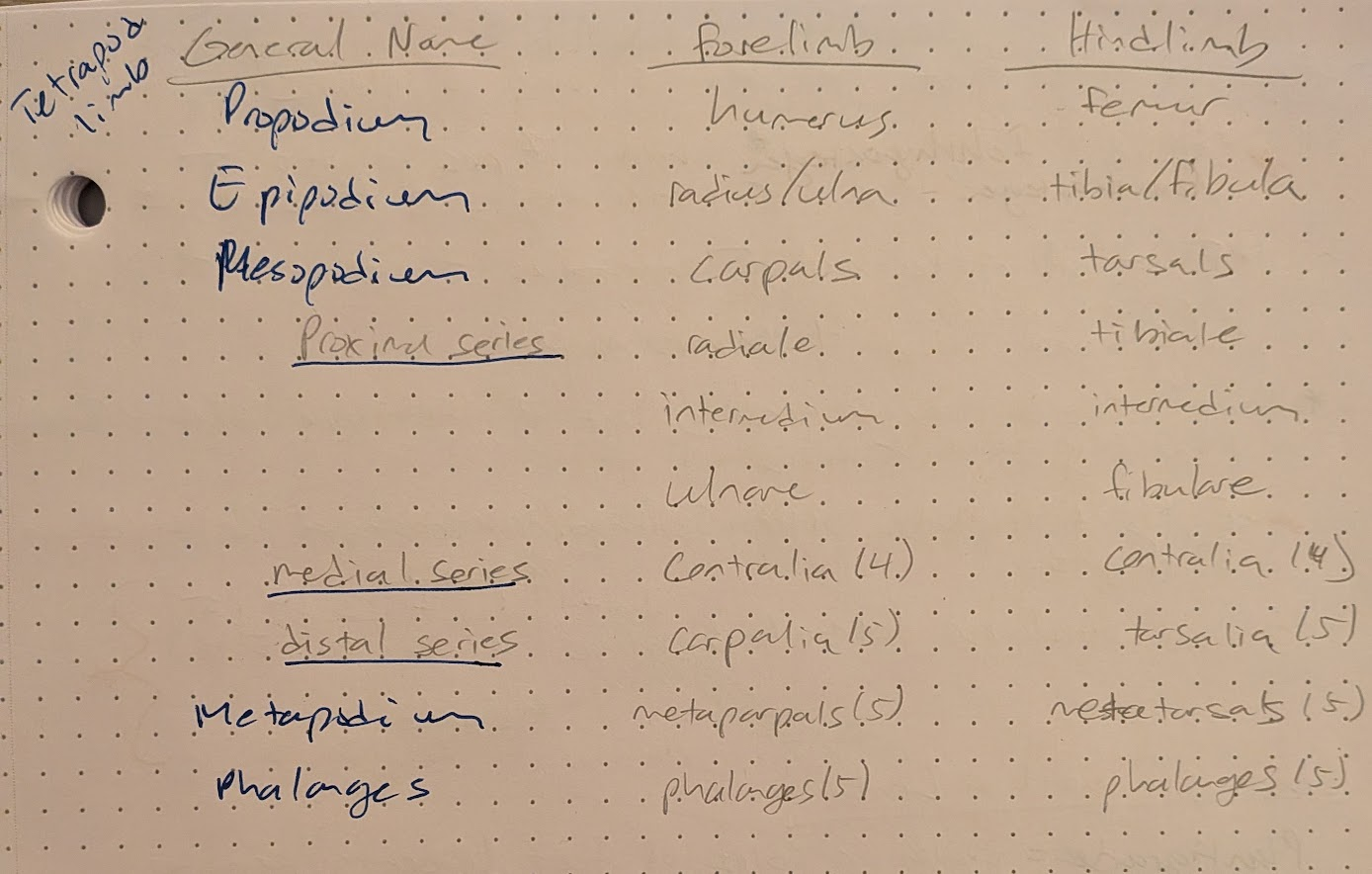
What’s the difference between suprinating and pronating?
Suprinating = thumbs out, palms up
Pronating = thumbs in, palms down
Who are the exceptions to the rule of early tetrapods having 5 digits?
Ichthiostega (had 7 pes digits) and Acanthostega (had 7 pes and 8 manus)
What is the general phalangeal formula for tetrapods and mammals (who are different from other tetrapods)?
Most Tetrapods → 2, 3, 4, 5, 4
Mammals → 2, 3, 3, 3, 3
What are the 3 types of walking in relation to phalangeal position?
Plantigrade = walk on soles of feet, most primitive (rodents, primates)
Digitigrade = Ankle an