Urban air quality
 Call Kai
 Learn
 Practice Test
 Spaced Repetition
 Match
 Flashcards
 Knowt Play
1/26

Earn XP
Description and Tags
L4
27 Terms
Which factors determine the dispersion and transformation of air pollutants?
for the dispersion of gases:
wind speed
urban configuration
geometry
for the transformation of air pollutants for example the formation of ozone:
global radiation
temperature
What are the MAPs in the urban environment?
major anthropogenically emitted/ produced substances, e.g:
SO2
NOX = NO + NO2
CO
aerosols or PM:
coarse: PM10 (D ≤ 10 μm)
fine: PM2.5 (D ≤ 2.5 μm)
fine: PM0.1 (D ≤ 0.1 μm)
VOCs
Ozone
main ingredient of photochemical smog
2ndary air pollutant formed from NOx and VOCs:
VOCs + NOx →hv O3
What are the HAPs in the urban environment?
trace compounds in the atmosphere with high toxicity, e.g.:
benzene
formaldehyde
polyaromatic hydrocarbons (PAHs)
perchloroethylene
methylene chloride
asbestos
toxic heavy metals, e.g. mercury, cadmium, chromium, lead
causes serious health effects, such as cancer, birth defects
What are the differences between MAPs and HAPs?
HAPs are present in the atmosphere in much smaller concentrations than MAPs
HAPs appear more localized, typically in urban areas or near industries
NO emitted by cars is converted rapidly to NO2. Which chemical reaction is responsible for this?
NO + O3 → NO2 + O2
What are the complex mixtures of organic/carbonaceous PM?
Elemental carbon (EC) or black carbon (BC)
emitted directly (combustion)
structure similar to impure graphite
Organic carbon (OC)
emitted directly (primary OC) incomplete fossil-fuel combustion
indirectly (secondary OC) condensation of VOCs (e.g. by-products of photochemical reaction (e.g. PAH))
Soot:
Both EC and (primary) OC

What are the health impacts of major air pollutants?

What are the toxicological effects and importance of particle size for public health?
toxicological effects:
inflammations (response immune system)
pulmonary effects
cardiovascular effects
importance of particle size:
PM0.1 > PM2.5 > PM10
because penetrates into lungs
How do particles penetrate into the lungs?
large particles deposit in upper airways
small particles deposit inside the lungs

Why are ultrafine and fine particles predominantly of anthropogenic origin?
ultrafine particle are formed by chemical reactions or are condensed from hot vapor, for e.g. from diesel exhaust, and they coagulate into fine particles
therefore the particles are predominantly of anthropogenic origin
Why is controlling the concentration of SO2 easer than ozone concentration?
Ozone is a 2ndary pollutant,
hence it can only be regulated via the primary pollutants,
which are VOCs and NOx, emitted by various anthropogenic and natural sources
SO2 is a primary pollutant,
can be regulated directly by emissions controls at coal power plants and on ships engines

Give 3 reasons why this guideline can be questioned.
the current air quality guideline for PM is based on the mass concentration of particles with diameter = or < than 10 μm (PM10)
the effects on the respiratory system are caused by the fine and ultra-fine particles which are able to penetrate deeply into the lungs.
although they dominate by far in number, their mass is negligible
no threshold value for the impact of particles on human health has been found
the chemical composition of particles is not well known, and health impacts may be due to other pollutants adsorbed on them
typically heavy metals or less volatile organic compounds
What are the health impacts of ozone?
adverse, structural, functional and biochemical alterations in the respiratory tract
increases in daily mortality and levels in populations
chronic effects: small airway function, asthma development
Explain why in many cases large industries and power plants in the vicinity of large cities contribute rarely to the local ground level air pollutant concentrations inside the urban area?
usually large industries and power plants have tall chimneys
air pollution emitted from a high release height will in many cases be transported out of the urban area before dispersed down to ground level,
depending on size of the urban domain
What is actual exposure in cities equal to?
actual exposure = street + city + region + long distance contribution

Why would the urban heat island effect further worsen the air quality in a city?
at low wind speeds the UGI effect can give rise to a circulation where the pollution is trapped
an increase in temperature may lead to an increase in surface ozone concentrations
during night-time urban air pollution may get worse due to development of a strong inversion across the urban canopy

What could be reason of two streets in different countries showing similar concentrations despite one having higher traffic in the streets?
the street with higher traffic may have high wind speeds and neutral conditions
the other may have low wind speeds and (near) stable conditions.
What ozone pollution result from?
VOCs
NOx
in combination with sunlight
weather & climate play an important role
Define aspect ratio of a street and the impact of aspect ratio on air quality at street level?
defined as the ratio between mean building height and street width (H/W)
has an important influence on the canyon vortex
on the dispersion and concentrations of air pollutants at street levels
with higher H/W, less pollutants will be dispersed out of the street canyon
so surface pollution levels will tend to be higher
What is the influence of the UBL at daytime and nighttime?
Daytime:
BL bulges upward due to city heat and building roughness
solar heating creates strong vertical mixing
air pollutants accumulate over the city and get swept downwind
Nightime:
the UHI effect lifts the inversion layer up and over the city,
trapping pollutants tightly inside the UCL
hight nighttime pollution concentrations
What are the flow patterns within the UCL?
average wind speeds in cities are lower
large differences at building/street level
impact on dispersion and concentrations of air pollutants

Explain this figure which shows a diurnal pattern for ground-level ozone concentration in areas that experience photochemical smog.
morning peak of NO at 6-7
largely due to emissions from vehicles during the morning rush of traffic
hydrocarbon peak at 9
temporal pattern similar to NO, except that their concentration peaks slightly later
emitted from vehicles and refineries
peak of NO2 at 7-9
in bright sunlight, the NO is photochemically oxidized with help of reactive hydrocarbons to NO2
resulting in a decrease of NO concentration and increase of NO2
broad peak of O3 concentration at 12-15:
photochemical reactions involving NO2 produce O atoms
which react with O2 to form O3
resulting in a net decrease in NO2 concentration and an increase in O3 concentration
as the day proceeds, the various gases decrease in concentration as they are diluted by fresh air masses blowing in from the Pacific Ocean or are consumed by photochemical reactions
Why could ozone levels be higher in the weekends in cities that during the working week?
during the weekends there is less traffic and NO emissions in the cities
hence, less O3 is destroyed by the reaction with NO

In the ozone transverse concentration profile, explain the concentration profiles at the points 1,2,3, and 4.
during daytime*
close to emission sources, NO reduces ozone by titration (NO + O3 → NO2 + O2)
Net formation some distance downwind of the sources:
in bright sunlight, the NO is photochemically oxidized with help of reactive hydrocarbons to NO2, resulting in a decrease in NO conc. and a peak of NO2
photochemical reactions involving NO2 produce O atoms which react with O2 to form O3
these result in a net decrease in NO2 concentration and an increase in O3 concentration
NOx becomes limiting
Loss of ozone due to deposition

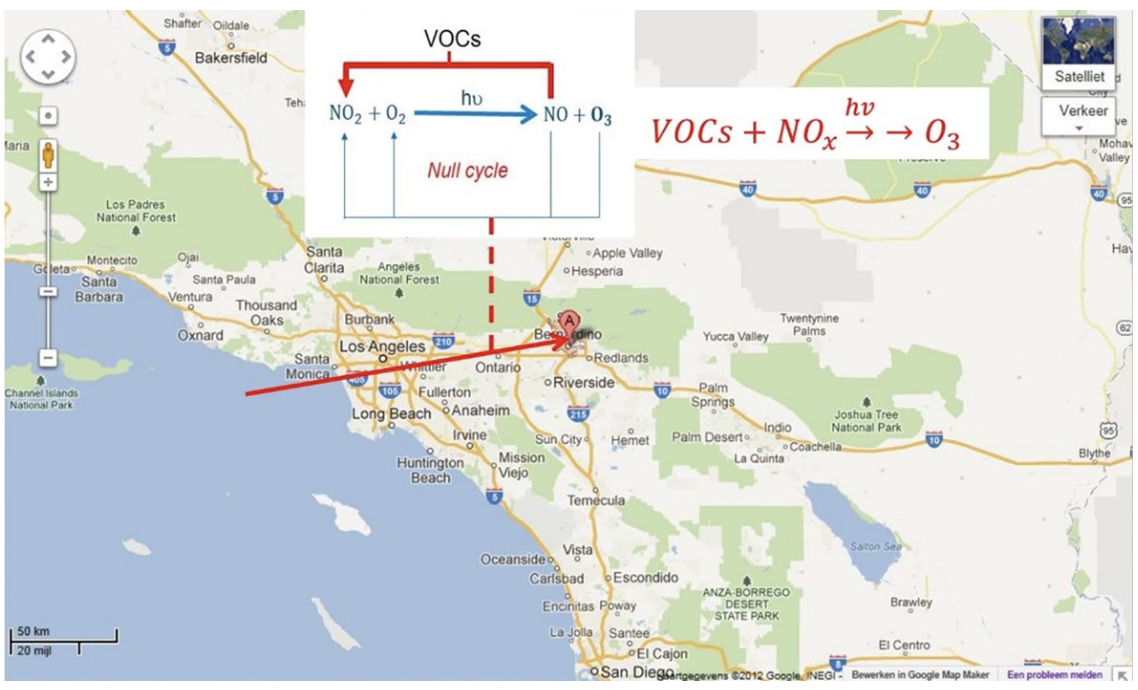
O3 mixing ratios are high and NO mixing ratio is low in SB, reverse is true in central LA. Why?
central LA is source region
heavy traffic and industry, pumping out primary pollutants like NO and VOCs
because NO is freshly emitted in high amounts, immediately titrates local O3
so NO high, O3 low
SB is receptor region
sea breeze transports the primary pollutants towards the mountains
sunlight drives photochemical reactions (VOCs + NOx +hv → O3)
secondary pollutants like O3 and PAN has fully formed
Why is it difficult to compare the air quality between different cities?
How AQI mitigate this problem?
difficult to compare the air quality between different cities:
differences in monitoring practices
differences in the mix of pollutants
differences in effects of local climate on pollutants
AQI helps:
addressing the challenge of comparing cities,
by measuring AQ relative of health standards
so that lacking measurements of one pollutant does not prevent the calculation of AQI
Why does the ambient outdoor AQ not adequately describe the actual exposure of people to air pollutants?
the levels that an individual is exposed to, may vary drastically during the day depending on their activity pattern.