Cell Cycle Checkpoints - 12
 Call Kai
 Learn
 Practice Test
 Spaced Repetition
 Match
 Flashcards
 Knowt Play
1/20

There's no tags or description
Looks like no tags are added yet.
21 Terms
What needs to be completed in the cells before mitosis?
☆ S phase. If replication incomplete, daughter cells can’t inherit complete genome copies = catastrophe
☆ Double in size during interphase. If not, cells would get smaller with each divison
Three main checkpoints in the cell cycle
✧ G1 (G1 to S phase) : monitors environment
✧ G2 (G2 to M phase) : checks DNA replication & environment
✧ M-phase or Spindle Assembly Checkpoint : monitors chromosomes for proper MT attachment & alignment at the metaphase plate.
Mitogens
signals transduction pathways that let the cell know to start growth/division
Rb protein (retinoblastoma)
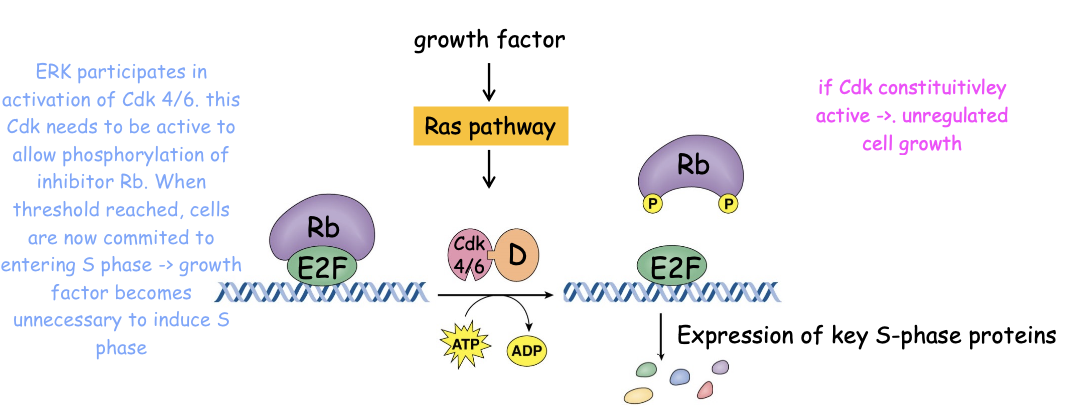
This tumor suppressor gene protein controls progression past G1 checkpoint and is a gatekeeper protein
ERK participates in activation of Cdk 4/6. this Cdk needs to be active to allow phosphorylation of inhibitor Rb. When threshold (restriction point) reached, cells are now committed to entering S phase -> growth factor becomes unnecessary to induce S phase
G0 phase
specialized state a part from the cell cycle - cells can be arrested here for long periods of time
✦ Cdks & cyclins absent so the cells emerge from G0 when signalled
i.e. nerve cells are terminally differentiated, liver cells divide once a yr
What happens when there’s DNA damage in the G1 phase?
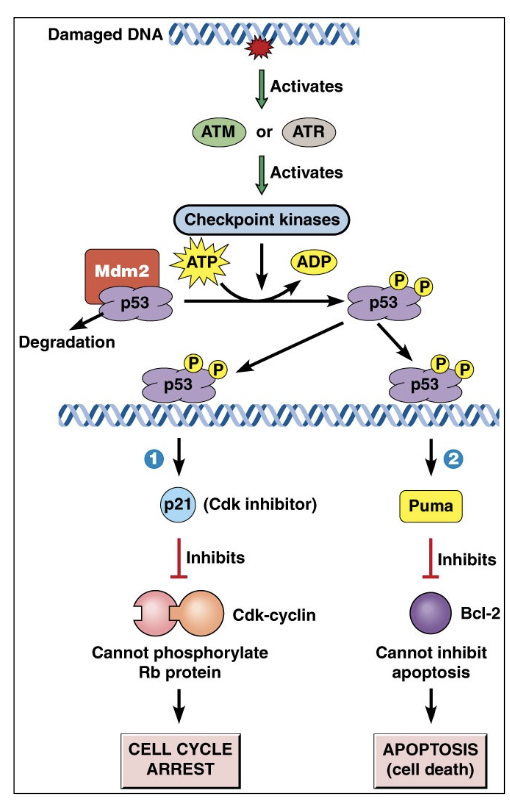
Protein kinases ATM & ATR , along with other kinases such as Chk1 & Chk2, are recruited to the site of DNA damage, leading to the phosphorylation and activation of p53
✦ similar pathway to prevent cells from entering M phase → ATR & Chk1 → phosphorylation and inactivation of Cdc25 (impossible to activate Cyclin B/M-Cdk)
p53
This tumor suppressor gene causes cell cycle arrest in G1, providing time for DNA repair. If repair is successful, cells re-enter the cycle. If unsuccessful, apoptosis
Induces expression of:
✦ p21 - regulatory protein that inhibits the cell Cyclin-Cdk complexes from forming (keeps cell in G1 by preventing Rb activation)
✦ PUMA (p53 Unregulated Modulator of Apoptosis) - protein that inactivates Bcl-2, an inhibitor of apoptosis
What gene is inactivated in many types of cancer?
p53 is the most commonly mutated protein in cancer (abt 50% of all cancers)
Geminin
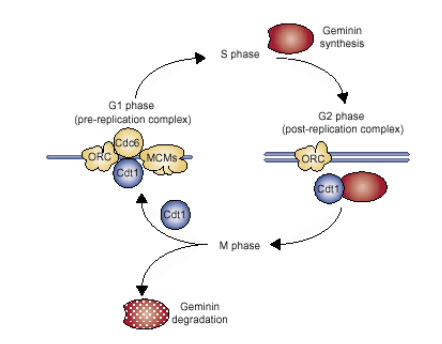
protein that ensures cells only have one cycle of DNA replication
✧ Expressed @ S phase → binds to Cdt1 preventing new pre-replication complexes (presence enables replication, consists of MCM, Cdt1)
✧ Anaphase : Geminin degraded freeing Cdt1
Why is the spindle assembly checkpoint necessary?
Makes sure that all chromosomes are attached to a MT and properly aligned at metaphase plate so daughter cells have the appropriate genome
Anaphase promoting complex/ Cyclosome (APC/C)
A protein complex that triggers the separation of sister chromatids and orchestrates destruction of proteins that regulate the cell cycle
Associates w/ Cdc20 to form a ubiquitin ligase; the complex ubiquitinates its targets for proteolysis
target cyclin B: once degraded, Cdk1 is inactivated
target securin: binds inactive separase. When APC/C active, securin ubiquitinated, separase degrades cohesion → chromosomes can be pulled by kinetochore MT
What inhibits Cdc20?
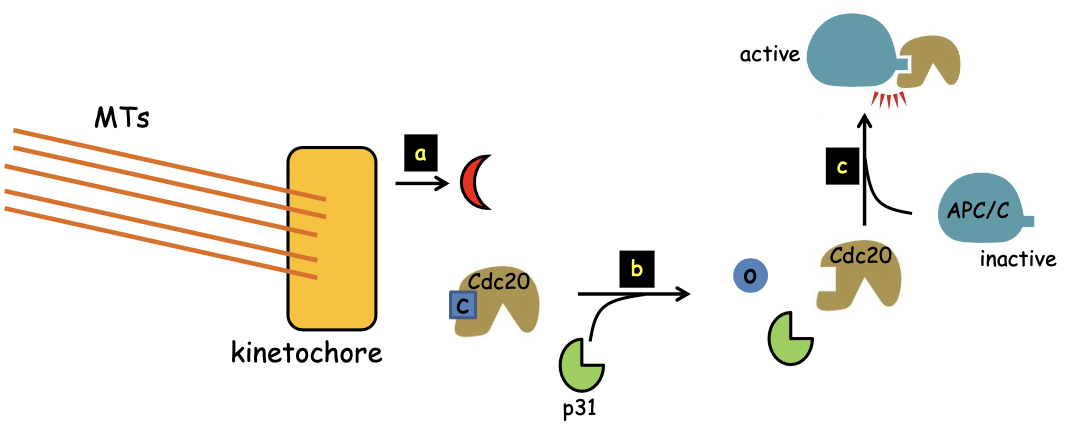
Cdc20 is inhibited by cMad2. The closed form of Mad2 occupies its APC/C binding site
How is Mad2 converted to the closed form?
associates with kinetochore-bound Mad1
How many unbound kinetochores are needed to inhibit all Cdc20 and prevent anaphase?
Just one.
Mad1
checkpoint at anaphase that checks for chromosome attachment to spindle at metaphase/equatorial plate
How is APC/C activated?
✧ when all kinetochores are properly attached to MTs, Mad1 leaves kinetochore
✧ cMad2 stops being produced
✧ p31 comet displaces cMad2 from Cdc20
✧ free Cdc20 can then bind & activate APC/C
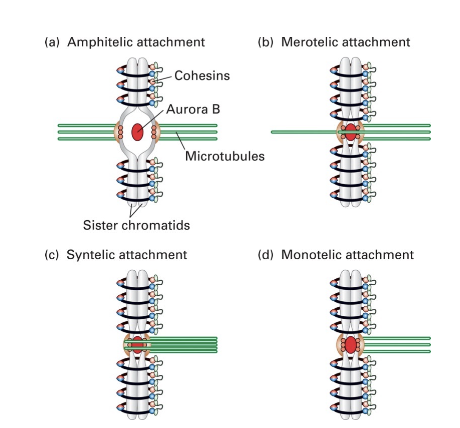
what are the 4 ways MT can attach to kinetochores
a- amphitelic - 2 kinetochores = 2 spindle poles (generates necessary tension)
b- merotelic - 1 kinetochore = 2 spindle poles
c- syntelic - 2 kinetochore = 1 spindle pole
d- monotelic - 1 kinetochore = 1 spindle pole
Aurora-B kinase phosphorylates...
phosphorylates specific proteins to cause detachment of MT from kinetochores with insufficient tension
✧ kinase that detects and destabilizes incorrect MT attachments
What happens if there is sufficient tension (amphitelic attachment)?
Because of the tension, Aurora B kinase can’t phosphorylate the kinetochore proteins
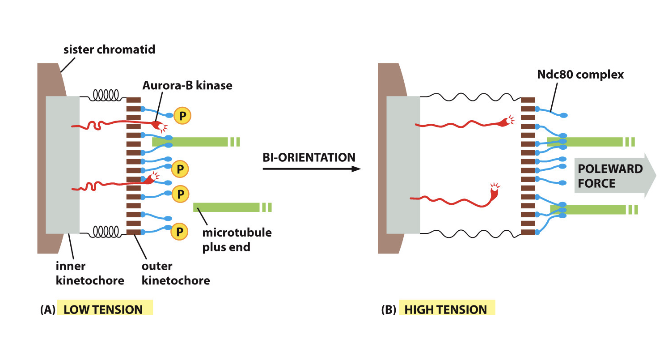
What type of kinetochore complex does Aurora B target? How does this rearrange the MT?
Ndc80 (key kinetochore protein), an MT binding protein is targeted. MT attachments are loosened, allowing them to reform correctly.
The last step is Mad1 coming off the kinetochore to inactivate SAC. What is needed for this?
all ampithelic attachements.