education exam 1
 Call Kai
 Learn
Learn Practice Test
 Spaced Repetition
 Match
Match Flashcards
 Knowt Play
1/55

There's no tags or description
Looks like no tags are added yet.
Name | Mastery | Learn | Test | Matching | Spaced | Call with Kai | Chat |
|---|
No analytics yet
Send a link to your students to track their progress
56 Terms
compare and contrast: quantitative, qualitative, action research
quantitative
data in the form of numbers
qualitative
in depth examination of complex issues/concepts
active
descriptive research carried out by educators in their own classrooms or schools
active research steps
identify area of focus/concern
collect data
analyze data
interpret data
action taken by teacher-researcher
draw appropriate conclusions from different types of research studies
experimental research: cause and effect
what causes what
correlational research: explores relationships, predict one variable based on knowledge of another, not to draw a conclusion
what variables are associated with what other variables
correlations
descriptive research: describes situations, draws conclusions about current situation but not for correlational or causation
how things are at the present time
strategies for collecting info about your own students
preplanned assessments
observing them as they act and interact in class/playground
conduct action research
long-term strategies for gaining experience as a teacher
become knowledgeable of current research, subject matter, teaching strategies (pedagogy), cultural backgrounds
reflect on our assumptions, beliefs, and classroom strategies
know you can make a difference
strategies for effective learning **
set goals: what do you want to accomplish
connect: to prior knowledge/experience
consider contradictions: challenge existing beliefs
tie concepts together: abstract and concrete
question: check your own understanding
four general principles on the general nature of child/human development
development is orderly and somewhat predictable
children develop at different rates
development occurs in spurts anad plateaus
heredity and environment interact (maturation, nature vs. nurture)
who is responsible for multiple layers of environmental influence
Brofenbrenner’s bioecological system
what are the layers of the bioecological system
the child — individual characteristics and developmentally based abilities
microsystems — systems in the child’s immediate and regular surroundings
family, school, close friendships
mesosystems — interactions among various microsystems
family and school
exosystem — people and institutions that affect the child’s microsystems
parents’ work environments and social-support networks, government policies
macrosystem — cultural beliefs and behaviors, as well s far-reaching current events
migration patters, ongoing social strife
chronosystem — passage of time
children and the systems they grow up in change over time
4 main points of brain and its development that affect learning and thinking
different parts of the brain have different specialties, but they all work closely with one another
learning and cognitive development involve changes in synapses, neurons, and glial cells
developmental changes in the brain enable increasingly complex and efficient though
the brain remains adaptable throughout life
Learning and cognitive development involve changes in synapses, neurons, and glial cells — additional details. describe neurons vs glial cells
As we learn synapses are strengthened or eliminated
Neurons and glial cells form
Neurons: communicate and receive information, interconnected
Glial cells: enhance the functioning of neurons, serve a variety of other specialized functions
Developmental changes in the brain enable increasingly complex and efficient thought — additional details. describe synaptogenesis and myelination
Genetic programming facilitates synaptogenesis shortly after birth
As children age, useless synapses fade away (synaptic pruning) (makes the brain more efficient)
Myelination: the development of the myelin sheath, increases neuron’s efficiency in firing and receiving messages
Hormones (and onset of puberty) affect brain and its development
basic assumptions of Piaget
children are active, motivated learners
children construct knowledge from experience
children learn through assimilation and accomodation
interactions with physical and social environments is essential
equilibration promotes progression toward increasingly complex thought
children think in qualitatively different ways at different ages
assimilation
thinking about or interacting with a new object or event in a manner consistent with a currently existing schema
i.e. seeing a four legged animal and putting in the dog scheme.
accommodation
modification of schemes when new information doesn’t fit
i.e. seeing a four legged animal and putting in the dog scheme.find out that cats are not the same as dogs and therefore create a new scheme for cats
disequilibrium and what it promotes
as we learn, movement from equilibrium (balance) to sidequilibrium (discomfort) and back
Promotes development of more complex thought and understanding
Desire for balance forces students to construct new schemes, or accommodate existing schemes
stages of Piaget
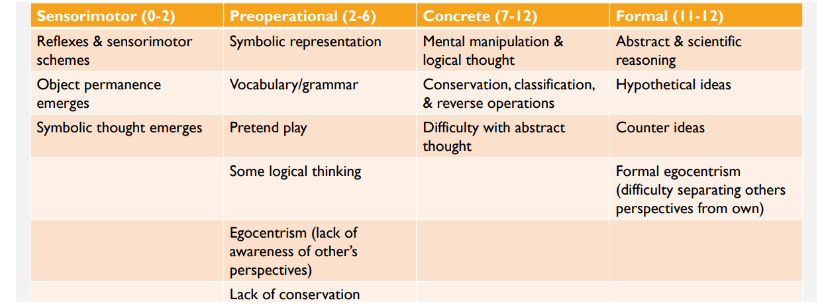
sensorimotor (0-2)
preoperational (2-6)
concrete operations stage (7-12)
formal operations stage (earliest 11-12)
stage 1 — piaget
Stage 1: sensorimotor stage (0-2 yrs)
@ birth – reflexes and sensorimotor schemes
Object permanence emerges
Symbolic though emerges (i.e. pretend play) – marks transition to next stage
stage 2 — piaget
Stage 2: preoperational stage (2-6 yrs old)
Around 2
Symbolic representation (can think beyond immediate experiences)
Rapid expansion of vocab, grammar structure
Extensive pretend play
Limited mental manipulation
Preoperational egocentrism (lack of ability to see others perspective)
Lack mental conservation (unable to recognize an object stays the same regardless of changes in appearance)
stage 3 — piaget
Some mental manipulation and logical thought
Reverse operations (learning math)
Difficulty with abstract and counterfactual ideas
stage 4 — piaget
Doesn’t appear in all cultures
Abstract and scientific reasoning
Hypothetical ideas
Contrary-to-fact ideas
Formal operational egocentrism (inability to separate one’s own logical abstractions from the perspectives of others)
chart of piaget stages
application of piaget
Use Piaget’s Theory (Stages of Development) as a guide. However, always keep in mind that there is variability for the “age levels.”
When students display signs of egocentrism, provide opportunities for them to hear other perspectives.
Explicitly relate concrete and abstract ideas.
Ask students to explain their thinking (metacognition).
Engage students in public service projects to address egocentrism or idealism.
vygotsky’s theory of cognitive development — key ideas
Adults convey cultural interpretations through informal interactions and formal schooling
Every culture passes along physical and cognitive tools
Thought and language become interdependent (self talk → inner speech) (mentally rather than aloud)
Complex mental processes begin as social activities and evolve into mental activitied (internalization)
Children appropriate (adapt) culture’s tools to meet their needs
Children can perform more challenging tasks when assisted
Challenging tasks promote maximum cognitive growth
play allows children to stretch themselves cognitively
ZPD
zone of proximal development
Working between the out of reach and current understanding to allow students to challenge themselves with the support of adults (scaffolding)

scaffolding
supportive assistance
students need guidance during challenging tasks
how to apply vygotsky
Provide students with academic resources and cognitive tools to assist with challenging tasks.
Present tasks that require assistance. Break down these complex assignments or tasks
(scaffold).
Provide students with study strategies such as mnemonic devices. (ex: FOIL method for multiplying binomials)
Allow time for students to work in groups.
compare and contrast piaget and vygotsky

describe nature and origin of child’s temperaments and personalities
Personality is the result of both heredity and environmental factors
Heredity: temperament
Activity level, adaptability, self-control, persistence, adventurousness, outgoingness, shyness, fearfulness, irritability, distractibility
Environmental factors: family dynamics, cultural expectations
suggestions for differing personalities
High energy students: minimize down time
Highly social students: provide opportunities to interact with classmates
Very shy students: be warm and attentive
Trouble adapting: extra structure and reassurance
Overwhelmed by noise and chaos: create calm environment
Impulsive students: teach self-control
describe specific factors that influence a children sense of self
Self-perception
Previous performance (self efficacy based on success and failure)
Behaviors of others (social context) (comparison of self with peers AND others’ expectations and feedback)
Group membership and achievements (peers, family, culture)
sense of self
Perceptions, belief, judgements, and feelings about who you are as a person
self-concept
assessment of one’s own characteristics, strengths, weaknesses
self-esteem
judgements and feelings about own’s own value and worth
how can teachers help students develop a healthy self of self
Do not tolerate bullying
Provide specific praise about what they are doing well
Allow students to share their work (pride)
Provide students the opportunity to explore their own culture
Avoid scare tactics when discussing consequences
how can teachers promote positive peer relationships and address student aggression or bullying
Provide regular opportunities for social interaction and cooperation
Help students interpret social situations accurately and productively
Teach specific social skills, provide opportunities for students to practice them, and give feedback
Promote understanding, communication, and interaction among diverse groups
Explain what bullying is and why it cannot be tolerated
Apply your knowledge of peer relationships and social cognition in promoting productive social skills and addressing student interaction in and out of the classroom.
Set up situations in which students can form cross-group friendships
Minimize or eliminate barriers to social interaction
Encourage and facilitate participation in extracurricular activities, and take steps to ensure that no single group dominates in membership or leadership in any particular activity
As a class, discuss the undesirable consequences of intergroup hostilities
Develop nondisabled students’ understanding of students with disabilities, provided that the students and their parents give permission to share what might otherwise be confidential information
describe typical advancements in moral and prosocial development over the course of childhood and adolescence
Internal standards to evaluate heavior (young age)
Distinction between moral vs. conventional transgressions
Increase in capacity to respond emotionally to others’ harm and distress
Guilt and shame
Understanding feelings of others
Empathy and sympathy
Reasoning about moral issues becomes more abstract
Moral dilemmas
prosocial behavior
Aimed at benefiting others more than oneself, like sharing, helping, comforting
morality
General standards about right and wrong, like honesty, fairness, concern for others
describe factors that influence moral and prosocial development
Level of moral reasoning
Ppl who exhibit more advanced moral reasoning behave more morally
Guilt, perspective taking, empathy
Prosocial children often are very empathetic and have above-average perspective taking skills
Personal motives
Children’s needs and goals come into play
Self-perceptions
Commitment to moral values is integrated into the overall identity
General cognitive development
Perspective taking ability
Adults’ reasons and rationales
Inductive discipline
Disequilibrium
Exposure to moral issues and dilemmas
Sense of self
High self-efficacy for helping behaviors
Personal needs and goals
kohlberg’s 3 levels and 6 stages of moral reasoning
Preconventional
Stage 1: Avoidance of punishment
Don’t want to get caught
Stage 2: Exchange of favors
Want something in return
Conventional
Stage 3: Good child
Wanting to be liked
Stage 4: Law and order
Want to follow the rules
Postconventional
Stage 5: Social contract
Want the greater good so okay to break rules
Stage 6: Universal ethical principle
erikson 8 stages of prosocial devleopment
Trust vs. mistrust (infancy)
Is the world a trustworthy place?
Autonomy vs. shame and doubt (toddler)
Am I capable of doing things on my own?
Initiative vs. guilt (preschool)
Is my growing independence supported?
Industry vs inferiority (elementary school)
Am I encouraged to make and do things, and then praised for my accomplishments?
Identity vs role confusion (adolescence)
Who am I? What do I believe in? What path will I choose for myself?
Intimacy vs. isolation (young adulthood)
Can I fully commit to another person?
Generativity vs. stagnation (middle adulthood)
What can I contribute to the next generation?
Integrity vs. despair (late adulthood)
Do I have regrets, or am I satisfied with how my life went?
critique of erikson
He thought individuals achieved sense of identity by end of adolescence, but others have proposed that it continues into adulthood
Research data
He used personal anecdotes vs. systematic research
Stages based on work with men
Did not account for the effects of culture
specific challenges that students form low-income families might face
Poor nutrition & health
Inadequate housing & frequent moves
Exposure to toxins
Unhealthy social environments
Emotional stress
Gaps in knowledge
Lower quality schools
students at risk
high probability of failing to acquire minimal academic skills necessary for success
how do teachers recognize at-risk students
History of academic failure
Emotional and behavioral problems
Lack of psychological attachment to school
Increasing disinvolvement with school
strategies to assist at risk students
resilient students
be dependable source of academic and emotional support
build on students’ strengths
identify and provide missing resources and experiences important for successful learning
at-risk students
identify at-risk students asap
create warm, supportive atmosphere
make long-term systematic efforts to engage students in academic curriculum
encourage and facilitate identification with school
gender differences in elementary, middle, and secondary classrooms
K-2 → more equal abilities, segregated play groups, difference in “play”
3-5→ self perceptions, physical maturity for females, males more aggressive
6-8→ males onset of puberty, females more emotional, more difference in self perceptions
9-12→improvement in females self eval,
Substance abuse and casual sex more common for males
Depression and eating disorders more common for females
accomodate gender differences
Provide opportunities for females to improve their spatial skills and males to improve their literacy skills.
Consider the interests and abilities of both females and males.
Use materials that represent both genders.
Check bias tendencies.
Provide role models such as guest speakers for both genders.
Discuss adverse effects of rigid gender roles.