BIOC3021 #15 - Electron Transport / Oxidative Phosphorylation Pathway
 Call Kai
 Learn
 Practice Test
 Spaced Repetition
 Match
 Flashcards
 Knowt Play
1/23

There's no tags or description
Looks like no tags are added yet.
24 Terms
Electron Transport / Oxidative Phosphorylation consists of…
A highly organized chain of enzymes that results in a high yield of ATP
Per glucose molecule, each pathway produces _ ATP
Glycolysis: 2 ATP
TCA: 2 ATP
ETC: 26-28 ATP
Total 30-32 ATP

While TCA cycle enzymes are of the inner mitochondrial matrix, electron transport / oxidative phosphorylation enzymes are…
Components of the inner mitochondrial membrane

Linkage between the TCA Cycle and Electron Transport / Oxidative Phosphorylation
Linked by the protons and electrons bound to NADH and FADH2

During electron transport…
A proton gradient is established across the inner mitochondrial membrane
During oxidative phosphorylation…
The movement of protons through the ATP Synthase enzyme drives the synthesis of ATP
Electron transport is initiated by the binding of:
NADH to Complex 1
FADH2 to Complex 2

Electron Transport Reaction 1
NADH is a carrier for protons and electrons in electron transport

Electron Transport Reaction 2
These protons and electrons are BOTH required in the aerobic reaction

Protein Complexes Def
Large, multi-subunit complexes that are components of the inner mitochondrial membrane
Protein Complexes in Order
Complex 1: NADH-coenzyme Q reductase (flavoprotein 1)
Complex 3: Coenzyme Q-cytochrome c reductase
Complex 2: Succinate-coenzyme Q reductase (flavoprotein 2)
Complex 4: Cytochrome c oxidase
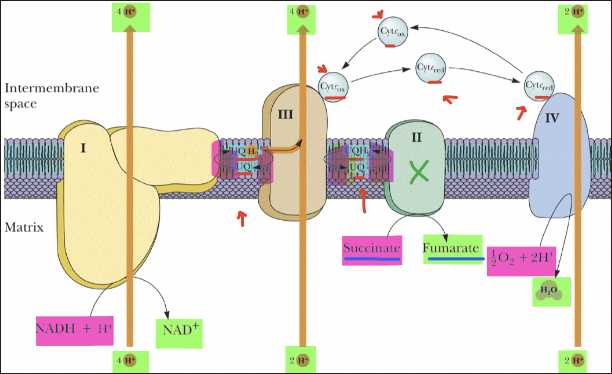
In the electron transport chain, protons and electrons are transferred BETWEEN protein complexes by…
Coenzyme Q (CoQ / UQ) and Cytochrome c (Cytc) ➡ Leading to the transport of protons across the inner mitochondrial membrane by Complexes 1, 3, and 4 to generate a proton gradient
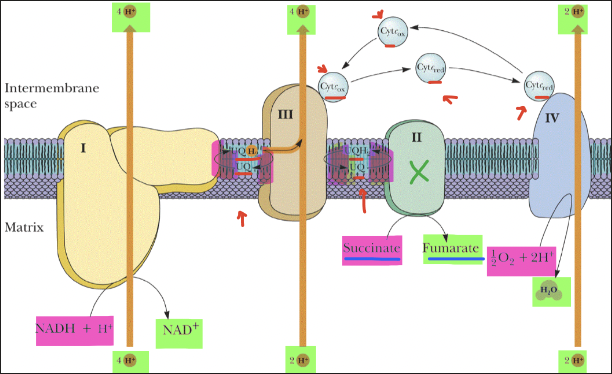
Complex 1 is also known as _ BECAUSE
Flavoprotein 1 BECAUSE ➡ It contains the coenzyme flavin mononucleotide (FMN)
Composed of multiple, different kinds of subunits (>30)
Complex 2 is also known as _ BECAUSE
Flavoprotein 2 BECAUSE ➡ It binds the coenzyme clavin adenine dinucleotide (FAD)
Composed of 4 different subunits
Both flavin mononucleotide (FMN) and flavin adenine dinucleotide (FAD) are…
Derivatives of riboflavin (vitamine B2)
Molecular Species of the Electron Transport Chain
Coenzyme Q (CoQ / UQ)
Cytochrome c (Cytc)
Flavoproteins
Iron-sulfur Proteins
Protein-bound Copper Ions
F1F0 -ATP Synthase
Mitochondrial protein complex that carries out ATP synthesis (ADP ➡ ATP)

F1F0 -ATP Synthase: F0 Unit
Forms a transmembrane channel, through which proteins move to drive ATP synthesis

F1F0 -ATP Synthase: F1 Unit
Catalyzes ATP synthesis

c, γ Function
Rotate, stimulating the alpha and beta subunits (like a motor)

a, B Function
Synthesizes ATP
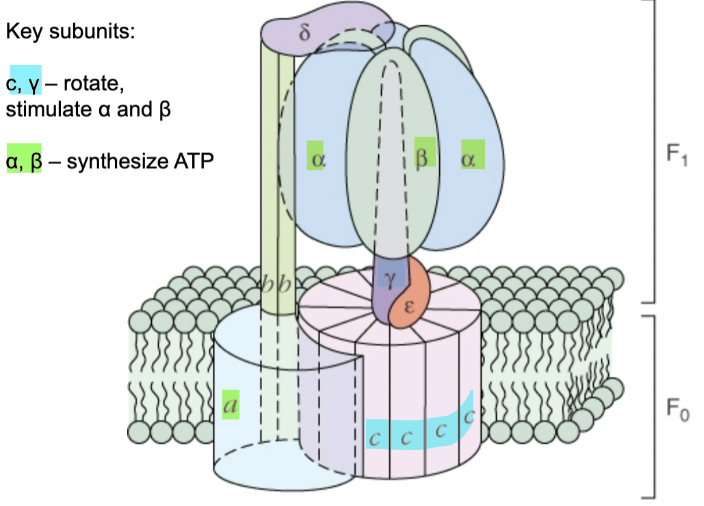
The electron transport / oxidative phosphorylation enzymes produce:
A proton gradient ➡ Results in conformational changes in ATP Synthase that lead to ATP synthesis

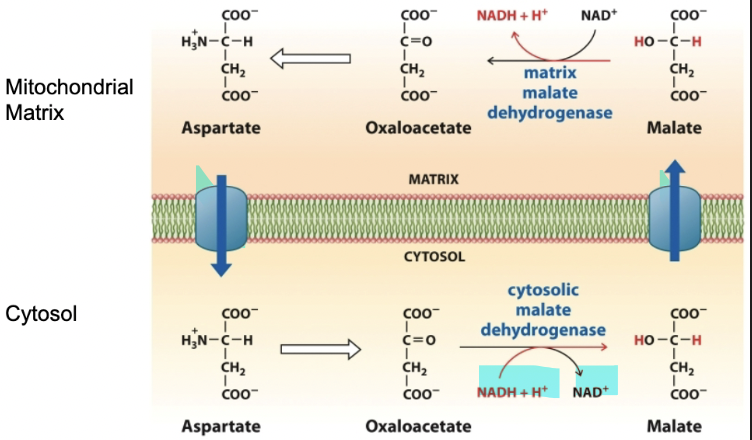
Malate-Aspartate Shuttle Function
Effectively transfers NADH from the cytosol INTO the mitochondrial matrix

Malate-Aspartate Shuttle Steps
The NADH produced by Glycolysis CANNOT pass through the inner mitochondrial membrane
Therefore, the H+ of NADH link to Oxaloacetate in the cytosol to produce Malate
Malate is readily transported into the mitochondrial matrix, after which the H+ are added back onto NAD+
This regenerates NADH, effectively transferring NADH from the cytosol into the matrix