Hematology I RBC Lecture
 Call Kai
 Learn
 Practice Test
 Spaced Repetition
 Match
 Flashcards
 Knowt Play
1/89

Earn XP
Description and Tags
CLS 536 Unit 4 - 11/2/2026
90 Terms
What do RBCs do?
Carry oxygen to tissue and carry CO2 away
What is an increase in RBCs called?
Erythrocytosis
What is a decrease in RBCs called?
Anemia
What is the hematologic term for the production of RBCs?
Erythropoiesis
What branch of the monophyletic hematopoiesis tree do RBCs come from?
Myeloid side
What is the BFU-E primarily regulated by?
IL-3 and GM-CSF
What happens to the BFU-E when exposed to EPO?
Relatively insensitive to EPO except in high concentrations due to low EPO receptors
What does the CFU-E give rise to?
8-60 Hgb containing cells within 2-5 days
What happens to the CFU-E when exposed to EPO?
Responds to lower EPO concentrations due to high level of EPO receptors
What are markers of the CFU-E?
Immediate precursor for pronornoblasts, lose CD34+ as they mature, and express erythroid characteristics of glycoprotein A and Rh antigens
What is the major cytokine for the production of RBCs?
Erythropoietin (EPO)
How long does a mature RBC live?
~120 days
Where are RBCs destroyed?
Spleen, liver and some in the bone marrow
What controls erythropoiesis?
Tissue oxygen and erythropoietin levels with functional feedback
How does tissue oxygen control erythropoiesis?
pO2 in tissues has a direct effect on oxidative metabolism of tissue cells
What is functional feedback in control of erythropoiesis?
Low tissue pO2 yields high EPO and high tissue pO2 yields low EPO
What are the kidney functions as an EPO producer?
Renal vasculature and renal O2 consumption
What are the kidney functions as an O2 sensor?
O2 affinity, Hbg concentration, blood volume, cardiopulmonary function, and atmospheric O2
What happens to hypoxia inducible factor?
Gets degraded to normal O2 levels and remains intact to promote EPO production at low O2 levels
What are some limitations on erythropoiesis?
Serum iron levels and transferrin saturation
What are the physiological causes for EPO variation/RBC changes on a CBC?
Posture, exercise, dehydration, age, sex, and attitude
What are the clinical causes for EPO variation/RBC changes on a CBC?
Anemia, cardiac or pulmonary disorder, or abnormal Hgbs
Where do the RBCs go to die and what type of destruction is this?
Macrophages in the spleen, liver, and bone marrow and it is extravascular
What type of destruction occurs when RBCs are destroyed and release Hgb directly into circulation?
Intravascular
What is erythron?
ALl the stages of development of the RBC
What is the normoblastic RBC nomenclature?
Pronormoblast
Basophilic normoblast
Polychromatic normoblast
Orthochromic normoblast
Polychromic erythrocyte
Erythrocyte
What is the rubriblastic RBC nomenclature?
Rubiblast
Prorubricyte
Rubricyte
Metarubricyte
Reticulocyte
Erythrocyte
What is the erythroblastic RBC nomenclature?
Proerythroblast
Basophillic erythroblast
Polychromatic erythroblast
Orthochromatic erythroblast
Polychromatic erythrocyte
Erythrocyte
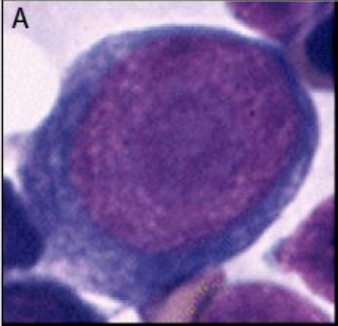
What cell is this?
Pronormoblast/rubriblast/proerythroblast

What cell is this?
Basophillic normoblast/prorubricyte/basophillic erythroblast

What cell is this?
Polychromatic normoblast/rubricyte/polychromatic erythroblast

What cell is this?
Orthochromatic normoblast/metarubricyte/orthochromatic erythroblast

What cell is this?
Polychromatic normocyte/reticulocyte/polychromatic erythrocyte
Why is the cytoplasm of immature RBCs so blue?
Abundance of RNA (as it turns to protein and Hgb increases it turns more pink)
What happens to the cell ad RBC maturations progresses?
Cell size decreases, cytoplasm ratio increases, nuclear size decreases and disappears, and cytoplasm staining changes to pinkish-red
What does the rubriblast appear like?
12-20 microns (80% nucleus), 1-2 nucleoli, and deep blue cytoplasm
How many rubriblasts appear in the bone marrow?
≤ 1%
How are RNA and Hgb related as RBC maturation occurs?
They are inversely proportional with RNA beginning in high concentrations and decreasing with Hgb acting the opposite as the cell gets more mature
What does the prorubricyte appear like?
10 - 16 microns (70% nucleus), chromatic beginning to clump, and cytoplasm is blue and basophillic
How many prorubricytes appear in the bone marrow?
1 - 4%
How many rubricytes appear in the bone marrow?
10- 20%
What does the rubricyte appear like?
12 - 15 microns (60% nucleus), chromatin is distinctly clumped, and cytoplasm is muted blue to muted orange
How many metarubricytes appear in the bone marrow?
5 - 10%
What does the metarubricyte appear like?
7-10 microns (nucleus 40-50%), chromatin is TIGHTLY clumped, and cytoplasm is orange-red
How do reticulocytes stain on a regular Wright smear?
Bluer
What is anther name for reticulocyte?
Polychromatic erythrocyte/polychromatic normocyte
What kind of special stain can be used to detect reticulocytes?
Supravital stain
When retics are increased, what do we call that on a peripheral smear?
Polychromasia
What is polychromasia?
Diffused bluish color throughout the reticulocyte due to RNA
What is anisochromasia?
Variation in Hgb content
What does the erythrocyte appear like?
7-8 microns with a biconcave disk
What is an erythroblastic island?
Central macrophage (nurse cell) where RBCs grow up
What is the RBC membrane made of?
Phospholipid bilayer (protein, lipids, and carbs)
What is the phospholipid bilayer-protein complex composition of the RBC membrane?
52% protein, 40% lipid, and 8% carbohydrate
Why is the membrane composition important to lab?
Determines the membranes antigenic properties (important for blood bank)
What receptors does the erythrocyte have?
EPO and transferrin
What is the role of RBC membrane in regulating metabolism?
Reversibly binding and inactivating many glycolytic enzymes
What are the 2 major characteristics that the RBC membrane needs?
Flexibility and strength
What is the role of membrane permeability in the RBC membrane?
Nearly impermeable to monovalent and divalent cations which is maintained at different levels than in plasma
What is RBC osmotic equilibrium maintained by?
Selective permeability of the membrane to cations and cation pumps located in the membrane (Na+/K+ pump and Ca++ pump)
How can Ca++ help in regulating Na+/K+?
An increase in intracellular Ca++ allows Na+/K+ to travel along concentration gradients
What does the Ca++/ATPase pump do and what does it require?
Maintains low levels of intracellular Ca++ but requires Mg++ to maintain function
What happens to the RBC if there is a cation pump failure?
Bulid up of NA+, loss of K+, cell will swell, and hemolysis
Why might an RBC cation pump fail?
Lack of glucose or decreased ATP
Where does the RBC get its energy?
Glycolytic pathway (Glucose → ATP
What marks and RBC for destruction?
Inability to maintain shape/flexibility
Clustering of membrane AGNs
Exposure of phospholipids on the outer layer
When we have variation in shape, what is that called on a peripheral smear?
Poikilocytosis
What is Poikilocytosis?
Variation in shape athat is associated with anemias
What conditions are associated with elliptocytosis?
Hereditary elliptocytosis and other anemias
What conditions are associated with codocytes?
Hemoglobinopathies, post-spelectemy, and liver disease/jaundice
What conditions are associated with dacryocytes?
Myelofibrosis with myeloid metaplasia, myelophthisis, pernicious anemia, and hemolytic anemia,
What conditions are associated with echinocytes?
Liver diease, uremia, PK deficiency, peptic ulcers, and cancer of the stomach
What conditions are associated with acanthocytes?
Severe liver disease, hepatorenal failure, anorexia nervosa, chronic starvation, and severe hemolytic anemia
What conditions are associated with spherocytes?
Hereditery spherocytosis, immune hemolytic anemias, and severe burns
What conditions are associated with schistocytes?
Severe burns, disseminated intravascular coagulation (DIC), thrombic thrombocytopenic purpura (TTP), and heriditary pyropoikilocytosis
What conditions are associated with keratocytes?
Severe burns, DIC, and TTP
What conditions are associated with drepanocytes?
Sickle cell anemia, Hgb SC disease, SD disease, and S-beta thalassemia
What conditions are associated with stomatocytes?
Hereditary stomatocytosis, liver disease, and acute alcoholism
What conditions are associated with Howell-Jolly Bodies?
Megaloblastic anemia, thalassemia, hemolytic anemia, hyposplenism, and post-splenectomy
What conditions are associated with basophilic stippling?
Lead poisoning, thalassemia, and refractory anemia
What are Howell-Jolly bodies composed of?
Remnant DNA
What is basophilic stippling composed of?
RNA
What conditions are associated with Pappenheimer bodies?
Hemolytic anemia, sideroblastic anemia, hyposplenism and post-splenectomy,
What are Pappenheimer bodies composed of?
Iron

What are these inclusions indicative of?
Malaria (Plasmodium falciparum)

What are these inclusions?
Hgb C crystals

What are these inclusions?
Hgb S crystals
What conditions are associated with Rouleaux?
Multiple myeloma
What is the difference between intravascular and extravascular hemolysis?
Inside the vascular system is intravascular and outside the tissue/spleen is extravascular

What is the cell in the center and why is this occuring?
A nurse cell (macrophage) for an erythroblastic island)