Chapter 4 - Muscular system

0.0(0)
Studied by 4 people
call kaiCall Kai
learnLearn
examPractice Test
spaced repetitionSpaced Repetition
heart puzzleMatch
flashcardsFlashcards
GameKnowt Play
Card Sorting

1/28

encourage image

There's no tags or description

Looks like no tags are added yet.

29 Terms

1
New cards

Origin

  • End of muscle

  • Attached to least movable structure


<ul><li><p>End of muscle</p></li><li><p>Attached to least movable structure </p></li></ul><p></p>
2
New cards

Insertion

  • Other end of muscle

  • Attached to movable structure

  • Insertion moves towards origin


<ul><li><p>Other end of muscle</p></li><li><p>Attached to movable structure</p></li><li><p><span style="color: rgb(255, 0, 0);"><strong>Insertion moves towards origin</strong></span></p></li></ul><p></p>
3
New cards

6 muscular groups

  • Cervical muscle

  • Muscle of mastication

  • Muscle of facial expression

  • Muscle of the tongue

  • Muscle of the soft palate

  • Hyoid muscles


Crashing My Finals, This Semester’s Hell

4
New cards
<p><span style="color: rgb(255, 0, 0);"><strong>Cervical muscles</strong></span></p>

Cervical muscles

Sternocleidomastoid (SCM) muscle

  • Large, thick, superficial

  • Origin

    • Clavicle and sternum

  • Insertion

    • Mastoid process of temporal bone

  • Action

    • Tilting head when both right and left side contract
      Rotating head when one side contracts

Trapezius muscle

  • Broad, flat, triangular muscle

  • Origin

    • Occipital bone

  • Insertion

    • Clavicle and scapula

  • Action

    • Shrug shoulders (lift clavicle and scapula up)


Both

  • Paired muscles (left and right)


<p><span style="color: rgb(0, 24, 255);"><strong>Sternocleidomastoid (SCM) muscle</strong></span></p><ul><li><p>Large, thick, superficial</p></li><li><p><strong>Origin</strong></p><ul><li><p>Clavicle and sternum</p></li></ul></li><li><p><strong>Insertion</strong></p><ul><li><p>Mastoid process of temporal bone</p></li></ul></li><li><p><strong>Action</strong></p><ul><li><p><span>Tilting head when both right and left side contract</span><br><span>Rotating head when one side contracts</span></p></li></ul></li></ul><p><span style="color: rgb(0, 9, 255);"><strong>Trapezius muscle</strong></span></p><ul><li><p>Broad, flat, triangular muscle</p></li><li><p><strong>Origin</strong></p><ul><li><p>Occipital bone</p></li></ul></li><li><p><strong>Insertion</strong></p><ul><li><p>Clavicle and scapula</p></li></ul></li><li><p><strong>Action</strong></p><ul><li><p>Shrug shoulders (lift clavicle and scapula up)</p></li></ul></li></ul><p></p><p><strong>Both</strong></p><ul><li><p>Paired muscles (left and right)</p></li></ul><p></p>
5
New cards
<p><span style="color: rgb(255, 0, 0);"><strong>Muscle of mastication</strong></span><br><br>“eat time”</p>

Muscle of mastication

“eat time”

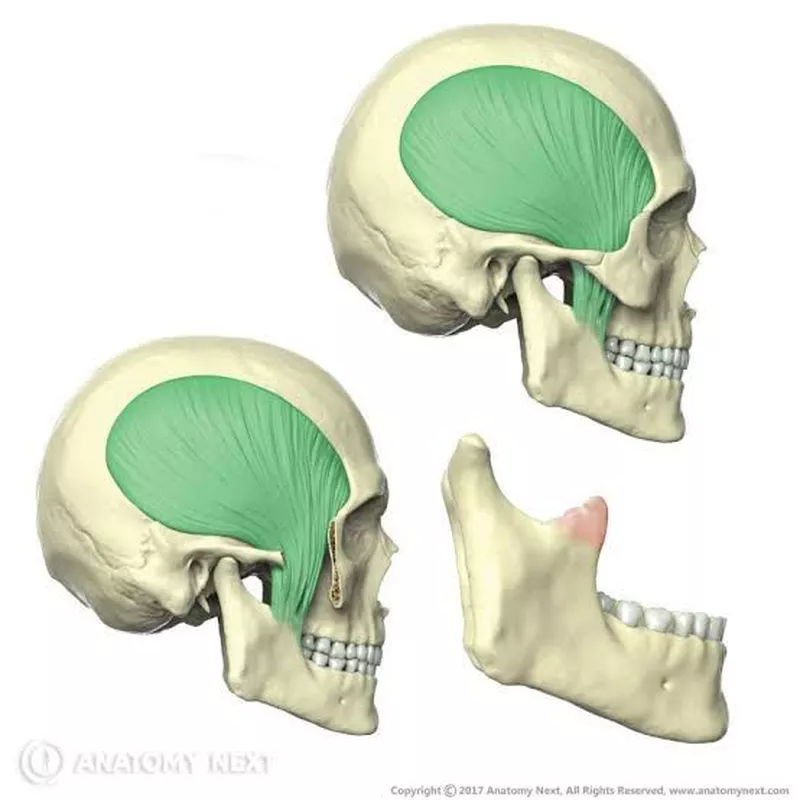
  • 4 paired muscles

    • TIME

    • Temporalis muscle

    • Internal (medial) pterygoid muscle

    • Masseter muscle

    • External (lateral) pterygoid muscle

→ All innervated by 3rd division of CNV (Trigeminal nerve)

  • Work with TMJ to move

  • Elevate ↑ , protrude →, retrude ← and move mandible laterally

  • Nerve supply: 3rd division of CN V (trigeminal nerve)

6
New cards
<p><strong>Muscle of mastication: </strong><span style="color: rgb(255, 0, 0);"><strong>Temporalis </strong></span></p>

Muscle of mastication: Temporalis

  • Broad fan shaped muscle


Origin

  • Temporal fossa


Insertion

  • Coronoid process and anterior ramus of mandible


Action

  • WHOLE muscle contracts — Raises (elevates) mandible

  • POSTERIOR fibers contract — Retrusion (backward motion) of mandible


<ul><li><p>Broad fan shaped muscle</p></li></ul><p></p><p><strong>Origin</strong></p><ul><li><p>Temporal fossa</p></li></ul><p></p><p><strong>Insertion</strong></p><ul><li><p>Coronoid process and anterior ramus of mandible</p></li></ul><p></p><p><strong>Action</strong></p><ul><li><p>WHOLE muscle contracts — Raises (elevates) mandible</p></li><li><p>POSTERIOR fibers contract — Retrusion (backward motion) of mandible</p></li></ul><p></p>
7
New cards

Muscle of mastication: Internal (medial) pterygoid

  • Superficial and deep heads located at different depths


Deep head

  • Origin

    • Lateral pterygoid plate of sphenoid bone

  • Insertion

    • Ramus and angle of the mandible


Superficial head

Origin

  • Palatine bone and maxillary tuberosity

Insertion

  • Ramus and angle of the mandible

Action

  • Elevates mandible (weaker than masseter)

  • Not as strong as masseter muscle


Both deep and superficial insertion = same

<ul><li><p>Superficial and deep heads located at different depths</p></li></ul><p></p><p><strong>Deep head</strong></p><ul><li><p><strong>Origin</strong></p><ul><li><p>Lateral pterygoid plate of sphenoid bone</p></li></ul></li><li><p><strong>Insertion</strong></p><ul><li><p>Ramus and angle of the mandible</p></li></ul></li></ul><p></p><p><strong>Superficial head</strong></p><p><strong>Origin</strong></p><ul><li><p>Palatine bone and maxillary tuberosity</p></li></ul><p><strong>Insertion</strong></p><ul><li><p>Ramus and angle of the mandible</p></li></ul><p><strong>Action</strong></p><ul><li><p>Elevates mandible (weaker than masseter)</p></li><li><p>Not as strong as masseter muscle</p></li></ul><p></p><p>Both deep and superficial insertion = same </p>
8
New cards
<p><strong>Muscle of mastication: </strong><span style="color: rgb(255, 0, 0);"><strong>Masseter muscle</strong></span></p>

Muscle of mastication: Masseter muscle

  • Most superficial

  • Strongest muscle

  • 2 heads at different depths

    • Superficial

    • Deep

Origin

  • Zygomatic arch and zygoma

Insertion

  • Lateral surface of angle of mandible

Action

  • Raise (elevates) mandible

  • Clench teeth, feel muscle through cheek


<ul><li><p>Most superficial</p></li><li><p>Strongest muscle</p></li><li><p>2 heads at different depths</p><ul><li><p>Superficial</p></li><li><p>Deep</p></li></ul></li></ul><p><strong>Origin</strong></p><ul><li><p>Zygomatic arch and zygoma</p></li></ul><p><strong>Insertion</strong></p><ul><li><p>Lateral surface of angle of mandible</p></li></ul><p><strong>Action</strong></p><ul><li><p>Raise (elevates) mandible </p></li><li><p>Clench teeth, feel muscle through cheek</p></li></ul><p></p>
9
New cards
<p><span style="color: rgb(0, 0, 0);"><strong>Muscle of mastication: </strong></span><span style="color: rgb(255, 0, 0);"><strong>External (Lateral) pterygoid muscle</strong></span></p>

Muscle of mastication: External (Lateral) pterygoid muscle

  • Short, thick muscle

  • Has superior and inferior head


Superior head

Origin

  • Greater wing of sphenoid bone

Insertion

  • TMJ disc and capsule


Inferior head

Origin

  • Lateral pterygoid plate of sphenoid bone

Insertion

  • Mandible condyle inner surface of mandible


Action

  • Depressing and protruding mandible when both sides (R/L) contracts

    • Protrude = both sides contract

    • Right muscle contracts → jaw moves left

    • Left muscle contracts → Jaw moves right

  • Lateral movement only when 1 side contracts (On the side that’s contracting)


Only muscle of mastication that depresses the mandible aka OPENS THE JAW

Temporalis, masseter, medial pterygoid = elevates

<ul><li><p>Short, thick muscle</p></li><li><p>Has superior and inferior head</p></li></ul><p></p><p><span style="color: rgb(245, 0, 0);"><strong>Superior head</strong></span></p><p><strong>Origin</strong></p><ul><li><p>Greater wing of sphenoid bone</p></li></ul><p><strong>Insertion</strong></p><ul><li><p>TMJ disc and capsule</p></li></ul><p></p><p><span style="color: rgb(255, 0, 0);"><strong>Inferior head</strong></span></p><p><strong>Origin</strong></p><ul><li><p>Lateral pterygoid plate of sphenoid bone</p></li></ul><p><strong>Insertion</strong></p><ul><li><p>Mandible condyle inner surface of mandible</p></li></ul><div data-type="horizontalRule"><hr></div><p><strong>Action</strong></p><ul><li><p>Depressing and protruding mandible when both sides (R/L) contracts</p><ul><li><p>Protrude = both sides contract</p></li><li><p>Right muscle contracts → jaw moves left</p></li><li><p>Left muscle contracts → Jaw moves right</p></li></ul></li><li><p>Lateral movement only when 1 side contracts (On the side that’s contracting)</p></li></ul><p></p><p>Only muscle of mastication that <strong><u>depresses </u></strong>the mandible aka OPENS THE JAW</p><p>Temporalis, masseter, medial pterygoid = elevates</p>
10
New cards

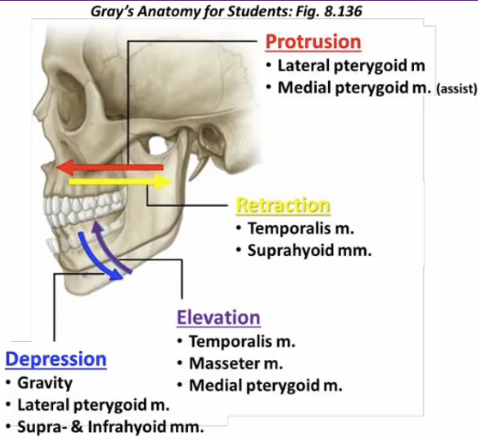
Muscle of mastication actions

Protrusion

  • Forward

  • Lateral pterygoid muscle

  • Medial pterygoid muscle (assist)

Retraction

  • Temporalis muscle

  • Suprahyoid muscle

Elevation

  • Temporalis muscle

  • Masseter muscle

  • Medial pterygoid muscle

Depression

  • Gravity

  • Lateral pterygoid muscle

  • Supra— & Infrahyoid muscle


<p><span style="color: rgb(255, 0, 0);"><strong>Protrusion</strong></span></p><ul><li><p>Forward </p></li><li><p>Lateral pterygoid muscle </p></li><li><p>Medial pterygoid muscle (assist) </p></li></ul><p><span style="color: rgb(200, 177, 0);"><strong>Retraction</strong></span></p><ul><li><p>Temporalis muscle</p></li><li><p>Suprahyoid muscle</p></li></ul><p><span style="color: rgb(105, 0, 255);"><strong>Elevation</strong></span></p><ul><li><p>Temporalis muscle</p></li><li><p>Masseter muscle </p></li><li><p>Medial pterygoid muscle </p></li></ul><p><span style="color: rgb(0, 123, 255);"><strong>Depression</strong></span><strong> </strong></p><ul><li><p>Gravity</p></li><li><p>Lateral pterygoid muscle</p></li><li><p>Supra— &amp; Infrahyoid muscle </p></li></ul><p></p>
11
New cards
<p><strong>Muscle of </strong><span style="color: rgb(255, 0, 0);"><strong>facial expression</strong></span><span style="color: rgb(0, 0, 0);"><strong> </strong></span><span style="color: rgb(255, 0, 0);"><strong>(Disgust)</strong></span></p>

Muscle of facial expression (Disgust)

Levator labii superioris alaque nasi muscle

Origin

  • Frontal process of the maxilla


Insertion

  • (1) Ala of the nose

  • (2) Upper lip


Action

  • Elevates upper lip and flares nostrils

  • Seen in sneering or disgust


<p><strong>Levator labii superioris alaque nasi muscle</strong></p><p><strong>Origin</strong></p><ul><li><p>Frontal process of the maxilla</p></li></ul><p></p><p><strong>Insertion</strong></p><ul><li><p>(1) Ala of the nose</p></li><li><p>(2) Upper lip</p></li></ul><p></p><p><strong>Action</strong></p><ul><li><p>Elevates upper lip and flares nostrils</p></li><li><p>Seen in sneering or disgust</p></li></ul><p></p>
12
New cards
<p><strong>Muscle of </strong><span style="color: rgb(255, 0, 0);"><strong>facial expression (Smile) </strong></span></p>

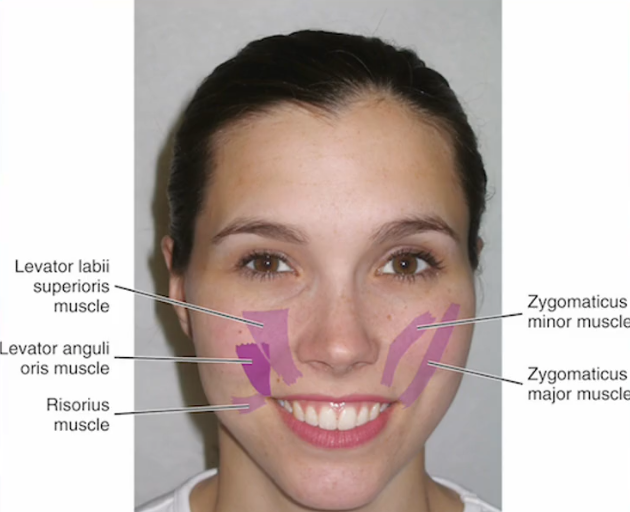
Muscle of facial expression (Smile)

  • Levator labii superioris muscle

  • Zygomaticus minor muscle

    • Origin: Zygomatic bone

    • Insertion & action: Same


Origin

  • Frontal process of maxilla

Insertion

  • Skin of upper lip

Action

  • Elevates upper lip

  • Seen in smiling


  • Zygomaticus major muscle

Origin

  • Zygomatic bone

Insertion

  • Skin at labial commissure and orbicularis oris

Action

  • Elevates labial commissure of the upper lip and pulls laterally


  • Levator anguli oris muscle

Origin

  • Canine fossa

Insertion

  • Skin at angle of mouth (labial commissures)

Action

  • Elevates labial commissure


  • Risorius muscle

Thin, fibrous tissue enclosing a muscle

Origin

  • Fascia overlying masseter muscle

Insertion

  • Angle of mouth

Action

  • Moves angle of mouth laterally

5 muscles for smiling

  • Levator labii superioris

  • Zygomaticus minor

  • Zygomaticus major

  • Levator anguli oris

  • Risorius


<ul><li><p><span style="color: rgb(255, 0, 0);"><strong>Levator labii superioris muscle</strong></span></p></li><li><p><span style="color: rgb(255, 0, 0);"><strong>Zygomaticus minor muscle</strong></span></p><ul><li><p><strong>Origin: </strong>Zygomatic bone</p></li><li><p><strong>Insertion &amp; action: Same</strong></p></li></ul></li></ul><p></p><p><strong>Origin</strong></p><ul><li><p>Frontal process of maxilla</p></li></ul><p><strong>Insertion</strong></p><ul><li><p>Skin of upper lip</p></li></ul><p><strong>Action</strong></p><ul><li><p>Elevates upper lip</p></li><li><p>Seen in smiling</p></li></ul><p></p><ul><li><p><span style="color: rgb(255, 0, 0);"><strong>Zygomaticus major muscle</strong></span></p></li></ul><p><strong>Origin</strong></p><ul><li><p>Zygomatic bone</p></li></ul><p><strong>Insertion</strong></p><ul><li><p>Skin at labial commissure and orbicularis oris</p></li></ul><p><strong>Action</strong></p><ul><li><p>Elevates labial commissure of the upper lip and pulls laterally</p></li></ul><p></p><ul><li><p><span style="color: rgb(255, 0, 0);"><strong>Levator anguli oris muscle</strong></span></p></li></ul><p><strong>Origin</strong></p><ul><li><p>Canine fossa</p></li></ul><p><strong>Insertion</strong></p><ul><li><p>Skin at angle of mouth (labial commissures)</p></li></ul><p><strong>Action</strong></p><ul><li><p>Elevates labial commissure</p></li></ul><p></p><ul><li><p><span style="color: rgb(255, 0, 0);"><strong>Risorius muscle</strong></span></p></li></ul><p>Thin, fibrous tissue enclosing a muscle</p><p><strong>Origin</strong></p><ul><li><p>Fascia overlying masseter muscle</p></li></ul><p><strong>Insertion</strong></p><ul><li><p>Angle of mouth</p></li></ul><p><strong>Action</strong></p><ul><li><p>Moves angle of mouth laterally</p></li></ul><p><span style="color: rgb(0, 24, 255);"><strong>5 muscles for smiling</strong></span></p><ul><li><p>Levator labii superioris</p></li><li><p>Zygomaticus minor</p></li><li><p>Zygomaticus major</p></li><li><p>Levator anguli oris</p></li><li><p>Risorius</p></li></ul><p></p>
13
New cards
<p><strong>Muscle of </strong><span style="color: rgb(255, 0, 0);"><strong>facial expression: </strong></span><span style="color: rgb(0, 0, 0);"><strong>Buccinator muscle</strong></span></p>

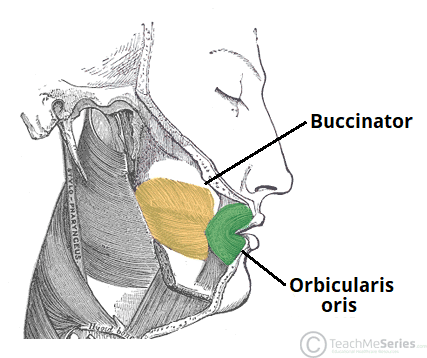
Muscle of facial expression: Buccinator muscle

Origin

  • Pterygomandibular raphe (tendinous tissue)

    • Tissue located to most distal molar of mandibular

Insertion

  • Skin at the labial commissure

Action

  • Pulls angle of mouth laterally and posteriorly

    • Aids in mastication to keep food between cheek and teeth

    • Helps forcibly expel air or create sucking action


“Trumpet muscle”

<p><strong>Origin</strong></p><ul><li><p>Pterygomandibular raphe (tendinous tissue)</p><ul><li><p>Tissue located to most distal molar of mandibular</p></li></ul></li></ul><p><strong>Insertion</strong></p><ul><li><p>Skin at the labial commissure</p></li></ul><p><strong>Action</strong></p><ul><li><p>Pulls angle of mouth laterally and posteriorly</p><ul><li><p>Aids in mastication to keep food between cheek and teeth</p></li><li><p>Helps forcibly expel air or create sucking action</p></li></ul></li></ul><p></p><p>“Trumpet muscle” </p>
14
New cards

Muscle of facial expression: Platysma muscle

Origin

  • Skin superficial to the clavicle and shoulder

Insertion

  • Inferior border of the mandible

Action

  • Raises skin of neck and pulls labial commissure down


<p><strong>Origin</strong></p><ul><li><p>Skin superficial to the clavicle and shoulder</p></li></ul><p><strong>Insertion</strong></p><ul><li><p>Inferior border of the mandible </p></li></ul><p><strong>Action</strong></p><ul><li><p>Raises skin of neck and pulls labial commissure down </p></li></ul><p></p>
15
New cards

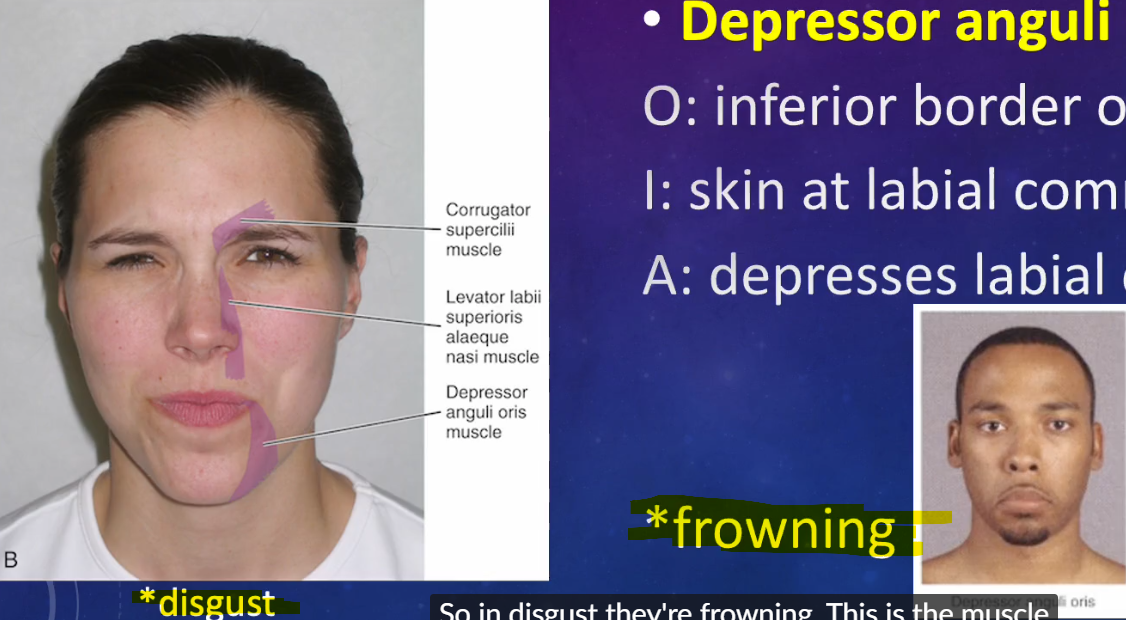
Muscle of facial expression: Depressor anguli oris muscle

  • Frowning / disgust

Origin

  • Inferior border of the mandibular

Insertion

  • Skin at labial commissure

Action

  • Depresses labial commissure (pulls lips down)

<ul><li><p>Frowning / disgust </p></li></ul><p><strong>Origin</strong></p><ul><li><p>Inferior border of the mandibular </p></li></ul><p><strong>Insertion</strong></p><ul><li><p>Skin at labial commissure </p></li></ul><p><strong>Action</strong></p><ul><li><p>Depresses labial commissure (pulls lips down) </p></li></ul><p></p>
16
New cards

Muscle of facial expression: Depressor labii inferioris muscle

  • Irony

Origin

  • Inferior border of mandible

Insertion

  • Skin of lower lip

Action

  • Depresses lower lip to expose mandibular incisor teeth


<ul><li><p>Irony </p></li></ul><p><strong>Origin</strong></p><ul><li><p>Inferior border of mandible </p></li></ul><p><strong>Insertion</strong></p><ul><li><p>Skin of lower lip</p></li></ul><p><strong>Action</strong></p><ul><li><p>Depresses lower lip to expose mandibular incisor teeth </p></li></ul><p></p>
17
New cards
<p><strong>Muscle of </strong><span style="color: rgb(255, 0, 0);"><strong>facial expression: </strong></span><span style="color: rgb(0, 0, 0);"><strong>Orbicularis <u>o</u>ris muscle</strong></span></p>

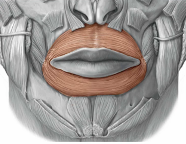
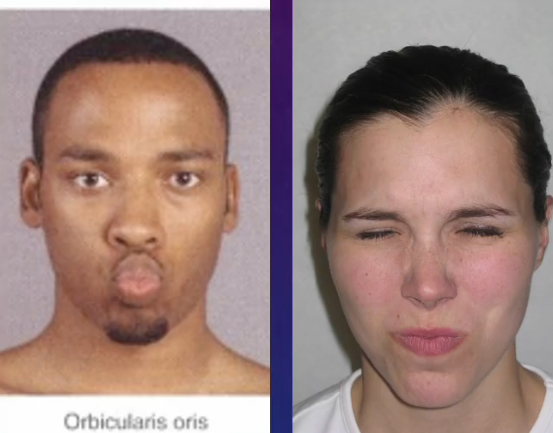
Muscle of facial expression: Orbicularis oris muscle

Origin

  • Encircles mouth (no bony attachment)

Insertion

  • Skin of lips at labial commissures and philtrum

Action

  • Close lips

    • Rolling inward between teeth (grimacing)

    • Thrusting lips outwards (pouting/ kissing)

  • Pursing lips


  • NO bony attachment


<p><strong>Origin</strong></p><ul><li><p>Encircles mouth (no bony attachment) </p></li></ul><p><strong>Insertion</strong></p><ul><li><p>Skin of lips at labial commissures and philtrum </p></li></ul><p><strong>Action</strong></p><ul><li><p>Close lips </p><ul><li><p>Rolling inward between teeth (grimacing)</p></li><li><p>Thrusting lips outwards (pouting/ kissing)</p></li></ul></li><li><p>Pursing lips </p></li></ul><p></p><ul><li><p>NO bony attachment </p></li></ul><p></p>
18
New cards

Muscle of facial expression: Mentalis muscle

Origin

  • Mandible near midline

Insertion

  • Skin of chin

Action

  • Raises chin


<p><strong>Origin</strong></p><ul><li><p>Mandible near midline </p></li></ul><p><strong>Insertion</strong></p><ul><li><p>Skin of chin</p></li></ul><p><strong>Action</strong></p><ul><li><p>Raises chin </p></li></ul><p></p>
19
New cards

Muscle of the tongue

Complex movements (actions)

  • Mastication

  • Swallowing

  • Speaking


Grouped according to location

  • Intrinsic

    • Muscles inside tongue

    • Not attached to bone

  • Extrinsic

    • Muscles outside tongue

      • Insertion inside tongue

      • Origin outside tongue


<p><strong>Complex movements (actions) </strong></p><ul><li><p>Mastication</p></li><li><p>Swallowing</p></li><li><p>Speaking</p></li></ul><p></p><p><strong>Grouped according to location</strong></p><ul><li><p><strong>Intrinsic</strong></p><ul><li><p>Muscles inside tongue</p></li><li><p>Not attached to bone</p></li></ul></li><li><p><strong>Extrinsic</strong></p><ul><li><p>Muscles outside tongue</p><ul><li><p>Insertion inside tongue</p></li><li><p>Origin outside tongue</p></li></ul></li></ul></li></ul><p></p>
20
New cards

Muscle of the tongue: Intrinsic

  • Longitudinal muscle — superior and inferior

  • Transverse muscle

  • Verticle muscle


Inside tongue, no bony connection

<ul><li><p>Longitudinal muscle — superior and inferior</p></li><li><p>Transverse muscle</p></li><li><p>Verticle muscle </p></li></ul><p></p><p>Inside tongue, no bony connection </p>
21
New cards

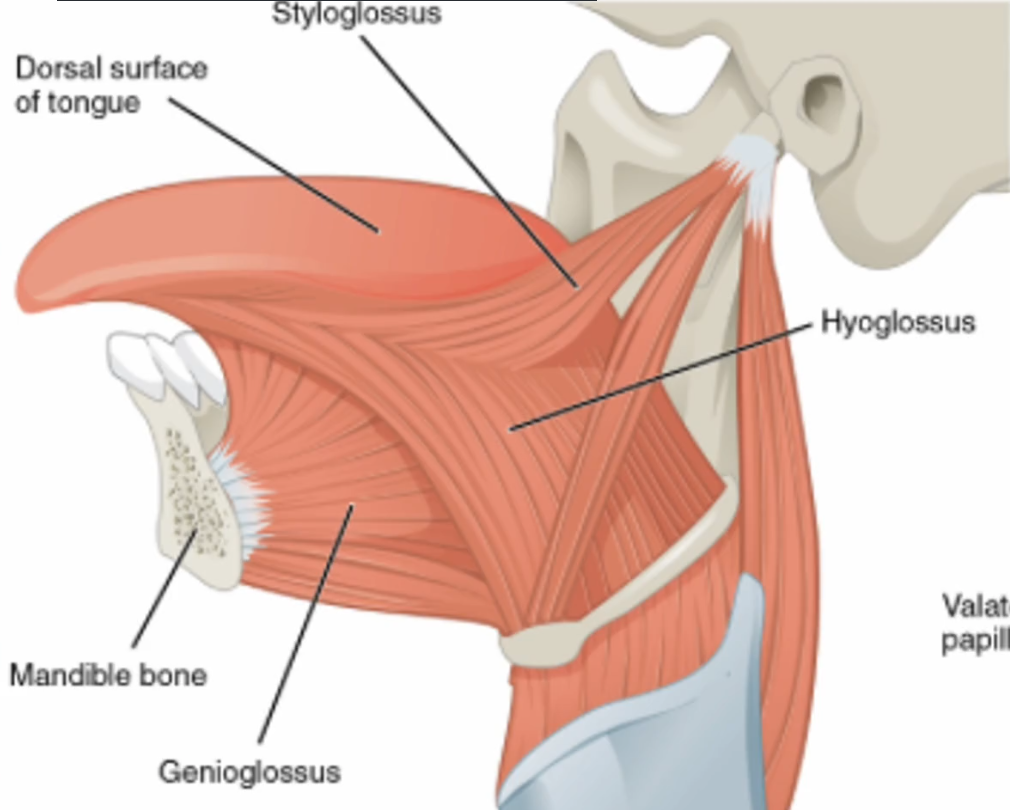
Muscle of the tongue: Extrinsic — SGH (sigh)

  • Styloglossus muscle

    • attached to styloid process

  • Genioglossus muscle

    • Attached to genio tubercles in mandible

  • Hyoglossus muscle

    • Attached to hyoid bone


Origin outside, insertion inside

<ul><li><p><strong>Styloglossus muscle</strong></p><ul><li><p>attached to styloid process</p></li></ul></li><li><p><strong>Genioglossus muscle</strong></p><ul><li><p>Attached to genio tubercles in mandible</p></li></ul></li><li><p><strong>Hyoglossus muscle</strong></p><ul><li><p>Attached to hyoid bone</p></li></ul></li></ul><p></p><p>Origin outside, insertion inside</p><p></p>
22
New cards

Muscle of the soft palate (PP—LTM)

Involved in speaking and swallowing

  • Palatoglossus muscle

  • Palatopharyngeus muscle

  • Levator veli palatini muscle

  • Tensor veli palatini muscle

  • Muscle of the uvula


Just know they belong to soft palate
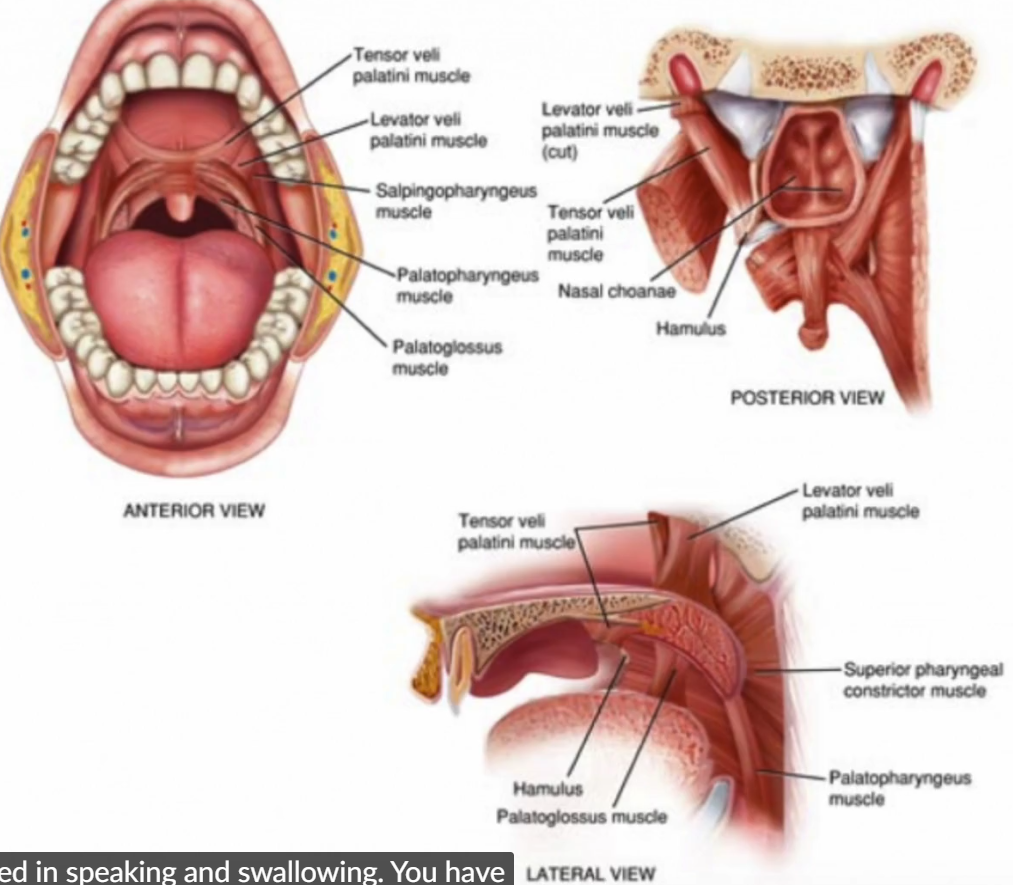
<p>Involved in speaking and swallowing</p><ul><li><p>Palatoglossus muscle</p></li><li><p>Palatopharyngeus muscle</p></li><li><p>Levator veli palatini muscle</p></li><li><p>Tensor veli palatini muscle</p></li><li><p>Muscle of the uvula</p></li></ul><p></p><p>Just know they belong to soft palate</p>
23
New cards
<p><span style="color: rgb(255, 0, 0);"><strong>Hyoid </strong></span><strong>muscles </strong></p>

Hyoid muscles

Suprahyoid muscle

(Grand Master Diamond Support)

  • Above hyoid bone

  • Geniohyoid

  • Myloyhoid

  • Digastric

  • Stylohyoid

  • Digastric + mylohyoid

    • Elevates hyoid bone, depress mandible

  • Mylohyoid

    • Forms floor of the mouth

Infrahyoid muscle

(TOSS)

  • Below hyoid bone

  • Thyrohyoid muscle

  • Omohyoid muscle

  • Sternothyroid muscle

  • Sternohyoid muscle


Just know which belongs to supra/infra

<p><span style="color: rgb(255, 0, 0);"><strong>Suprahyoid muscle</strong></span></p><p><span style="color: rgb(255, 0, 0);"><strong><u>(G</u>rand <u>M</u>aster <u>D</u>iamond <u>S</u>upport) </strong></span></p><ul><li><p>Above hyoid bone</p></li><li><p>Geniohyoid</p></li><li><p>Myloyhoid</p></li><li><p>Digastric </p></li></ul><ul><li><p>Stylohyoid</p></li></ul><ul><li><p><strong>Digastric + mylohyoid</strong></p><ul><li><p>Elevates hyoid bone, depress mandible</p></li></ul></li><li><p><strong>Mylohyoid</strong></p><ul><li><p>Forms floor of the mouth</p></li></ul></li></ul><p><span style="color: rgb(255, 0, 0);"><strong>Infrahyoid muscle</strong></span></p><p><span style="color: rgb(255, 0, 0);"><strong>(TOSS)</strong></span></p><ul><li><p>Below hyoid bone</p></li><li><p>Thyrohyoid muscle</p></li></ul><ul><li><p>Omohyoid muscle</p></li><li><p>Sternothyroid muscle</p></li></ul><ul><li><p>Sternohyoid muscle</p></li></ul><p></p><p>Just know which belongs to supra/infra</p>
24
New cards

Muscle of facial expression (oral region) summary

Muscle

Origin

Insertion

Action

Levator labii superioris alaque nasi muscle

Frontal process of maxilla

Ala of nose
Upper lip

elevates upper lip and flares nostrils (sneer)
disgust

Levator labii superioris muscle

frontal process of maxilla

skin of the upper lip

elevates upper lip
smiling

Zygomaticus minor muscle

zygomatic bone

skin of the upper lip

elevates upper lip
smiling

Zygomaticus major muscle

zygomatic bone

skin at labial commissure and orbicularis oris

elevates labial commissure of the upper lip and pulls laterally
smiling

Levator anguli oris muscle

canine fossa

skin at angle of mouth

elevates labial commissure
smiling

Risorius muscle
Thin, fibrous tissue enclosing a muscle

fascia overlying masseter muscle

angle of mouth

moves angle of mouth laterally
smiling

Buccinator muscle

pterygomandibular raphe (tendinous tissue)

skin at the labial commissure

Pulls angle of mouth back laterally and posteriorly
Aids in mastication to keep food between cheek and teeth
Helps forcibly expel air or create sucking action.
“Trumpet Muscle”

Platysma muscle

skin superficial to the clavicle and shoulder

inferior border of the mandible

raises skin of the neck and pulls labial commissure down

Depressor anguli oris muscle

inferior border of the md

skin at labial commissure

depresses labial commissure
Frowning or disgust

Depressor labii inferioris muscle

inferior border of md

skin of lower lip

depresses lower lip to expose mandibular incisor teeth
irony

Orbicularis oris muscle

encircles mouth (no bony attachment)

skin of lips at labial commissures and philtrum

Closing lips
Rolling inward between teeth (grimacing)
Thrust lips outward (pouting, kissing)
Pursing lips

Mentalis muscle

mandible near midline

skin of chin

raises chin


25
New cards

Cervical muscles summary

Muscle

Origin

Insertion

Action

Sternocleidomastoid muscle

Clavicle and sternum

Mastoid process of the temporal bone

Tilting head when both right and left side contract
Rotating head when one side contracts

Trapezius muscle

Occipital bone

Clavicle and scapula

Shrug shoulders (lift clavicle and scapula


26
New cards

Muscles of mastication summary

Muscle

Origin

Insertion

Action

Masseter muscle
-most superficial
-strongest
-superficial and deep head

zygomatic arch and zygoma

lateral surface of the angle of the mandible

Raises (elevates) mandible
Clench teeth, you can feel muscle through cheek.

Temporalis muscle
-Broad fan shaped muscle

Temporal fossa

Coronoid process and anterior ramus of mandible

WHOLE muscle contracts - Raises (elevates) mandible
POSTERIOR fibers contracts – Retrusion (backward motion)

Lateral pterygoid muscle
-Short, thick muscle
-superior and inferior head

Superior head - Greater wing of sphenoid
Inferior head - Lateral pterygoid plate of sphenoid bone

Superior head - TMJ disc and capsule
Inferior head - Mand. Condyle inner surface

Depressing and protruding mandible when both R/L sides contracts
Lateral movement - when only one side contracts
*Only one MoM that depresses mandible

Medial pterygoid muscle
-superficial and deep head

Deep head - lateral pterygoid plate of sphenoid bone
Superficial head - Palatine bone and maxillary tuberosity

ramus and angle of md

Elevates mandible (weaker than masseter)


27
New cards

Muscles of the hyoid summary

Muscle Group

Muscles

Action

Suprahyoid muscles

Digastric muscle
Mylohyoid muscle
Stylohyoid muscle
Geniohyoid muscle
Digastric and mylohyoid – elevate hyoid bone, depress mandible
Mylohyoid – forms floor of the mouth

Assist in mastication and swallowing

Infrahyoid muscles

Sternothyroid muscle
Sternohyoid muscle
Omohyoid muscle
Thyrohyoid muscle

Assist in mastication and swallowing


28
New cards

Muscles of the tongue summary

Muscle Group

Muscles

Action

Intrinsic muscles
inside the tongue, not attached to bone

Longitudinal muscle – Superior and inferior
Transverse muscle
Vertical muscle

Mastication
Speaking
Swallowing

Extrinsic muscles
origin is outside the tongue but insertion is inside the tongue

Styloglossus muscle
Genioglossus muscle
Hyoglossus muscle

Mastication
Speaking
Swallowing


29
New cards

Muscles of the soft palate summary

Muscles

Action

Palatoglossus muscle
Palatopharyngeus muscle
Levator veli palatini muscle
Tensor veli palatini muscle
Muscle of the uvula

Speaking and swallowing