Rabbit Medicine and Surgery
 Call Kai
 Learn
 Practice Test
 Spaced Repetition
 Match
 Flashcards
 Knowt Play
1/100

There's no tags or description
Looks like no tags are added yet.
101 Terms
How many healthy rabbits die under anesthesia?
1 in 72
How many sick rabbits die under anesthesia?
1 in 14
What percentages of anesthestic deaths in rabbits occur in induction?
6%
What percentages of anesthestic deaths in rabbits occur in maintenance?
30%
What percentages of anesthestic deaths in rabbits occur in recovery?
64%
What are some things that cause rabbits to have a difficult reputation with surgery?
Lack of familiarity (different anatomy)
Proportionally small thoracic cavity
Diaphragmatic breathers
Large gastrointestinal tract (15% body weight)
Light skeletral frame
Large muscle mass
Dense fur coat
How can underlying disease give rabbits a difficult reputation?
Prey species
Asymptomatic Disease
Comorbidities common
Stabilize BEFORE anesthesia, thorough clinical exam, weight and BCS, pre-anaesthetic bloods
How can veterinary inexperience give rabbits a difficult reputation?
Inappropriate drug usage - too high dose and too rapid an induction
Unable to intubate
Panic
Lack of understanding of what you can do to recover a situation
How can drug doses give rabbits a difficult reputation?
published doses of injectable agents for deep surgical anesthesia where no volatile agent is used
If high drug doses of multiple drugs = heighted adverse effects
How can you advise the owner to allow calm preparation when getting to the practice?
Stress free as possible
Transport in secure enclosure with towel and hay
Towel covering open wire ends
Companion for moral support
Provide familiar scents
What are some food pre-anesthetic considerations in rabbits?
No fasting required - they cannot vomit, owners may provide food and water up to, and including, the journey to the practice (remove pellets 30 minutes prior to induction)
Ask the owner for a packed lunch
What are some hospitalization pre-anesthetic considerations in rabbits?
Separate waiting area for prey and predator species
Minimize handling and interventions
House at floor level and include absorbent base with comforting layer, hides, a litter tray, hay, pellets, mixed greens and water
What should your standardized preanesthetic routine include?
physical examination - TPR
Clip fur and EMLA skin over R and L side - marginal ear and lateral saphenous veins
Place marginal ear vein IV catheter
Blood work - biochem and hematology
preliminary fur clip
oral medications - gut stimulant and analgesia (ranitidine and meloxicam)
What shows a good catheter placement?
soft padding in ear and around catheter

What qualities does a good premedication have?
Relax and sedate the patient
Provide analgesia
Anti-anxiolytic effect
Allows for a lower dose of induction agent to be used
What should you do when administering a premedication?
Note the time administered
Ensure the environment is quiet to prevent stimulation
Monitor the rabbit while it takes effect
What side effects can occur with premedications?
respiratory depression, cardiac suppression and hypothermia
What are your standard premedications for a spay/castration?
Ketamine 5 mg/kg IM
Dexmedetomidine 0.025 mg/kg IM
Opioid analgesia - Methadone 0.3 mg/kg SC (spay) or Buprenorphine 0.03 mg/kg SC (castrate)
How can you use ketamine in rabbits?
Multimodal anesthetic best or can be used for a CRI
How does ketamine work?
Non-competitive NMDA antagonist - minimal effects of cardiovascular parameters
Low dose - analgesia
High dose - sedation
What alpha 2 agonists can you use in rabbits?
Medetomidine
Dexmedetomidine
What do you use to reverse your alpha 2 agonists?
Atipamezole
What does dexmedetomidine provide?
sedation, muscle relaxation, central analgesia, initial vasodilation followed by vasoconstriction, depression of HR and RR
What must you remember if giving opioids for analgesia?
short time frame of action so repeat administration required
What do opioids provide?
good analgesia for major trauma or procedures can cause respiratory depression
What opioids are an option?
Buprenorphine, Butorphanol, Morphine, Pethidine, Methadone, Tramadol
What do benzodiazepines provide?
muscle relaxation, sedation and amnesia, minimal cardiovascular effects, NO analgesia, can increase recovery times
What reversal agent should you have for benzodiazepines?
flumazenil
What is a benzodiazepine you can use in rabbits that is short acting and water soluble?
midazolam
When should you use a benzodiazepine instead of a alpha 2 antagonist?
older animals, cardiovascularly unstable animals and sedation
If using midazolam what dose and other medications should you give?
Midazolam 0.5-1 mg/kg
Buprenorphine 0.03-0.05 mg/kg
SQ

What does this image show?
epaxial muscle injection
What should you do after premedication has been given?
pre-oxygenation - mask over nose or flow by
eye lubrication - don’t over do it, sterile sachet or tube per patient
Which injectable drugs can you use for IV induction on rabbits?
Alfaxalone
Midazolam
Propofol
Why use alfaxalone in rabbits?
reliable induction agent, recently licensed
What should you do and remember when giving alfaxalone?
administer slowly (> 60 seconds) as can cause apnea if given quickly
can dilute → given to effect
hypothermia?
Whats a good dose for alfaxalone?
1-3 mg/kg slow IV to effect which is lower dose than the data sheet
What are the anatomical problems with intubation?
obligate nasal breathers - long and narrow oral cavity and fleshy tongue (large torus)
Why is inhalation induction not recommended?
outdated
noxious smell causes patient panic, struggles, kicks and breath holding
What intubation techniques can be used and highlight the important one?
Otoscopic with introducer
Otoscopic *
Laryngoscope
Blind
Endoscopic
What are some tips for intubation?
pre-lubrication and straighten tubes
good positioning - straight line from nose to glottis
“flick” soft palate out of way with larger tube
if signs of laryngospasm, use local anesthetic spray
How can you tell you have successfully intubated?
condensation in tube, bag movements, stable and steady breathing
**End tidal CO2 trace reading - capnography
How do you intubate with a laryngoscope?
Wisconsin or Flecknell blade
Rabbit in dorsal or sternal
Extend neck, grasp tongue, retract it and hold to one side
Visualize larynx and insert tube
How do you intubate blind?
check mouth for food/bedding
curved tube
displace soft palate first
pass tube over tongue and advance until exhalation heard loudly or presence of condensation observed
How do you intubate with a endoscope?
rigid scope
ET tube over the scope
take the scope to the glottis
What is V-gels?
supraglottic airway device or laryngeal mask
How does a V-gel work?
does not enter trachea but creates a seal around the larynx
What must you do if using V-gels?
Check the mouth prior to placement
Possible aspiration of foreign material if present in oropharynx at the time of insertion
Readily moved from the correct position over the larynx if the patient is moved
Must be used with capnography
Lingual cyanosis → Pulse oximetry challenging

What does this image show?
lingual cyanosis

What does this image show?
V-gels
What minute volume should you use for oxygen flow rate?
250 ml/kg/min
What is the MAC value of Isoflurane?
2.49%
What is the MAC value of Sevoflurane?
3.7%
What are the benefits of Sevoflurane over Isoflurane?
Less respiratory mucosa irritation and less noxious smell
What can isoflurane and sevoflurane cause?
respiratory depression
low blood solubility = faster recovery time
What monitoring of the respiratory rate should you do?
observation of chest movements, movements of reservoir bag
gold standard - capnograph
What are normal RR measurements?
20-30 bpm
35-45 mmHg
What should you do if theres respiratory arrest at induction (not intubated)?
lift rabbits back end gently up and down, can help to move the diaphragm and stimulate spontaneous breathing
toe pinch
IPPV via a tightly fitted mask over nose (NOT MOUTH)
What should you do if theres respiratory arrest at induction (intubated)?
Manual IPPV
Ventilator IPPV
What tidal volume should you have for IPPV?
4-6 ml/kg
What should you do for IPPV?
Inspiratory to expiratory ratio = 1:3
Chest movements - over inflation = lung damage/tension pneumothorax
manually bag or ventilator
How should you monitor the HR?
stethoscope, Doppler flow monitors or ECG
What should the HR be?
180-300 bpm
How does doppler flow monitors work?
audible pulse rate when placed over a vessel
allows rate and rhythm to be assessed
every one in the room can hear
How do you use a ECG?
clip top surface of feed not underneath (pododermatitis risk)
How can you monitor blood pressure?
doppler flow monitors
Where can you measure the pulse?
central auricular
metacarpal
medial metatarsal
How can you indirectly measure the blood pressure?
Doppler, Cuff
What should the BP be?
70-180 mmHg
How do rabbits loose heat?
anesthesia, hair removal, skin preps, opening of body cavity, exteriorization of organs, breathing cold gases
Why are rabbits highly sensitive to hypothermia during anesthesia?
large surface to volume ratio compared to larger mammals
How can you monitor oxygen saturation?
pulse oximetry but has variable accuracy
What other monitoring other than HR and RR should you do?
Reflexes - toe pinch
Jaw tone - lateral movement not opening mouth
MM color - pink
CRT - <2 seconds
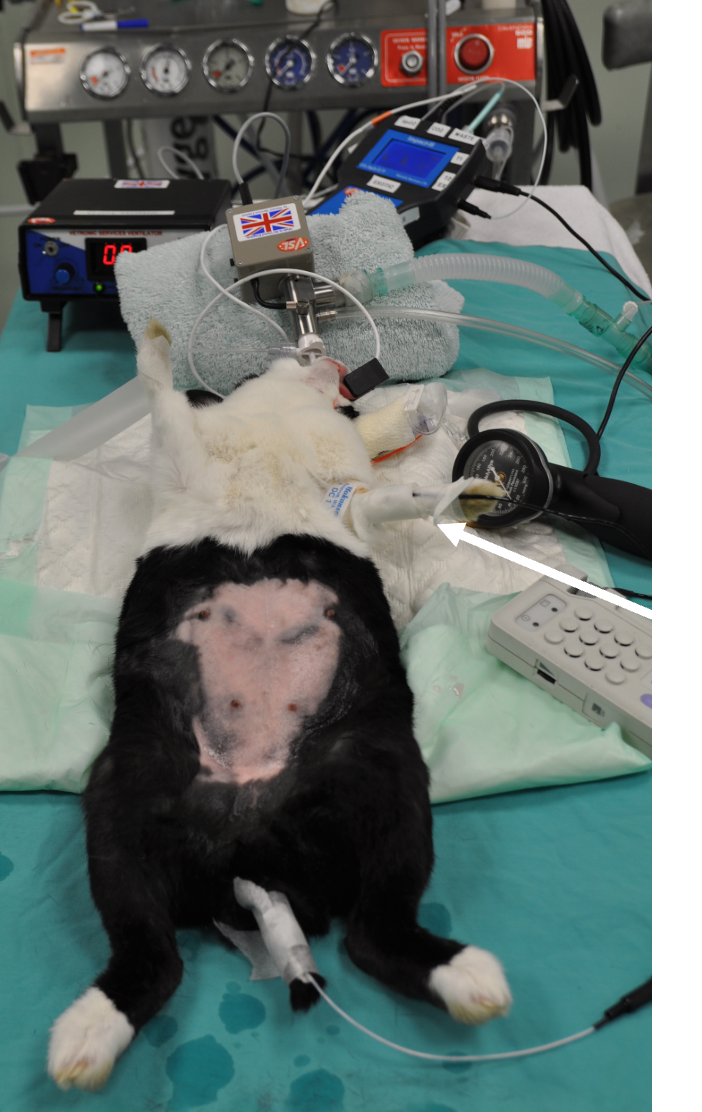
What is this arrow pointing to?
Doppler (HR)

What is this arrow pointing to?
BP cuff

What is this arrow pointing to?
IV line
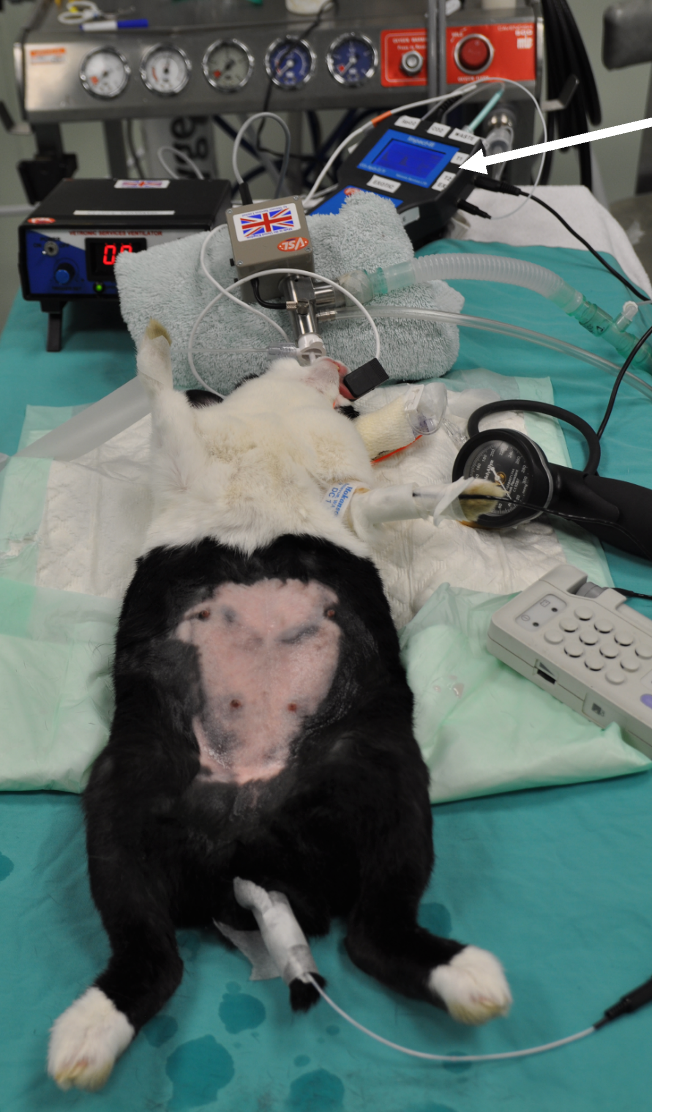
What is this arrow pointing to?
Capnograph (RR)

What is this arrow pointing to?
Ventilator

What is this arrow pointing to?
Intubated
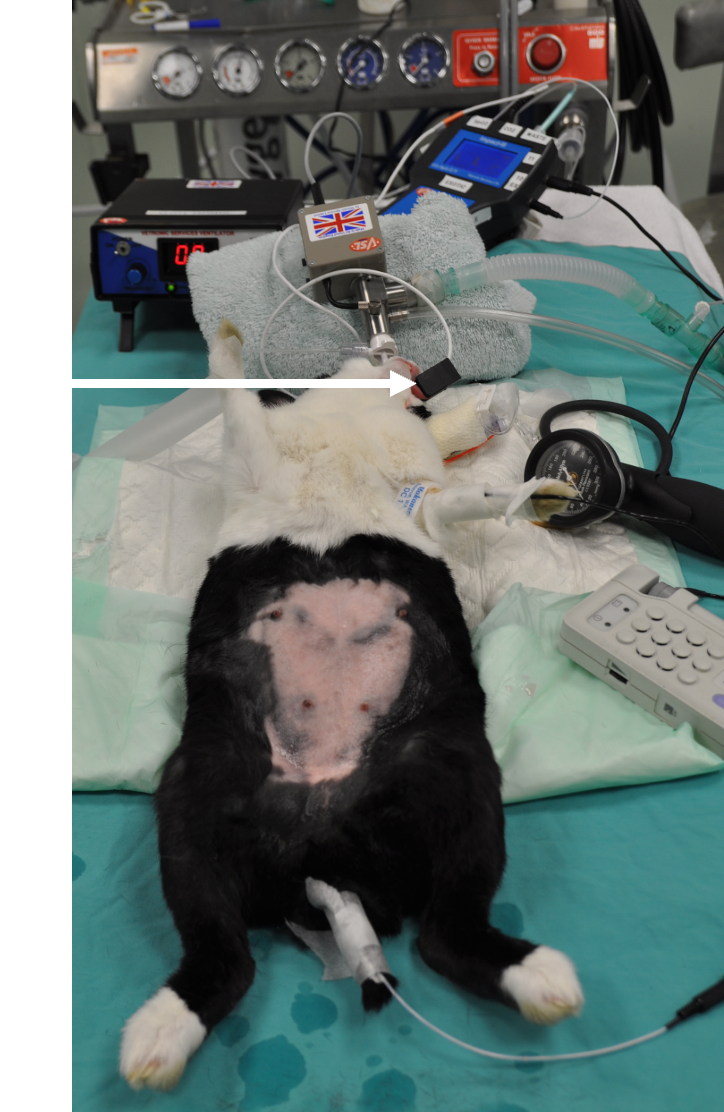
What is this arrow pointing to?
Pulse oximeter

What is this arrow pointing to?
Rectal thermometer
What should you do during recovery after anesthesia?
Switch off inhalation agents (flush circuit)
Return to sternal recumbency
Continue inhalation oxygen
administer an reversal agents
wait until responsive for extubation
transfer to incubator - active monitoring with regular temperature temps
When should you extubate a rabbit?
jaw movement, cough, body movement
How can you minimize adhesion risk during abdominal surgery?
Careful tissue handling
Keep organs hydrated (warmed sterile saline)
Moist surgical swabs
Minimal haemorrhage
Anti-inflammatory - NSAID
What are some helpful tips in surgery?
Clear plastic drapes -allow orientation of anatomy landmarks
Surgical clips - adrenal gland removal and splenectomy
Cautery
What suture materials are best?
those removed by hydrolysis
What suture do you typically use for the muscle layer?
Polydioxanone - PDS
What suture do you typically use for ligatures, subcutaneous and intradermal sutures?
Poliglecaprone 25 - Monocryl
Why are intradermal sutures best finished with an Aberdeen knot?
reduces risk of self suture removal
Why perform an Ovariohysterectomy?
Health - uterine adenocarcinoma
Behavioral
Prevent reproduction
What are the parts of the rabbit reproductive tract?
two ovaries → two uterine horns → two cervices → one vagina
Where do you make an incision in a OVH?
Identify umbilicus and the pubis
Halfway between the umbilicus and pubis (or slightly cranial)
How should you get through the subcutaneous layer?
blunt dissect with scissors to expose muscle layer
How should you get through the linea alba?
tent the muscle upward and make stab incision with the tip of an upside down scalpel blade
What should you do with the vaginal stump?
over sew it
What are some surgical complications of a spay?
hemorrhage, perforation of ceecum or bladder, ligation of ureter, fat necrosis, muscle closure herniation, would self trauma, wound infeciton
Why perform a castration?
Behavioral, prevent reproduction, and eliminate risk of testicular tumors
How do you do an open castration?
With the rabbit in dorsal recumbency and the scrotum surgically prepared, the testicle is pushed downwards into the scrotum, such that the scrotal skin is taught
an incision is made through the skin of the scrotum, approximately 1-1.5 cm in length avoiding skin vessels
the incision is then deepened to extend through the vaginal tunic to expose the testicle
the testis is readily exteriorized from the scrotum
Using forceps, the tunic is held before the attachments between the tunic and scrotal skin are gently manually broken down.
The attachments between the tunic and scrotum are broken down (360◦) to expose a large section of tunic
The testicle and tunic are double clamped before double ligatures are placed around the tunic proximally, essentially making this a closed castration. It is important the tunic is closed.
The tunic is cut between the clamps removing the testicle
The stump is examined for haemorrhage before being allowed to retract back
The empty scrotal sac then has the skin incision tissue glued closed.
The castration is repeated on the opposite side.
How do you perform a closed castration?
The scrotal skin only is incised, while the vaginal tunic remains closed. The testicle is exteriorized using traction and blunt dissection to break down the attachments between the scrotal skin and tunic.
What surgical complications can arise from a castration?
Herniation -if tunic not closed - REMEMBER open inguinal canal
Scrotal oedema
Scrotal haematoma
Wound self-trauma