Parasitology Exam 4
 Call Kai
 Learn
 Practice Test
 Spaced Repetition
 Match
 Flashcards
 Knowt Play
1/35

There's no tags or description
Looks like no tags are added yet.
36 Terms
What des pathogenesis mean?
The capacity to cause disease
What does disease mean
alteration in normal cells, organs, or organismal activity
What does subclinical infection mean?
an infection with no accompanying signs or symptoms
What’re the three factors that effect likelihood of disease
The status of host defenses
The number of parasites present
The virulence of those parasites
What is a threshold of disease?
The number of parasites required to cause detectable signs and symptoms in an infected individual
The threshold of disease varies depending on the virulence of the parasite
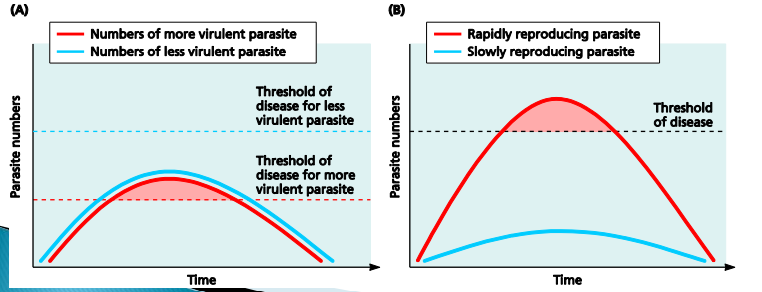
What’re the examples listed in class for how pathogenicity is caused by parasitic infections caused my variety mechanisms?
Vitamin deficiencies
Tissue damage
Host cell destruction
Parasite induced pathology can be a [ ] of the Infection
Parasite induced pathology can be an unfortunate byproduct of the infection that is of no obvious adaptive value to the parasite
What is an example of a parasite that causes pathology as a byproduct?
Southeast Asian liver fluke
Adults inhabit bule ducts of mammalian defensive host
Chronic infections lead to cancer

What is an example of a parasite that causes pathology as an adaptive strategy?
Yersinia Pestis
When it affects the rat flea, it blocks its digestive system, so that it’ll be super hungry and bite as many times as possible to try and feed
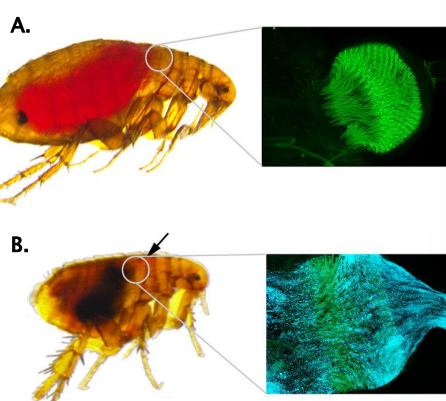
What’re the difference types of pathology causes by parasitic infections? (6)
Parasite-induced trauma to cells, tissues, and organs
Changes in cellular growth patterns
Interference with host nutrient acquisition
Toxins released by the parasite
The host immune response to infection
Disruption of the microbiome
Pathogenesis caused by a particular parasite can be placed in multiple categories
What is an example f a parasite that causes multiple types of pathology through infection ?
Intestinal Nematode
Migrating larvae can damage intestinal epithelial cells
Causes respiratory distress
Lead to blockage of intestines
Lead to inflammation
Lead to nutrient deficits
What’re examples of parasites that cause direct trauma to host cells, tissues, and organs?
Damage occurs as the parasite moves, develops, and feeds. They can cause tissue trauma as larvae migrate through the host.
Tissue cysts by tapeworms
Taenia Solium (pork tapeworm)
Causes formation of cysts; can create some within the CNS, which causes major problems
Echinococcus species
Can cause HUGE impact on surrounding tissues and break bones
What is an example of tissue damage caused by Plasmodium falciparum
P. Falciparum express PfEMP- 1 on surface RBCs.
These form sticky knobs which adhere to the endothelium of capillaries, where accumulation then leads to severe tissue damage.

How does entamoeba histolytica cause tissue damage?
Many people infected with the parasite remain asymptomatic.
Some individuals develop amoebic dysentery
Some may create ulcers, and continue to spread across membranes and other muscle/tissue.
Invasive E. Histolytica enter the circulatory system.

What is a virulence factor?
Molecules produced by parasites, such as toxins and enzymes, that allow them to colonize a host, evade immune defenses, and cause disease
What virulence factors contribute to pathogenicity of virulent strains?
overexpression of various digestive enzymes
Over abundance of surface proteins (lectins) for binding host cells
Activate of host cell apoptotic pathway
Phagocytosis and trogocytosis of host cells
Secretion of immunomodulatory proteins
What’re the different ways parasitic infections can alter host cell growth patterns
Hypertrophy
Hyperplasia
Metaplasia
What does hypertrophy mean?
An increase in the size of of an organ or tissue resulting from an enlargement of its component cells
What does hyperplasia mean?
An increase in cell number
can be a normal response to a stimulus
can be response to abnormal stimuli
What does metaplasia mean?
Cells of one type are replaced by cells of another type (usually reversible)
What’re well known examples of parasite induced hypertrophy
Leishmania donovani:
Trypanasoma Cruzi:
Merocystis kathae:
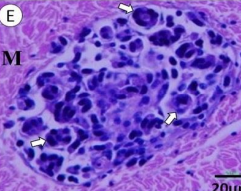
What are examples of parasite induced hyperplasia?
Liver fluke (Fasciola hepatica)
Beneficial to the parasite
Adults mature in bile duct, which lead to proliferation of duct epithelial cells, which flukes can feed on
Glochidia
larval stages of certain freshwater bivalves. They can attach to gill filaments of host fish, which can provide benefits

What are examples of parasite induced metaplasia?
Trichinella spiralis
Muscle fiber cells become nurse cells
Adults inhabit cytoplasm of several adjacent mucosal epithelial cells. And the larvae proceed to travel through the circulatory system
The penetration of muscle fiber cells can then change gene expression

What is parasite induced neoplasia
Cell growth patterns usually return to normal if the stimulus causing hyperplasia or metaplasia is removed; neuroplasia results if it does not happen
Abnormal proliferation of cells in response to an external stimulus that continues even after cessation of the stimulus.
What are examples of parasite induced neoplasia?
Opisthorichis viverrini
can cause cancer of bile duct
Release bacterial toxins
Harbors H.Pylori in its gut
Spirocerca lupi
Esophogeal worm
larvae can penetrate dog stomach then get to esophagus
can lead to esophogeal sarcoma
What are examples of parasites having adverse effect on host nutrition?
Parasites divert nutrients to themselves; intestinal helminths can lead to nutrient depletion and/or internal bleeding
Broad fish tapeworm
Most humans are either asymptomatic or have mild symptoms
Can cause a severe Vitamin B12 deficiency, needed for cell metabolism
What are the main takeaways from discussion paper 6?
Mature hairworms induce activity in infected crickets
Hairworm-induced activity is reversible
Infected crickets display positive phototactic behavior
Positive phototactic behavior may be distinct from water seeking behavior
How does Giardia Lamblia effect host nutrition?
They adhere to host intestinal microvili, cause nutrient absorption issues
Fat absorption compromised
Appetite loss due to GI discomfort
Induces intestinal cells to secrete chloride ions into intestinal lumen
Increased lactose intolerance

How does plasmodium infection infect host?
Plasmodium infections can result in host iron deficiency, common in malaria infections
Causes red blood cells lysis
May also be result of competition between parasite strains
once parasitemia hit, replicating merozoites have strategy to prevent newly inoculated sporozoites from replicating in the liver. releases iron regulatory hormone hepcidin
iron conc in hepatocytes declines, inhibiting growth inside hepatocytes
What is a toxin
A poisonous or venomous substance produced naturally by a living organism.
targets and adversely affect specific molecules, leading to direct interference with host processes
What’re the two types of fungal toxins and disease presented in class?
Oral and vaginal candidiasis
Produces candidalysin as a byproduct of hyphae formation. Calcium ion influx into host cells, osmotic balance, and host cell lysis.
Parasite of rye grass
Produces ergot toxin, if infected grains used to make bread, consumption of this toxin. Leads to vasoconstriction and mental disturbances.
What is hemozoin?
Hemozoin is produced as an insoluble waste of hemoglobin digestion by Plasmodium.
What’re the effects of hemozoin?
When released by lysed RBCs, can be ingested by phagocytes. Inhibits respiratory bursts
Forms complexes with other Plasmodium molecules and can bind toll like receptors leading to an inflammatory response due to upregulation of Il2 and TNF alpha
Recent studies have demonstrated toxicity to cells of central nervous system
Uptake by neurons and astrocytes lead to apoptosis
What is an example of pathology from immune mediated damage to host cells and tissues?
A significant amount of pathology results from indirect effects of the host immune response- immunopathology
Onchocerca vulvulus
Nematode that causes river blindness
Live worms cause little inflammation, but when worms die, their endosymbiont bacteria are released
As bacteria die, they release Wolbachia surface protein (WSP)
Acts as PAMP for TLR
Proinflammatory cytokine response
Why hasn’t natural selection eliminated harmful immune mediated responses?
Immunopathology and a successful immune defense demonstration that evolution results in compromise
Hosts must have powerful array of defensive immunological weapons to combat array of parasite
parasites must exploit their host to survive
What is a granuloma?
A tiny cluster of white blood cells and other tissue. It can be found in the lungs, skin or other parts of the body
They form in response to infections, inflammation, irritants, or foreign objects.
Results from a delayed-type hypersensitivity response (DTH)
A type of cell-mediated response initiated by an antigen. Delayed because the reaction occurs hours or days after exposure to the antigen.