Fertilization
 Call Kai
 Learn
 Practice Test
 Spaced Repetition
 Match
 Flashcards
 Knowt Play
1/16

There's no tags or description
Looks like no tags are added yet.
17 Terms
What are the three fates of spermatozoa deposited in females
Oocyte fertilization
Retrograde loss
Phagocytosis via immune cels
What factors can affect sperm loss
Site of deposition
Volume of ejaculate - more is better
Gel/plug fraction
Sialomucin vs sulfomucin
Low viscosity, crypts, swimable
High viscosity, tips of folds, unswimable
What type of sperm transport is able to fertilize the oocyte
Not the first guy; slow trickle transport - fertile
E2 in the female helps with sperm transport, how
Endometrial secretions and myometrial contractions
What is the first thing sperm do once they reach teh oviduct and why is it important
Dock in isthmus
Promotes viability
Describe capacitation of sperm
Starts once sperm is deposited and is a relatively slow process
Involves removal of membrane coating molecules, removal of cholesterol, and increase Ca2+ con intracellularly
What is the term for reversal of capacitation and how does it work
Decapacitation - return sperm to seminal plasma
When might capacitation need to be artificially induced
In vitro fertilization because no interaction with female repro tract prior to fertilization
What is the fucntion of the Zona pellucida
Glycoprotein rich membrane surrounding oocyte - prevents oocyte from adhering to oviduct
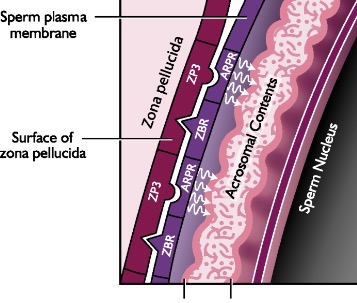
Describe the zona pellucida and sperm binding proteins and their interactions
ZBR on sperm binds ZP3 - attaches sperm to zona
ARPR on sperm binds ZP3 - initiates acrosome reaction
Activation of what receptors on the spermatozoa will further increase Ca2+ concentrations
P4-Gq linked
ZP# - GPCR like
Describe acrosome reaction
Ca2+ dependent release of acrosomal contents that facilitate sperm penetration of ZP
Fusion of sperm PM and outer acrosomal membrane → small vesicles form → exocytosis → release of acrosomal proteins (proacrosin and acrosin)
Describe what happens after the spermatozoon penetrates ZP up till syngamy
Enters perivetelline space → binds oocyte PM at equatorial segment of sperm → sperm nucleus ungulfed → sperm nuclear membrane degrades → DNA decondenses → syngamy(fusion of pro nuclei)
What is the purpose of cortical granules and their cortical reaction
Cortical granules undergo exocytosis after syngamy
Contents released into perivitelline space → causes zona block
What two mechanisms prevent polyspermy following syngamy
Zona block: changes ZP penetration abilities
Vitelline block: changes oocyte MP penetration abilities
What does increased cytoplasmic Ca2+ stimulate following syngamy
Cortical granules exocytosis and more importantly resumption of the cell cycle and completion of meiosis