Systems U1
 Call Kai
 Learn
Learn Practice Test
 Spaced Repetition
 Match
Match Flashcards
 Knowt Play
1/70

There's no tags or description
Looks like no tags are added yet.
Name | Mastery | Learn | Test | Matching | Spaced | Call with Kai | Chat |
|---|
No analytics yet
Send a link to your students to track their progress
71 Terms
Which part of the Neuron is responsible for integrating upcoming signals and determining whether an action potential will be generated?
A) Axon Terminal
B) Dendrites
C) Myelin
D) Axon Hillock
D) Axon Hillock
Define Binary
It’s a way of representing information using only two states, 0 and 1, based on a threshold or rule. Usually written as 8 bits
Define McCullough-Pitts Neuron
First formal mathematical model of a neuron. It uses a number of inputs (x), the weight of each input (w), an activation function (g), a summation function z(x), and a threshold g(z) defined by T.
Describe Base2
How you’d convert a Binary string to decimal form. The first bit represents 128, next one represents 64, next 32, each halving until 1, which is the last bit in the 8-bit string. If the number is 1, you add the corresponding value to the total, if it is 0, you neglect it. So, 10000000 would be 128, because the bit corresponding to 128 is on, while the other bits are “off”.
Explain Logic Gates
Different ways in which an input affects the McCullough-Pitts Neuron, could be the “and” gate where all inputs have to be on for the neuron to fire, could be the “or” gate, where if either input is on the neuron fires, or the “not” gate where the input has to be off for the neuron to fire. This feeds into the concept of Unintegrated (each input affecting one neuron (or gate)) vs Integrated (inputs affecting multiple neurons, “and” gate).
Give example(s) of an Unintegrated System
Taste (labeled line encoding), every input represented by a single neuron.
Give example(s) of an Integrated System
Olfaction (combinatorial encoding), as neurons share information reducing the need for excessive neurons, allowing for more nuanced perception.
What is a secondary example of an Unintegrated System?
Escape circuits in amphibians. 2 giant neuron on left and right side of the hindbrain called Mauthner cells, which have a large diameter for fast conduction velocity. They receive auditory and visual input.
Define stimulus?
What was shown, input, (0 or 1)
Define response?
What was reported, output, (0 or 1)
What would be the most likely binary input encoding for a crocodile, if alligator is: 11000010?
A) 00000111
B) 11000011
C) 00111100
D) 22000020
B) 11000011
Which of the following is NOT an advantage of modelling the neuron as a binary encoder?
A) Captures the key output we often care about: whether the neuron fires or does not fire
B) Binary representations are well suited to computational models because computers naturally process information in binary form.
C) It allows us to accurately represent all of the continuous changes in a neuron’s membrane potential
D) Binary encoding provides a reliable and clear representation of neural activity by distinguishing between firing and not firing
C) It allows us to accurately represent all of the continuous changes in a neuron’s membrane potential
Showing a toddler a snake causes an activation pattern
of 000001 of cortical neurons, resulting in crying. In this
case, does crying require integration? How do you know?
Why would this type of signaling be beneficial in this
situation?
No, it does not require integration because only one neuron is activated. Integrated systems involve combinatorial encoding, where multiple neurons are activated in response to one stimulus, while unintegrated systems will associate one neuron with each input. Unintegrated system would be beneficial with this scenario because crying could be in response to a dangerous stimulus, so a quick response with low decoding cost would be more necessary.
Define voltage
Difference in electrical potential, electromotive force. Measured in volts
Define current
Charged particles (ions) that move through an electrical circuit. Direction = net flow of + charges, measured in Amps
Define resistance
The force that counteracts the flow of current, an indicator of how difficult it is for current to flow, measured in Ohms
Define insulator
A resistor with infinite resistance
Define conductor
A material that allows electrical flow
Define conductance (G)
The opposite of resistance, measured in Siemens (S)
Define capacitor
A passive electrical component that stores energy in an electric field. Current does NOT pass through.
Define capacitance (C)
The ability to store energy in the form of an electrical charge, measured in Farads or F
Define battery
Converts chemical energy into electrical energy, usually slowly. This generates voltage
Define circuits
Interconnection of electrical elements that contain at least one closed Current path.
Define series
A circuit whose components are connected end to end. Current passing through each resistor is the same, voltage is the sum of each area.
Define parallel
Circuit where all components are connected across each other. Voltage is the same, but the current is the sum of each area
Describe Equivalent Circuit Model of Neurons
Simulates electrical components and properties of neurons, quantitative description of input/output function yields mechanistic understanding of neuronal signaling. Gets artificial network models closer to how the brain works
Describe the Integrate and Fire model or IF Model
Mathematical model used to describe how neurons respond to stimuli. Membrane potential integrates upcoming inputs until it reaches a threshold, at which point the neuron fires (spikes) and resets. Membrane potential increases linearly (indefinitely until threshold is reached) based on injected current and does not decay over time. Output is a bit, 0 (off) or 1 (fired)
What are the main differences between the IF model and the McCullough-Pitts model?
1) The IF model takes into account variations in membrane properties with Capacitance (C) or ability to store charge that could affect how mV changes over time. 2) While both models are mathematical, IF uses physical quantities (mV) to get its 0 or 1 result. M-P uses weights. 3) IF model explicitly resets after an AP is fired. 4) IF model measures impulses that affect membrane potential with respect to time, while M-P does not take time into account. MP can do spacial summation, while IF can do both temporal and spacial summation.

What is the highlighted region called and what is its role in an electrical circuit?
A) Capacitor, storage of electrical charge
B) Resistor, causing resistance of current flow
C) Battery, storage of electrical charge
D) Battery, electromotive force
E) Capacitor, establishing voltage
A) Capacitor, storage of electrical charge
What is the main reason the IF model is not the best model?
Leaky (always open) ion channels are conductors/resistors that dictate ions (current) flow across the membrane constantly, even during resting potential
Describe the LIF model
Extends the IF model by incorporating “leaky” ion channels, showing the natural decay of membrane potential over time as current is lost to the lost leaky ion channels
What do both LIF and IF models require for an action potential?
An artificial spike generator, which checks whether injected current (Ic) reaches the capacitor, records a spike, then triggers a reset
What does both the LIF model AND the IF model NOT include?
Voltage gated ion channels
Describe the Hodgkins-Huxley Model of the neuron
Incorporates VG ion channels, including Sodium and Potassium channels, into the description of neuronal activity and a more sophisticated/realistic/complicated model compared to LIF and IF. Does not need the spike generator because it models the different voltage gated ion channels, which means the voltage rises and falls how it is supposed to through those channel dynamics.
Describe the main limitation of the Hodgkins-Huxley model of the neuron
It assumes that all parts of the membrane (dendrites, soma, axon) have the same properties and that all ion channels behave identically
Define post synaptic potential
A graded change in the post synaptic neuron’s membrane voltage caused by synaptic input
Define mechanically gated vs chemically gated ion channels
Mechanically gated ion channesl open in response to physical deformation, while chemically gated ones open when a chemical messenger binds
Define temporal vs spacial summation
Temporal summation combines inputs arriving close together in time, while spacial combines inputs arriving at different synaptic locations
Define neural encoding
How neurons represent information through electrical activity at the level of individual cells or networks
Define spike train
A sequence of action potentials recorded over time from an individual neuron. Can also look at multiple spike trains simultaneously from multiple neurons in a system
Define raster plot
Displays individual spike times as marks, with separate rows for different trials of neurons
Define Peristimulus Time Histogram (PTH)
Shows average firing rate in time bins relative to a stimulus, across repeated trials
Define interspike interval (ISI)
The time between consecutive action potentials for the same neuron
A researcher wants to simulate 50,000 cortical neurons to
examine how network connectivity affects synchronization and
oscillations during attention. The main goal is which neurons fire
together over time. Which model we discussed would be best?
Leaky integrate and fire, (LIF), because it tracks changes in mV over time, and it is also biologically realistic (incorporating leak channels due to decay). Its relative simplicity makes it suitable to model a large amount of neurons without the additional coplexity of voltage gated ion channels with Hodgkins-Huxley.
Define neural decoding
the hypothetical reconstruction of sensory/stimuli information from the pattern of action potentials present in nuerons/networks
Define histogram
A graphing display where data are grouped into ranges and then plotted as bars
What is the relationship between current and voltage
Current, which is artificially injected through an electrode, is responsible for changing voltage
What is the “rate code”
type of encoding, action potenital frequency
What is the “temporal code”
type of encoding, spike timing in relation to a stimulus
What is the “latency code”
type of encoding, delay between the onset of a stimulus and the first AP
What is the “synchrony code”
type of encoding, coincident spikes in different neurons (coordination)
What is the “population code”
type of encoding, generated by combining information from multiple neurons

What is metric 3 referring to in figure 1?
A) Latency time
B) Interburst interval
C) Duration of a burst
D) Spikes in a network burst
B) Interburst interval

Which of the following has the highest seizure risk at the lowest concentration?
A) Amoxapine
B) Tramadol
C) Picrotoxin
D) Pilocarpine
C) Picrotoxin
Explain the Generalized Linear Model
Says that a neuron firing or not depends on 1) The stimulus, 2) What it fired recently or the spike history, 3) What other neurons are doing. This model does not include membrane voltage… is models spike probability in small time bins
Two identical depolarizing currents are applied to neurons
with different membrane time constants (τ). Which neuron is
likely to show shorter inter-spike intervals when firing
repetitively?
A) Neuron with a larger τ,
because voltage changes
accumulate more slowly.
B) Neuron with a smaller τ,
because voltage decays more
quickly.
C) Neuron with a smaller τ,
because it recovers faster
between spikes.
D) Both will have identical ISIs.
C) Neuron with a smaller τ,
because it recovers faster
between spikes.
What are the factors that affect neural coding?
Presynaptic input (spatial/temporal summation, inhibition, presynaptic firing patterns), Synaptic properties (strength of synapses, synaptic plasticity, receptor expression and density)
Define acuity
ability to differentiate details
Define sensitivity
ability to detect low intensity stimuli
Define wind up
In nociception, painful stimuli when repeated at the same intensity but at a high frequency can increase pain perception
If glutamate is successfully released from all pre-synaptic neurons and no other neurotransmitter is released, what two circumstances will cause the resulting injected current to be zero? Be very specific as to the ultimate cause and use electrical terminology rather than biological. (hint: think about situations where no net ion flow would occur)
1) If conductance = 0, meaning resistance is infinite. “An open circuit.” This means no current can flow even if a voltage difference exists. 2) If the driving voltage is 0, or if Vm = Eion. The membrane potental is the channel’s reversal potential, so there is no net current.
In the leaky integrate and fire (LIF) model neuron, integration is leaky because...
A) ions freely pass through open pores in the membrane
B) current through the capacitor flows in only one direction
C) leak resistance prevents ions from crossing the membrane
D) the capacitor is leaky
A) Ions freely pass through open pores in the membrane
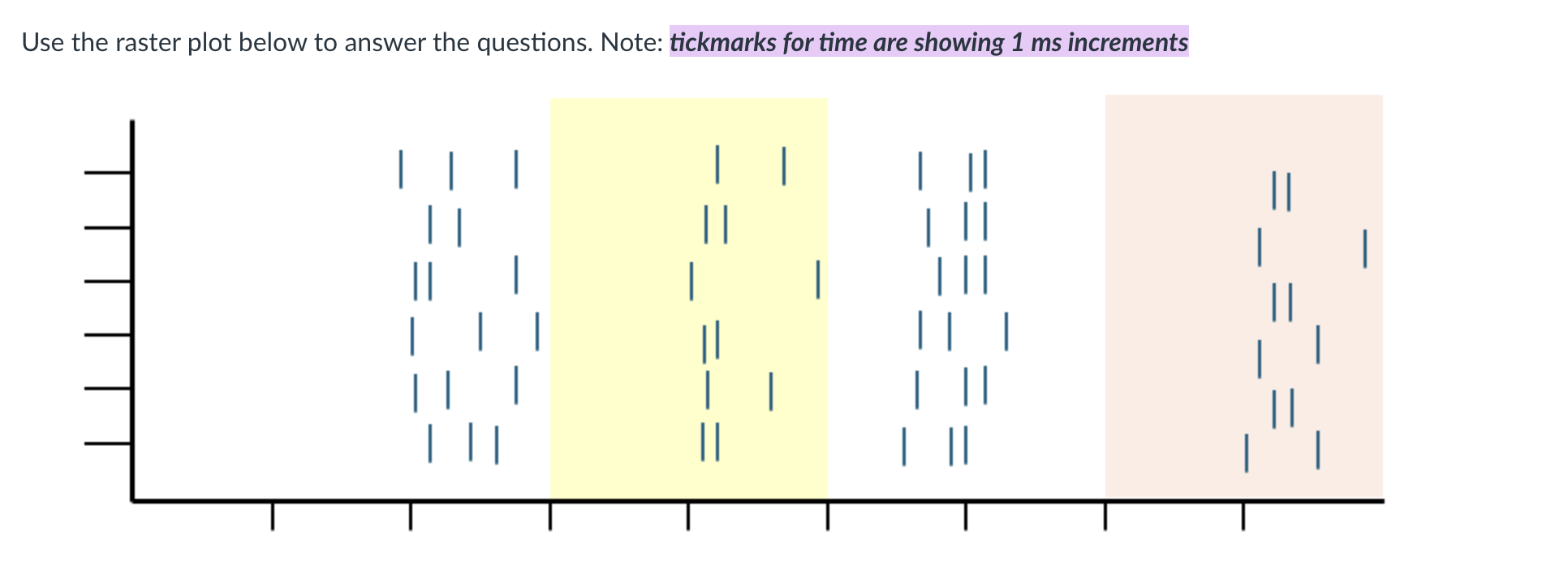
What is the latency response of the yellow stimulus?
1 ms

What is the rate of response to the orange stimulus?
1 spikes/ms

If we were to use a spike train to infer that the stimuli were inhibitory, what would this be an example of? (one word)
Decoding

You decide that you want to update the model to include IPSP summation. What symbol would need to be added to an equivalent circuit to best represent the forces that are acting on the current to determine its direction? The name of the symbol is:
Battery

Briefly list 3 changes we could make to the neuron's parameters (based on the visualization/what we know of the alien) that would allow the action potentials to reach threshold without changing the pulse width.
First, we could increase the magnitude of the current injected. Second, we could increase membrane resistance to decrease leak. Third, we could decrease membrane capacitance to allow the same current to change the voltage by more.

What is one way to obtain this same identical pattern with two different inputs (let's call them input1 & input2)?
Apply both inputs simultaneously, but provide half the original current for both with the same pulse width. Their sum equals the original input, producing the same voltage pattern.
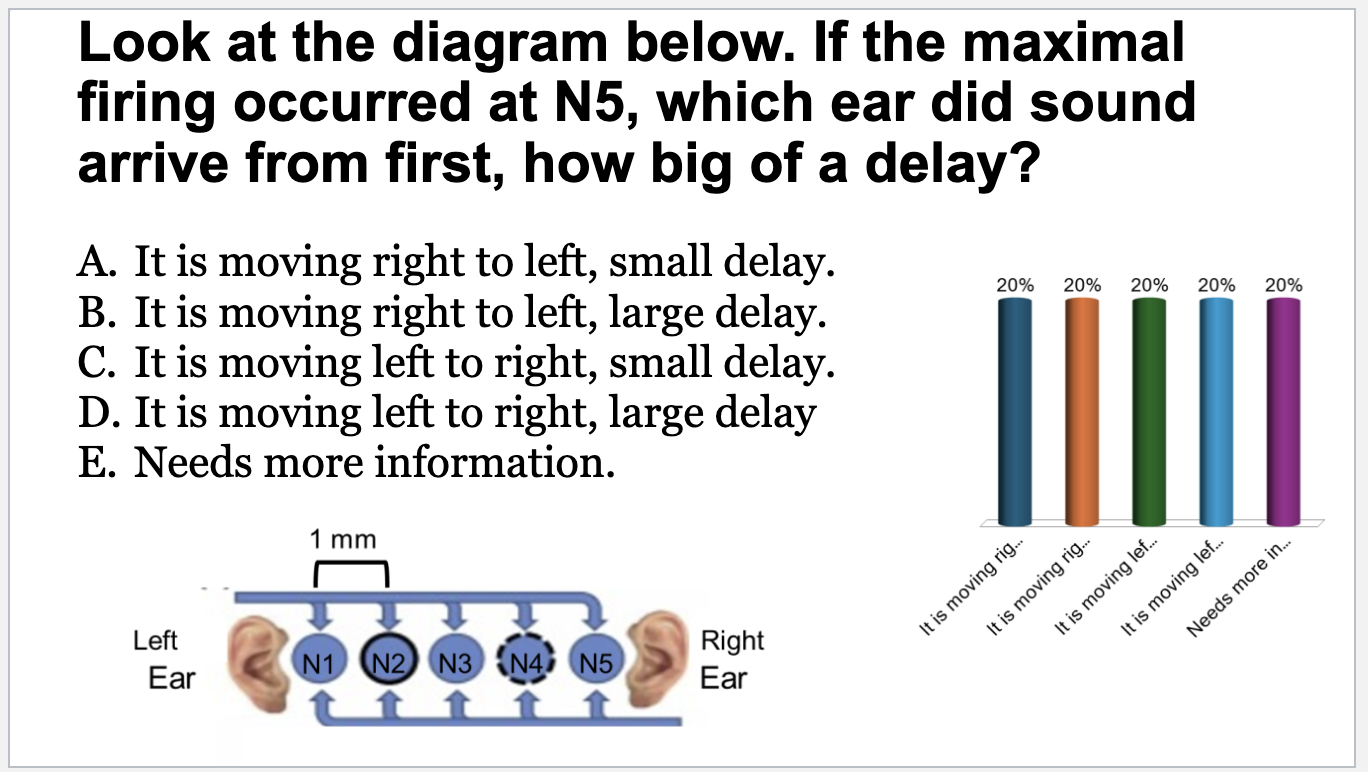
D) Left to right, large delay
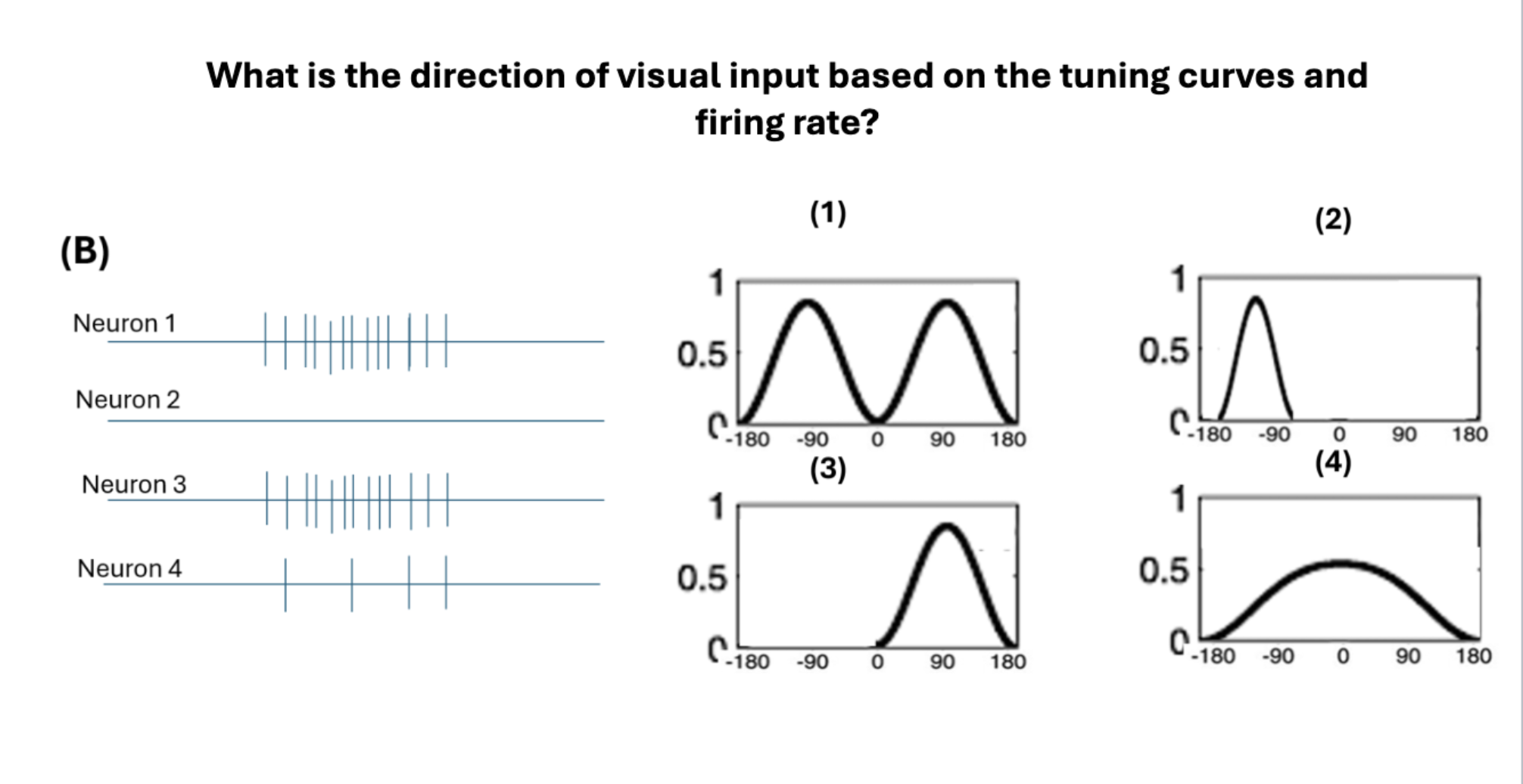
90 degrees