Algorithm and Flowchart Design Vocabulary
 Call Kai
 Learn
Learn Practice Test
 Spaced Repetition
 Match
Match Flashcards
 Knowt Play
1/73

Earn XP
Description and Tags
Vocabulary flashcards defining fundamental programming concepts, program structures, flowchart symbols, constants, variables, and expressions from the Mapúa University lecture slides.
Name | Mastery | Learn | Test | Matching | Spaced | Call with Kai | Chat |
|---|
No analytics yet
Send a link to your students to track their progress
74 Terms
A step-by-step procedure in solving a problem and a list of sequence procedures for carrying out a particular task, representing a high-level solution without following grammatical rules.
Algorithm
A straight English format or English-like representation used by programmers to plan the logical steps for solving a programming problem.
Pseudocode
The diagrammatic or pictorial representation of a sequence of events, drawn with conventional symbols representing different types of events and their interconnections.
Flowcharting
A type of flowchart that presents the total picture of a process without worrying about taking care of every detail.
System Flowchart
A type of flowchart that depicts a main segment of a complete computer program.
Program Flowchart
A literal value that does not change during program execution, which can be of numeric or string type.
Constant
A constant that may be an integer (whole number) or a real number (with a decimal place) and may be preceded by a positive or negative sign, containing no extraneous characters like commas or currency symbols.
Numeric Constant
A character or group of characters enclosed entirely in double quotation marks ("), containing numbers, letters, or special characters.
String Constant
A portion of the computer's main memory used to store a numeric or string constant, identified by a unique name and holding only one value at a given time.
Variable
A group of program elements consisting of operands (constants, variables, or array elements) and operators (arithmetic, logical, relational, or string) that yields a value of a certain type.
Expression
The priority order of arithmetic operators:
1.) Expressions in parenthesis,
2.) \*, /, %,
3.) +, −.
Arithmetic Expression Hierarchy
The priority order of logical operators:
1.) Expressions in parenthesis,
2.) Not (!),
3.) And (&&),
4.) Or (||).
Logical Expression Hierarchy
A program logic structure where steps are executed sequentially, generally involving input, processing, and output steps.
Sequential Program Structure
A program logic structure that uses conditional statements (such as if-then-else) to execute specific blocks of statements based on evaluated true or false conditions.
Selection/Conditional Program Structure
A program logic structure that repeatedly executes a block of statements while a specific condition remains true (such as a while-do loop).
Iterative/Repetition Program Structure
(pictorial representations)
Flowchart
a straight English format.
Pseudocode
(English-like representations)are used by programmers to plan the logical steps for solving a programming problem
pseudocode
Some professional programmers prefer writing pseudocode to drawing flowcharts, because
using pseudocode is more similar to writing final statements in programming language


4 general logic
Sequential
Branching
Looping
Combination
A variable may be one of the following:
Numeric, String, Array
String expression example
“3” + “4” = “34”
“Glo” + “ren” = “Gloren”

three main processing steps
- input, process, output
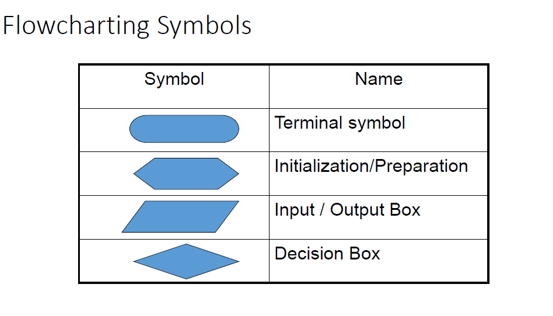
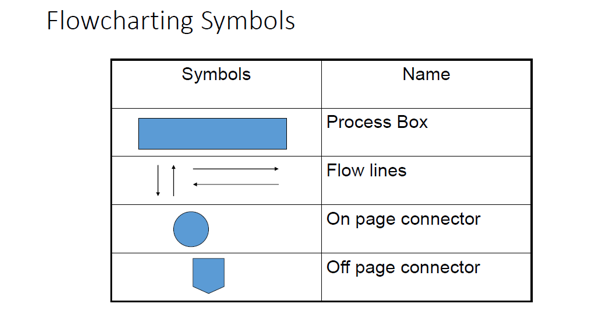
flowchart symbol used for a connector
circle
what flowchart symbol represents a decision
diamond
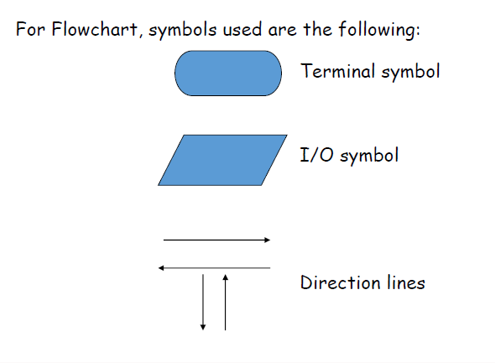
what flowchart symbol represents input / output
parallelogram
program structure executes statements in order
sequential
symbol for start and end
oval
step by step process
algorithm
structure used for choosing between alternative
conditional structure or selection structure
structure that repeats block of statements
iterative structure / repetition
used for fixed number of repetition
for loop
which loop checks the condition before executing
while loop
which loop checks the condition after executing
do while loop
purpose of top down design
break complex problems into smaller components
what is stepwise refinement
gradually adding details to a solution
what type of flowchart shows the overall system process
system flowchart
what type of flowchart focuses on program logic
program flowchart
IPO
input process output
main purpose of pseudocode
describe algorithms without
programming syntax
T / F - algorithm is a graphical representation of a process
False
T / F - pseudocode must follow strict programming syntax
false
T / F - the rectangle symbol represents processing
true
T / F - diamond symbol represents input/output
false
T / F - parallelogram represents input/output
true
T / F - for loop is for fixed number iterations
true
what loop is for fixed number of iterations
for loop
T / F - while loop is a pre test loop
true
which loop is a pre test loop
while loop
T / F - do while loop is a post test loop
True
which loop is a post test loop
do while
T / F - selection structures are used for decision making
TRUE
structures are used for decision making
selection structures
T / F -sequential structure involve repetition
false
data processing cycle
input , process output
T / F - data processing cycle is input process output
TRUE
T / F - top down design increases problem complexity
FALSE
T / F - system flowcharts focus only on one program's logic
FALSE
T / F - algorithms can be represented with pseudo and flowchart
TRUE
which symbol represents a decision
DIAMOND
represents processing symbol
RECTANGLE
represents input output
PARALLELOGRAM
which loop executes atleast once
DO WHILE LOOP
9/5 using "int"
1
4.0/5.0 using "double"
1.25
multiple paths
CONDITIONAL
top to bottom
sequential
first stage of data processing cycle
INPUT
second stage of data processing cycle
PROCESS
sample of sequencial structure
farenheit= 9/5 + celsius + 32
main purpose of pseudo
-logic without syntax