The Earth System
 Call Kai
 Learn
 Practice Test
 Spaced Repetition
 Match
 Flashcards
 Knowt Play
1/31

There's no tags or description
Looks like no tags are added yet.
32 Terms
01: What “spheres” are part of the Earth system
atmosphere, hydrosphere, cryosphere, geosphere, biosphere
01: What is the main energy source driving the climate?
Solar energy
01: What do we call incoming and outgoing radiation and how do they affect the Earth?
Incoming: Long-wave - warms, outgoing: short-wave - cools
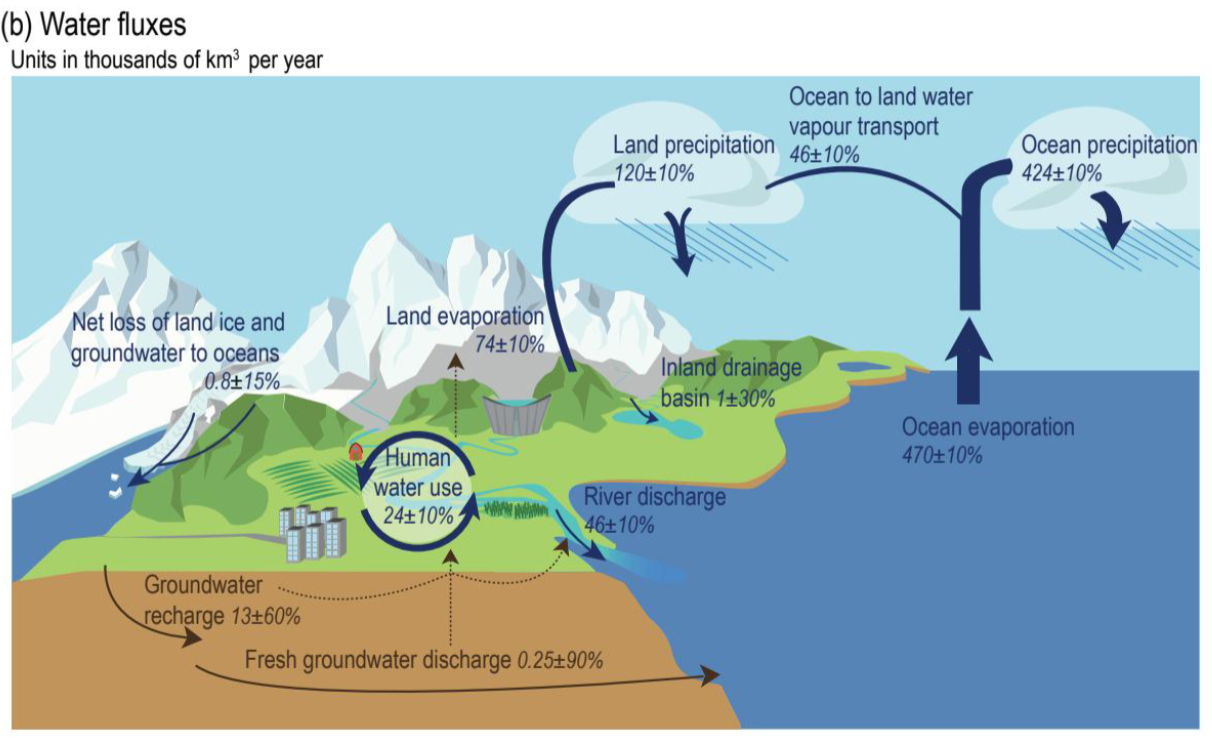
01: Give an overview of the water cycle
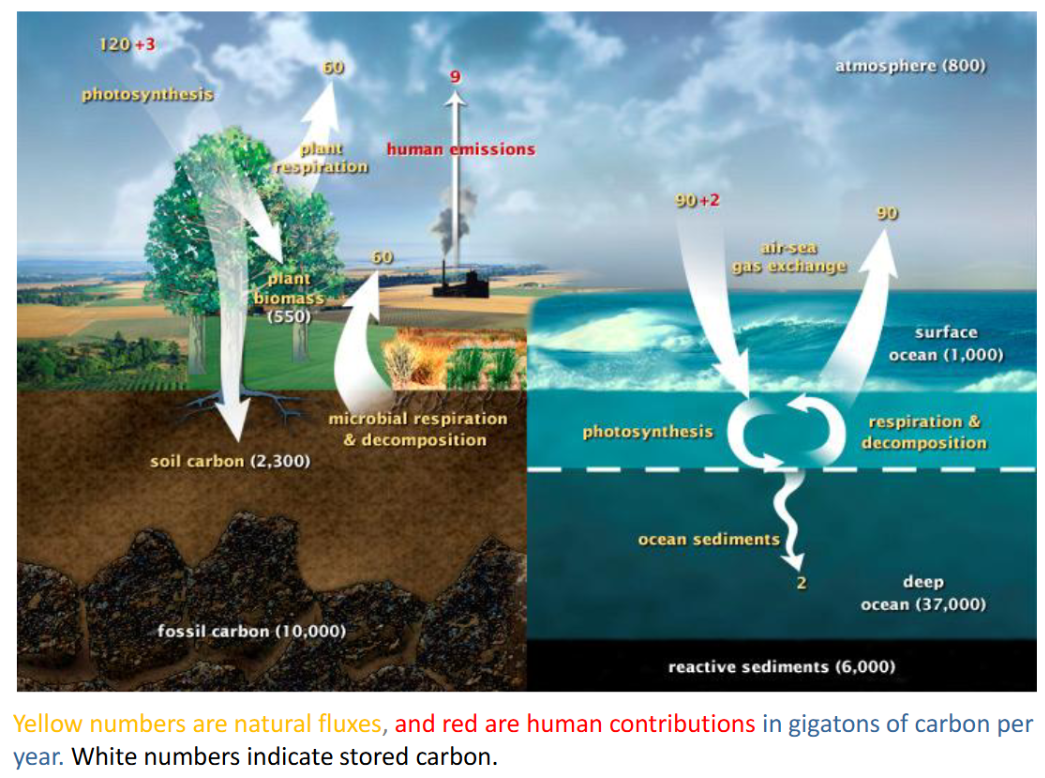
01: Give an overview of the carbon cycle
01: What parts of the earth system climate feecback timescale = hours → days?
Longwave radiation, lapse rate
01: What parts of the earth system climate feecback timescale = days?
Water vapour, clouds
01: What parts of the earth system climate feecback timescale = days→years?
Snow/ice albedo
01: What parts of the earth system climate feecback timescale = days→ centuries?
Air-land CO2 exchange, biogeophysics, non-CO2 GHG and aerosols
01: What parts of the earth system climate feecback timescale = years→ centuries?
Air-sea CO2 exchange, peat/ permafrost, land ice
01: What parts of the earth system climate feecback timescale = centuries?
Ocean circulation
01: What is albedo? What is it for fresh snow, forests, water?
Amount of energy reflected by surface. fresh snow: 90%, forests: 15%, water: 10%
01: Explain the greenhouse effect, mention long-wave radiation
Gases present in the atmosphere
increase the opacity of it in the infrared (long wavelengths)
→ Outgoing longwave energy affected
→ Heat is retained in the atmosphere, Earth’s surface warms.
01: What are the main greenhouse gases?
Carbon dioxide (CO2), water vapour (H2O), methane (CH4), aerosols (water droplets, dust particles, etc.)
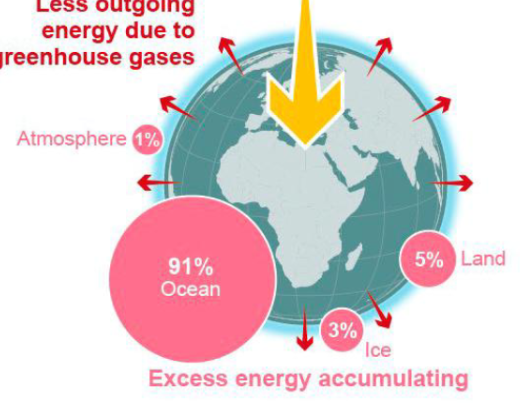
01: How is excess energy absorbed by the earth system distributed?
01: What can lead to radiative imbalance? What is a common name for these?
Climate (radiative) forcers – external perturbations:
Enhanced GHG longwhave radiation
ocean surface (?)
short-term volcanic eruptions
melting sea ice
cloud cover naturally and climate interventions
land ice melt, solar radiation variations
albdeo changes due to melting ice
land use change
emission of gases and aerosols - subsequent chemical reactions modifying ozone and aerosols amount
01: What is a positive feeback and a negative feedback? Give a few examples of both.
+: a self-reinforcing process
-: a self-diminishingprocess

01: What climate variables are now part of the ESM?

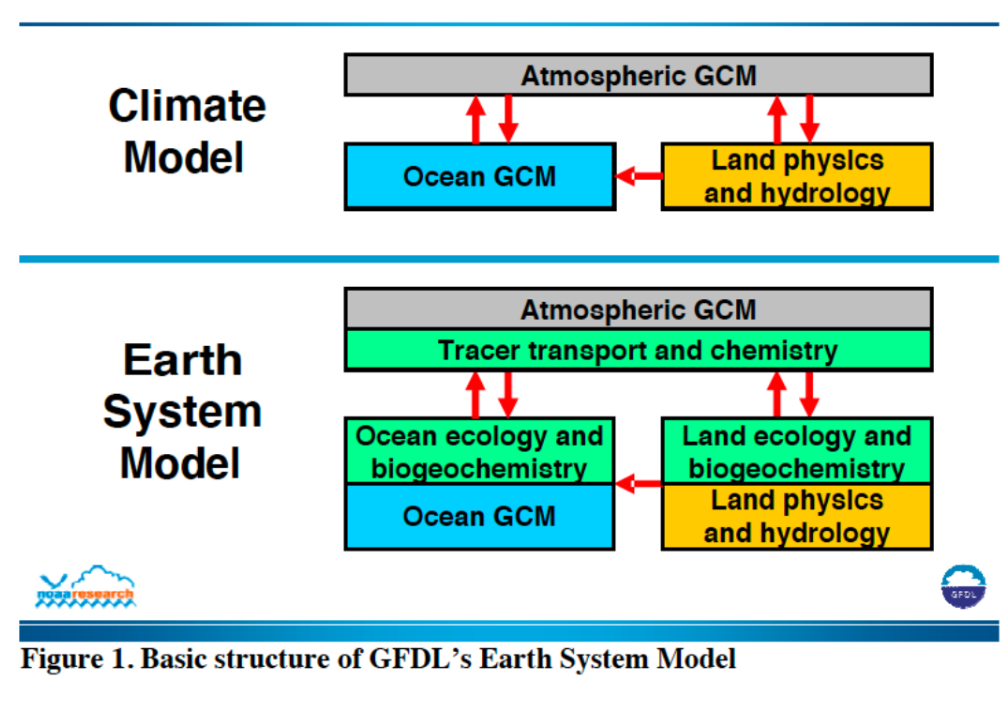
01: What is the difference between climate models and ESM?
GCM = general circulation model
01: What kind of assesments are done in IPCC?
Assesed evidence and agreement, fact, confidence, likelihood
01: What is the difference between weather and climate?
Weather refers to short term (days to weeks) atmospheric conditions, climate is the weather of a specific region averaged over a long period of time (IPCC: 10-20 years)
01: What is the AR6 model resolution?

01: What is CMIP
Coupled Model Intercomparison Project. Wants to answer how models respond to the same idealized forcing?
01: What are SSP?
Shared socio-economic pathway scenarios. Future emission scenarios.
01: What is a climate sensitivity? How does it relate to climate equilibrium?
Climate sensitivity is a metric used to characterise the response of the global climate system to a given forcing. It is broadly defined as the equilibrium global mean surface temperature change following a doubling of atmospheric CO2 concentration.
01: What is radiative forcing?
Change in net irradiance at the tropopause for equilibrium.
02: What are the 3 major radiative forcers? What is a common name for these? How have they “forced” for the past decades? Which radiative forcers give negative effective radiative forcing? Describe how the rate of change in ERF has developed the past decades.

Common name: Greenhouse gases. The rate of change likely has increased in the last 30 years, since CO2 concentrations increased at an increasing rate due to growing CO2 emissions (very likely), and since the aerosol forcing became less negative (more likely than not).
02: What do we call climate data used to reconstruct 10 000+ years old climate? Give some examples. What climate variables do we get data on from these?
Paleoclimate data. Tree rings, marine sediments, Corals, Ice cores. Temperature, precipitation, sea-ice coverage, wind, amount of land-ice.
02: How do we gain data on past atmospheric CO2?
Proxies from ocean sediments, soil and fossils.
02: What changes have we seen in ozone depleting substances?
CFCs decrease, others increase
02: Rank NH, tropics and SH on which has experienced the biggest ozone loss.
SH. 2. NH, 3. Tropics
What is the effect of historical land cover change on climate?
Likely have a net global cooling effect since 1750. The albedo has changed mostly due to human activity.