Water intro: Water as a Resource
 Call Kai
 Learn
 Practice Test
 Spaced Repetition
 Match
 Flashcards
 Knowt Play
1/92

There's no tags or description
Looks like no tags are added yet.
93 Terms
Property of water—movement
Moves between all three states (solid, liquid, gas)within the temperatures fond on Earth’s surface and can move between them with relative ease…This allows for it to be a “renewable source”
Property of water—heat
Water is a heat engine. Absorption of energy and conversion to mechanical energy→ distribute heat around the globe.
Evarporation and rainfall—ocean currents.
Property of water—expansion
Expands when heated→ contracts when cooled
Property of water—states
State changes = Density of water changes - more dense as it cools, until about 4 degrees.
The solid form is LESS DENSE than the liquid, so ice floats.
Property of water—polarity
Polarity of the molecule - weak bond between hydrogens and oxygen - this allows for it to be a universal solvent and dissolve other polar molecules ( transport things).
Properties of water: Hydrological Cycle

How much of Earth % does water cover?
70% but it’s only 1?1000th of the Earth’s volume
Where is most of the water in the world stored?
In glaciers 68.7%
What percent is freshwater in the world?
2.5%
Usable water
Surface water and groundwater (not all)
Deep groundwater, glaciers, sea water, permafrost, atmospheric → high energy input to utilize (make it drinkable)
Surface water
Lakes, rivers, precipitation
Redirection of surface water between source and oceans
depends on geological epoch
Importance of Water
The most fundamental resource
Drinking, cooking, washing, traveling, agriculture, manufacturing, mining, energy production, and waste disposal.
→ every major social and economic activity
Importance of Water
Ecosystem Services of Water
Shapes continents, moderates global climate, allows for organisms to survive
Provisioning, Regulating, Supporting, Cultural (all)
What do we use water for? — Competing water uses
In the world, what is the activity with the highest % of water usage?
Agricultural 70%

What do we use water for? — Competing water uses
In low and mid income countries, what is the activity with the highest % of water usage?
Agricultural 82%

What do we use water for? — Competing water uses
In high income countries, what is the activity with the highest % of water usage?
Industrial 59%

Estimated water lost in agricultural irrigation
What % of all agricultural production depends on irrigation.
40 % of all agricultural production depends on irrigation.
Estimated water lost in agricultural irrigation
% of water effectively used by crops
45%
Where are the largest municipal water withdrawals?
Africa region
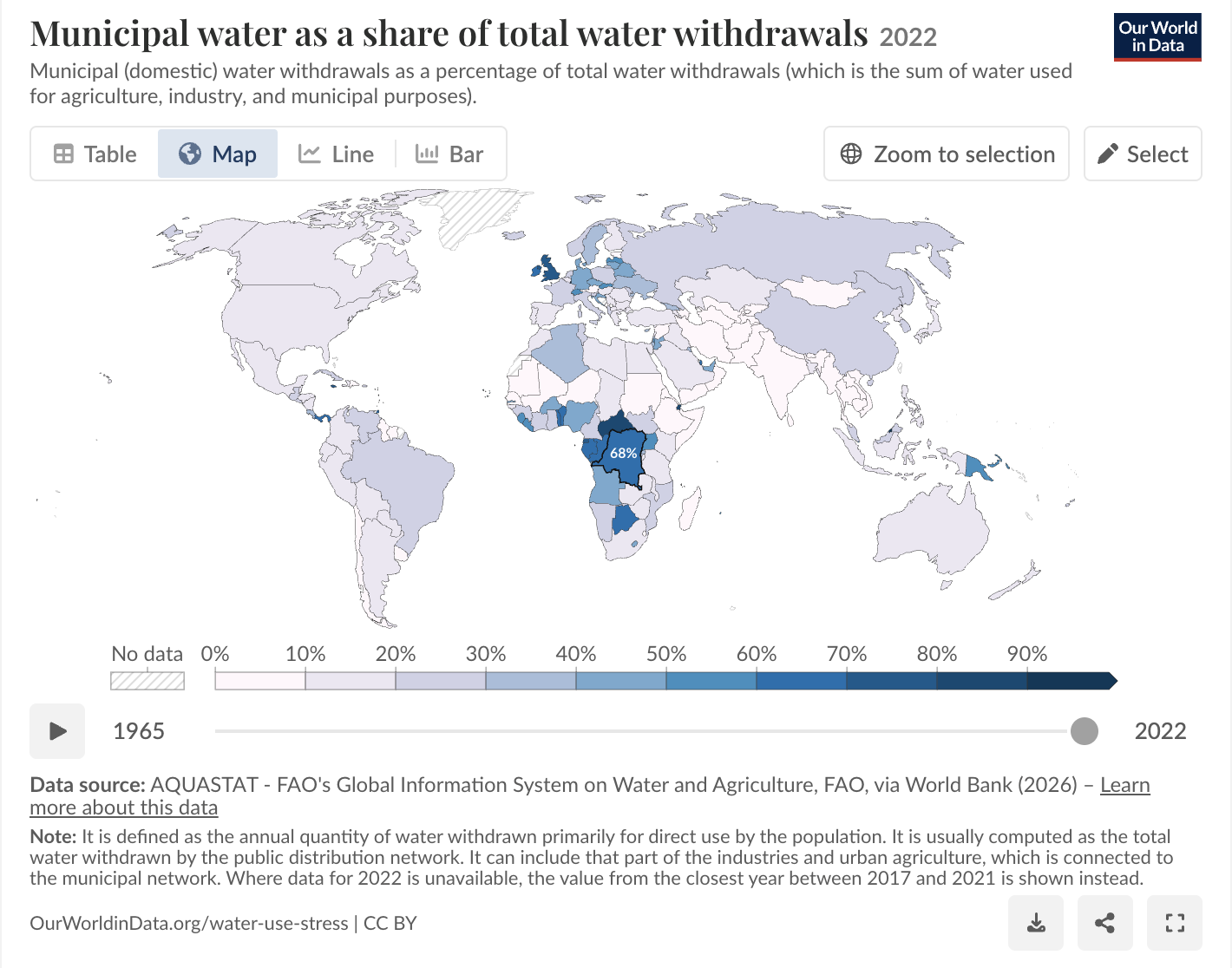
Water consumption in: agricultural, domestic, and industrial, has there been more withdrawal or consumption?

WATER AND AI
In what sector is water being highly demanded?
AI for:
cooling processes systems
Electricity generation → energy
WATER AND AI
How many gallons of water does the largest “hyperscale” data centres uses?
3-5m gallons of water/day: about the same daily consumption as a town of 40,000 people.
WATER AND AI
As new models are designed, new demands of energy.
What was the water footprint associated with training GPT-4?
about 600 million liters, enough to meet the minimum annual domestic water needs of 81,000 people in Sub-Saharan Africa, or fill 237 Olympic-sized pools.
WATER AND AI
As new models are designed, new demands of energy.
What is the water footprint estimated for training of GPT-5?
1 billion liters, enough to meet the annual domestic water needs of more than 135,000 people in Sub-Saharan Africa.
WATER AND AI
As new models are designed, new demands of energy—responses and interactions
% of total AI energy use to generate responses of billions of interactions.
To generate responses for billions of interactions is estimated to account for 80% to 90% of total AI energy use.
WATER AND AI
As new models are designed, new demands of energy—usage and images
Energy required to generate AI images and videos.
image: enough to power a 10watt LED bulb for 17 minutes
video: enough to power a 10watt LED bulb for 48 hrs
electricity associated water footprint is about 2 table spoons for a single image…jumps to 4.1L for a complex video = 2 day drinking water need for one person.
WATER AND DATA CENTERS AS INFRASTRUCTURE
What was the water footprint of data centers’ 2025 electricity consumption?
4.5 trillion L = fill 1.8 million Olympic-sized pools = meen annual basic domestic water needs for over 600 million people in Sub-Sharan Africa
WATER AND DATA CENTERS AS INFRASTRUCTURE
What is the associated water footprint of projected 2030 electricity consumption of data centers?
9.3 trillion L = meet the min annual domestic water needs of all 1.3 billion residents of Sub-Saharan Africa
Global Water Concerns
According to UN SDG Goals:
2024, 2.2 billion people lacked safely managed drinking water
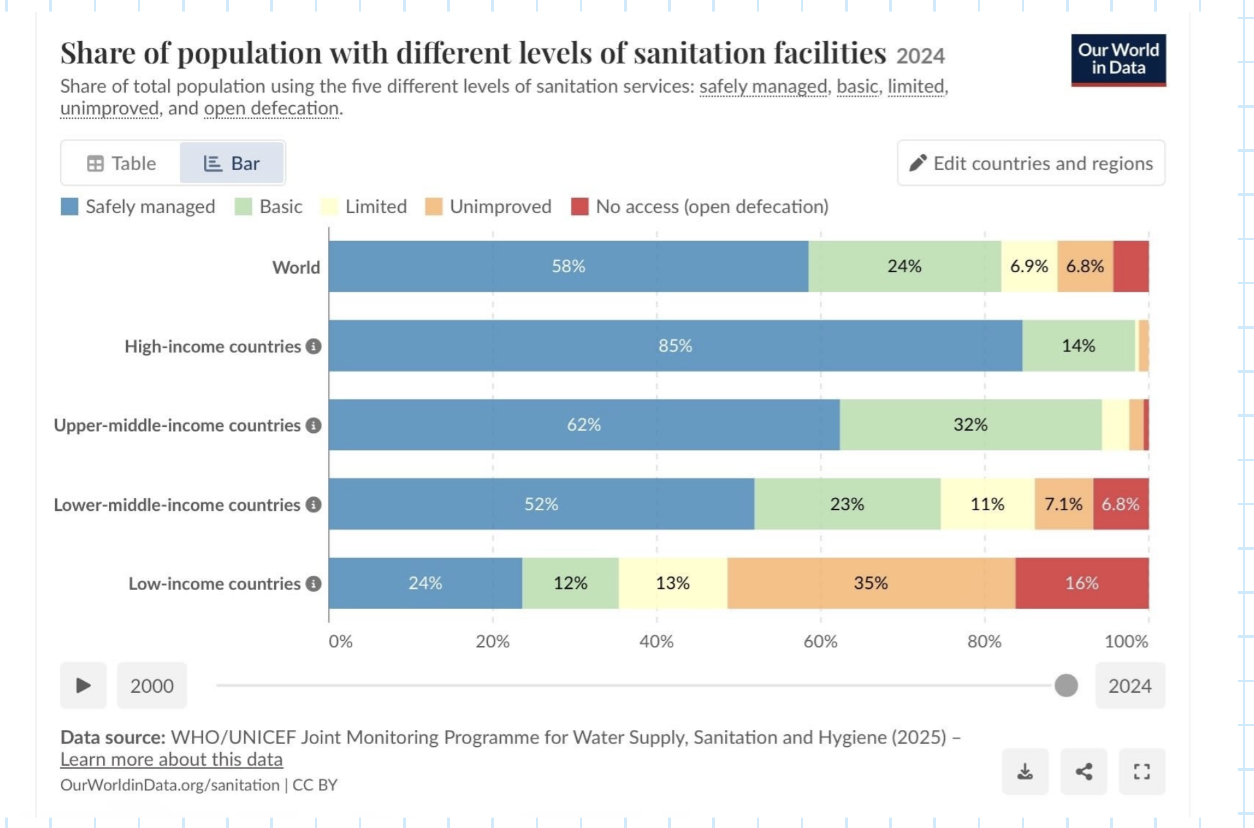
3.4 billion went without safely managed sanitation
• 1.7 billion lacked basic hygiene services at home
In schools, 646 million children remain without basic hygiene services
Global Water Concerns
Water Stress
Annual water supplies drop since 2022
drop below 17-00 m3 / person unchanged more or less = 18% of the population
Global Water Concerns
Water Stress and Regional Differences
North Africa and West Asia, Central and Southern Asia face critical water stress exceeding 75%
North Africa and Western Asia 12% increase in water stress since 2015
About 10% of the global population now live under high or critical water stress
Global Water Concerns
Water Stress
How many child deaths happen due to preventable water and sanitation-related diarrhoeal diseases = lack or responsibility and ambiguity
1200/day
Global Water Crisis in the Holocene→Anthropocene
Related to:
Population growth & Economic costs → likely to get worse not better
Climate change exacerbation; new technologies exacerbation
Quality and Quantity of water are both concerns
Aquatic organisms are also affected
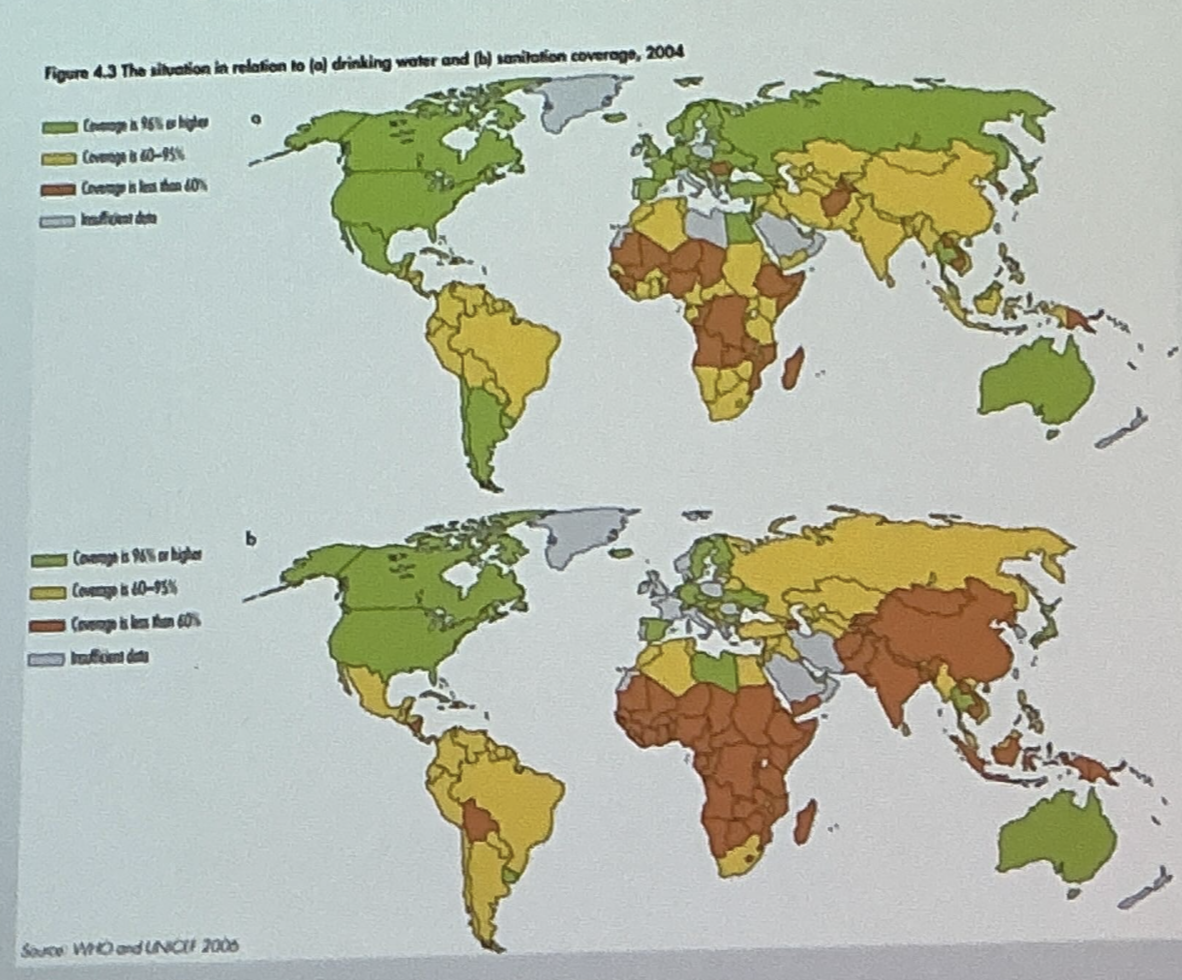
Water Quality and diseases—Situation in relation to drinking water and sanitation coverage 2004
drinking water : coverage is 96% or higher in America and Northern Asia and Europe, with less coverage in South America , Africa and the middle East
Sanitation coverage : coverage is 96% or higher in North America and oceania, with less coverage in South America , Africa, Asia, and the middle East
Water Quality
Intensive agriculture and dense settlement
Spatial distribution of effects -unique to systems
Catchment disturbance and pollution
Approximately 70 per cent of all water abstracted from rivers, lakes and aquifers is used for irrigation
Water Scarcity
"Aggregate impact of all users impinges on the supply or quality of water under prevailing institutional arrangements to the extent that the demand by all sectors, including the environment, cannot be satisfied fully."
A relative concept
Can occur at any level of supply or demand.
Refers to quality and quantity
Depends on specific needs
Water Scarcity
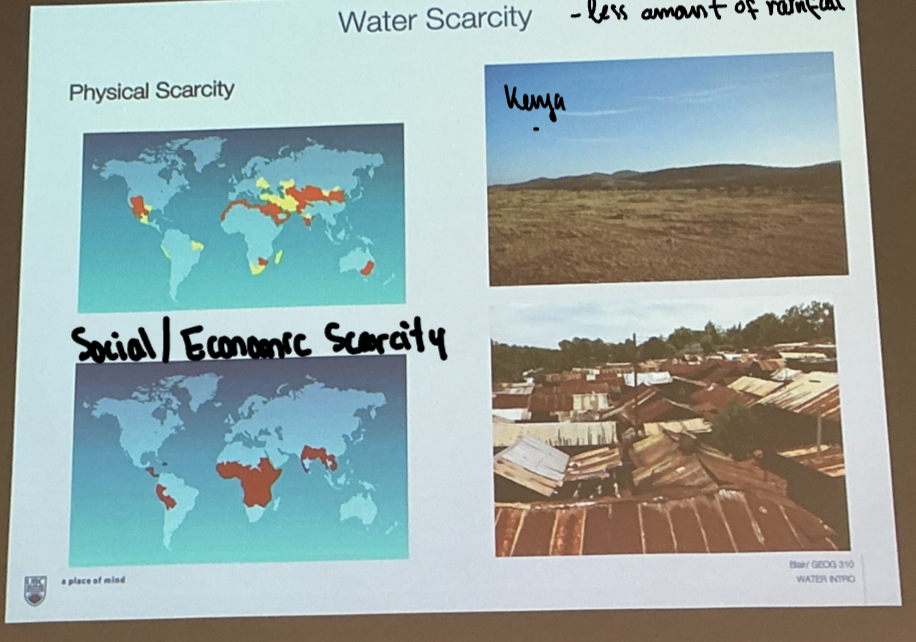
2 categories:
Physical Scarcity: related to precipitation and seasonal needs
→ Equator
Social/Economic Scarcity: related to economic, institutional conditions
→South Hemisphere
Water Stress
According to FAO map, where is there HIGH water stress (by country)?
Northern Africa and Middle East

Water Stress
According to FAO map, where is there HIGH water stress (by major basin)?
Along the Equator with no stress in Northern and Southern Hemispheres

Water Stress
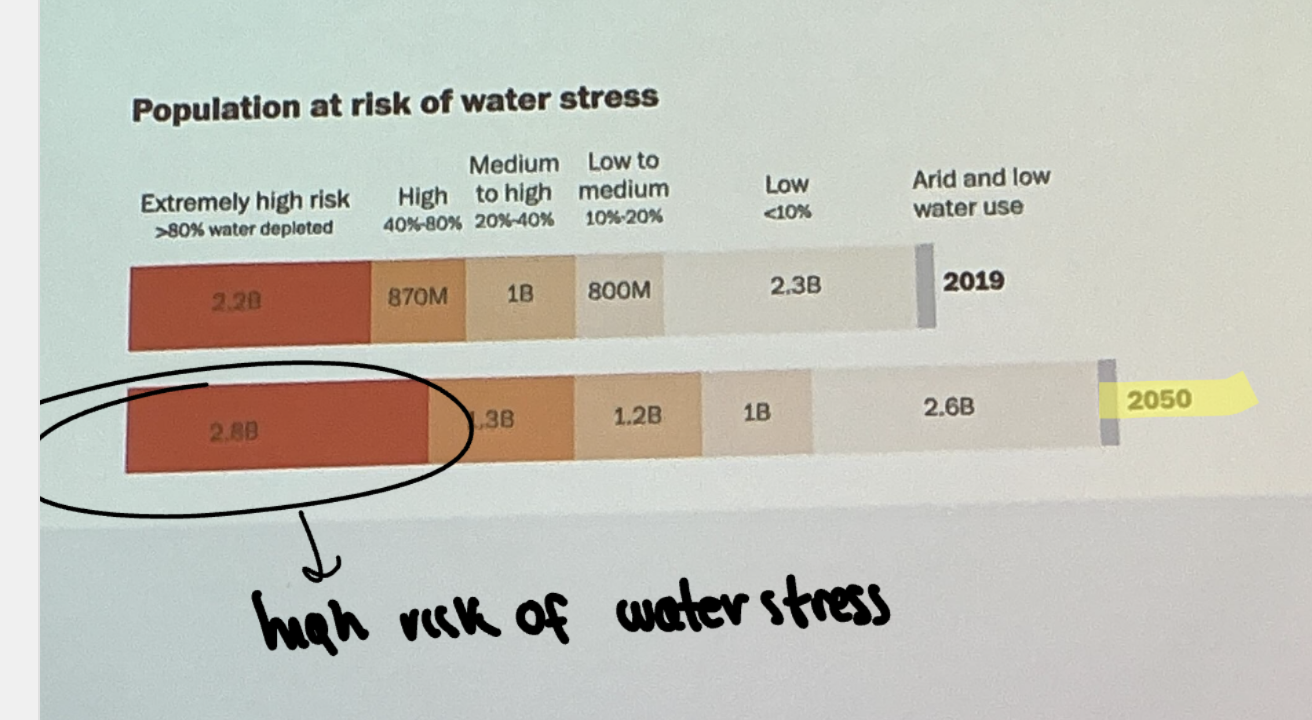
What is the number of population at risk of water stress 2019 vs 2050?
2019: 2.2B
2050: 2.8B
Water Scarcity—Causes
Water cycle characteristics
Poverty
Tech
Pollution externalities
Multiple manages responsibilities (political and hydrological boundaries)
Mismatch (between demand and supply, and between political and hydrological boundaries)→ how it is distributed and if there is water, how to access it?
Where do the drainage basins flow?
towards North Hemisphere

Water Security—Work to achieve it World Water Council 2000
'.. ensuring that freshwater, coastal and related ecosystems are protected and improved; that sustainable development and political stability are promoted, that every person has access to enough safe water at an affordable cost to lead a healthy and productive life and that the vulnerable are protected from the risks of water-related hazards.
World Water Council (2000)
According to Vorosmarty et al. Global geography of incident threat to human water security and biodiversity we have different impact in different areas.
The threat in biodiversity is similar to the threats to humans.
North hemisphere has low biodiversity threat and human water security threat
There are no areas with low biodiversity threat and high human water security threat

According to Vorosmarty et al. What is the main global water-security problem?
Nearly 80% of the world's population is exposed to high water-security threats
According to Vorosmarty et al. How do wealthy and less wealthy nations differ in managing water stress?
Wealthy nations use technology to offset stress, while poorer nations remain vulnerable due to limited investment.
According to Vorosmarty et al. How is freshwater biodiversity threatened?
Habitats associated with 65% of continental discharge are moderately to highly threatened.
According to Vorosmarty et al. What is the main recommendation for protecting freshwater resources?
Address threats at their source rather than relying on costly remediation of symptoms.
Dealing with Water Crisis
How does the freshwater crisis relate to the Environmental Kuznets Curve and technology?
Wealthier countries can use technology to offset water stress, but technology may treat symptoms rather than eliminate environmental threats at their source.
EKC: Economic growth can eventually reduce environmental degradation.
Technology: Can help reduce environmental impacts.
Freshwater crisis: Technology alone is insufficient; addressing the root causes is essential.

Sustainable Development Goals — causes of unsafe water
Unsafe water is responsible for 1.2 million death each year
6% of deaths in low-income countries are the result of unsafe water sources
¼ people do not have access to safe drinking water
6% of the world does not have access to an improved water source
Sustainable Development Goals 2030`
By 2030, achieve universal and equitable access to safe and affordable drinking water for all
By 2030, achieve access to adequate and equitable sanitation and hygiene for all and end open defecation, paying special attention to the needs of women and girls and those in vulnerable situations
By 2030, improve water quality by reducing pollution, eliminating dumping and minimizing release of hazardous chemicals and materials, halving the proportion of untreated wastewater and substantially increasing recycling and safe reuse globally
By 2030, substantially increase water-use efficiency across all sectors and ensure sustainable withdrawals and supply of freshwater to address water scarcity and substantially reduce the number of people suffering from water scarcity
By 2030, implement integrated water resources management at all levels, including through transboundary cooperation as appropriate
By 2020, protect end restore water-related ecosystems, including mountains, forests, wetlands, rivers, aquifers and lakes
Improved Water source—defined by WHO UN
What is an improved water source?
A source designed to better protect drinking water from contamination.
→Piped water, public taps, boreholes, protected wells, protected springs, and rainwater collection.
Improved Water source—defined by WHO UN
Does an improved water source guarantee safe drinking water?
No. It does not guarantee water safety or adequate supply.
definitions by WHO UN
What is safely managed drinking water?
Improved source, on premises, available when needed, and free from microbiological and priority chemical contamination.
definitions by WHO UN
What is a basic drinking water source?
An improved source within 30 minutes round-trip collection time.
definitions by WHO UN
What is a limited drinking water source?
An improved source requiring over 30 minutes round-trip collection time.
definitions by WHO UN
What is an unimproved drinking water source?
A source that does not protect against contamination.
definitions by WHO UN
What does no service mean?
Access to surface water only, such as rivers, lakes, or ponds.
Definitions across the drinking water ladder
Safely managed
An improved source:
located on premises
-available when needed
-not contaminated
Definitions across the drinking water ladder
Basic
An improved source:
misses a safely managed criteria
under 30 mins to collect (roundtrip)
Definitions across the drinking water ladder
Limited
An improved source:
misses a safely managed criteria
under 30 mins to collect (roundtrip)
Definitions across the drinking water ladder
Unimproved
Water from an unprotected dug well or spring
Definitions across the drinking water ladder
Surface water
Water direclty from a river, dam, lake, pond, stream or canal
Access to drinking water
Where is more safely managed water in the world?
Europe and Northern America 94%
High income countries 94%

Share of population with different levels of sanitation facilities
and 71% has access to basic and washing facilities → slowly increasing
SDG 6 – Clean Water and Sanitation (2026)
What is the goal of SDG 6?
Ensure availability and sustainable management of water and sanitation for all.
SDG 6 – Clean Water and Sanitation (2026)
How did access to safely managed water, sanitation, and basic hygiene change between 2015–2024?
Water: 68% → 74%;
Sanitation: 48% → 58%;
Hygiene: 66% → 80%.
SDG 6 – Clean Water and Sanitation (2026)
How many people gained access to these services between 2015–2024?
961 million gained safe drinking water;
1.2 billion gained safe sanitation;
1.6 billion gained basic hygiene.
SDG 6 – Clean Water and Sanitation (2026)
How many people still lack these services as of 2024?
2.1 billion lack safely managed water;
3.4 billion lack safely managed sanitation;
1.7 billion lack basic hygiene.
Is water a wicked problem?
High degree of uncertainty
difficult to define
persistent
unstable
multiple/ dependent causes
Water in Canada
What proportion of the world’s fresh water supply does Canada have?
6.6% is renewable water supply
20% is fresh water supply
Water in Canada
RENEWABLE WATER
"salt-free water that is fully replaced in any given year through rain and snow that falls on continents and island and flows through rivers and streams to the sea."
seen as → interest that can be spent indefinitely
Water in Canada
LAKES AND GROUND WATER
Capital that can only be spent once
Water in Canada
FRESHWATER PER CAPITA
is Canada strong?
yes, it has the highest water per capita in the world

Water in Canada
WATER WITHDRAWALS PER CAPITA 2023 from agricultural , industria and municipal purposes
Canada uses “top” of its water although it has many

Water in Canada
Is Canada water scarce?
Not when you consider total annual renewable fresh water supply per capita.
but we also need to consider:
Geographical mismatch' between population (where, how many, and consumption rate) and water sources (where, how much and what quality)
Physical and Social scarcity
Water in Canada
Nation water footprints
Canada
2049 m3/person/year
20% of our footprint = external
China
702 m3/person/year
7% of footprint = external
Global average: 1243 m3/cap/yr
Globalization- "Virtual Water"
Water in Canada—Issues
Pollutants→ high water intensity of our resources extractive and agricultural activities
Water in Canada—In municipal water systems
Canada ranked 12th
Canada, second lowest proportion of population served by tertiary treatment
Water in Canada—Issues with water management
Canada is the world's largest water diverter (mainly for hydroelectricity), and faces fragmented governance, weak enforceable water-quality standards, poor coordination, and data duplication and communication between federal and provincial governments.
Water in Canada— Issues with Water Availability
Vancouver precipitation example
There is a temporal water availability difference
There is more water when we don’t need that much and less during the summer
→ less precipitation during the summers
→ less snow precipitation
Ecological Footprint
"The area of land and water ecosystems required to produce the resources that the population consumes, and to assimilate the wastes that it produces, wherever on Earth the relevant land/water may be located
The land and water needed to support human consumption and absorb human waste.
This is the definition of Ecological Footprint.
Think of it as: How much of Earth's resources do we need to support our lifestyle?
Ecological Footprint Analysis
of a nation (or of a person) shows:
the total volume of water that is used to produce the goods and services consumed by the inhabitants of the nation (or by that person)
The water footprint is an indicator of direct and indirect water use.
→ Carbon footprint can also be utilized
Ecological Footprint Analysis—Virtual water
External water usage - outside your nation for products that yo actually use, but were not produced there.
Municipal Water Treatment
No treatment:
No treatment process or only screening and/or grit removal
Municipal Water Treatment
Primary treatment:
Removing a portion of suspended solids and organic matter by physical and/or chemical processes
Municipal Water Treatment
Secondary treatment:
Removing organic matter and suspended solids using biological treatment processes and secondary settlement
Municipal Water Treatment
Tertiary treatment:
treatment: Removing specific substances of concern (solids, nutrients and/or contaminants) after secondary treatment using a number of physical, chemical or biological processes
Solutions—water and ecosystem
Use natural ecosystem services: wetlands purify water, floodplains control floods
green infrastructure (swales, living roofs, rain gardens) manages urban water
embracing and valuing ecosystem services
Solutions—Demand management
Reduce the amount or quality of water needed,
improve water-delivery efficiency,
spread out demand over time,
build resilience to long-term changes in water supply.
Solutions—Pricing
make it accessible
Solutions —Participation
community management
community based water quality monitoring
community filling in governance gaps
need to coordinate with diff levels of governance
work on the unsolved problem of jurisdictional fragmentation
Solutions — Preserve water quality
Pollution prevention rather than mitigation
source water protection
multi-barrier approach (water treatment, distribution protection, testing and training)
Integrating land use, water quality and water quantity
Integrated watershed management - payments for ecosystem services potentially
Integrated urban water management
even connecting to more holistic approaches of management , land use, preserve