Genetics Lect 15
 Call Kai
 Learn
 Practice Test
 Spaced Repetition
 Match
 Flashcards
 Knowt Play
1/46

There's no tags or description
Looks like no tags are added yet.
47 Terms
Gene
segment of DNA used to make functional product (RNA or polypeptide)
1st Step: Transcription
Transcription
copying of DNA sequence into RNA sequence
proteins must recognize & act on DNA for it to occur
Gene Expression
overall process where info within a gene is used to produce a functional product which is used to (along w/ environmental factors) determine a trait
Regulatory Sequences
site for binding of regulatory proteins
regulatory proteins: influence rate of transcription (variety of locations)
Promoter
DNA sequences that “promote” gene expression by directing the exact location for initiation
site for RNA polymerase binding
signals beginning of transcription
located upstream from where transcription actually starts (near 5’ side)
Numbering System of Promoters
Transcription Start Site (TSS): 1st nucleotide that acts as a template for transcription
numbered in relation to start site
Downstream (+): nucleotides located at right (3’ direction of coding strand)
Upstream (-): nucleotide located to left (5’ direction of coding strand)
Consensus Sequence: most common sequence (-35 and -10)
high levels of transcription
less if away from consensus sequence
Terminator
signals of of transcription
Ribosome-Binding Site
site for ribosome binding to mRNA in bacteria
translation begins near this site in the mRNA
In eukaryotes, the ribosome binds to a 7-methylguanosine cap in the mRNA, & the ribosome scans the RNA for a start codon
Codons
codons: 3 nucleotide sequence that specify specific AA
start codon: specifies 1st AA in polypeptide sequence
formylmethionine (bacteria) or methionine (eukaryotes)
stop codon: end of polypeptide synthesis
polycistronic (bacteria): encodes 2+ polypeptides
Template Strand
DNA strand that is actually transcribed (used as template for complementary RNA sequence)
Coding Strand
also called sense strand or nontemplate strand
opposite strand of template strand
identical to base sequence in RNA (except for Thymine)
Transcription Factors
recognize promoter & regulatory sequences to control transcription
What directs translation
ribosomal binding site & codons
3 Stages of Transcription
initiation, elongation, & termination (involves protein-DNA interactions)
Transcription Initiation
promoter is a recognition site for transcription factors
transcription factors enable RNA polymerase to bind to promoter
After binding, DNA is denatured into bubble (Open Complex)
Transcription Elongation
RNA polymerase slides along DNA in open complex to synthesize RNA
slides along template strand in 3’ to 5’ direction & RNA synthesized in 5’ to 3’ direction
pyrophosphate released
open complex = 17 bases long & behind open complex, DNA rewind back into double helix
43 nucleotides/sec
Termination
terminator is reached
causes RNA-DNA hybrid of open complex separate
RNA polymerase & RNA transcript to dissociate from DNA
2 Transcription Terminator Mechanisms (E. coli)
rho-dependent termination
Requires a protein known as ρ (rho)
rho-independent termination
Does not require ρ
How is the p-dependent termination facilitied
a uracil-rich sequence located at the 3’ end of the RNA
stem-loop structure upstream of the uracil-rich sequence
RNA Polymerase Holoenzyme structure
complete, biologically active form of enzyme that is fully capable of initiating transcription at specific promoter site
Core Enzyme: handles actual elongation of RNA but can’t recognize promoters on their own
5 Subunits = α2BB’w
Sigma factor: regulatory subunit that binds to core enzyme to recognize & bind to promoter sequence
one subunit = σ
What does RNA Polymerase Holoenzyme do
RNA polymerase holoenzyme binds loosely to the DNA & scans along the DNA, until it encounters a promoter
When it does, sigma factor recognizes both the –35 and –10 sequences
A region within the sigma factor that contains a helix-turn- helix structure is involved in a tighter binding to the DNA
RNA Polymerase & Complexes
closed complex: binding of RNA polymerase to the promoter
open complex: formed when the TATAAT box in the -10 sequence is unwound
A-T bonds are more easily separated
A short RNA strand is made within the open complex
Sigma factor is released at this point
marks the end of initiation
How many RNA polymerases are used in Eukaryotic transcription
RNA poly I, II, II
RNA Polymerase I
Transcribes all rRNA genes (except for the 5S rRNA)
rRNA: combines w/ protein to form ribosome structure
RNA Polymerase II
transcribes all protein-encoding (structural) genes (that is, it synthesizes all mRNAs)
Transcribes some snRNA genes needed for splicing
short, non-coding RNA molecuels that mediate & catalyze pre-mRNA splicing
RNA Polymerase III
Transcribes all tRNA genes (
translation, helps form polypeptide chain w/ AA
Transcribes the 5S rRNA gene
Transcribes microRNA gene
controls post-transactional gene expression
Eukaryotic Transcription Promoter
have a core promoter & regulatory elements that influence the core promoter
core promoter (short): minimal portion of promoter required to properly intiate transcription
consists of TATA box (start area) & transcriptional start site (TATA not always present)
Basal transcription: minimal, baseline level of gene expression w/o help of specific gene activators/repressiors
core promoter by itself produces a low level of transcription
Regulatory Elements
Regulatory elements: short DNA sequences that affect the binding of RNA polymerase to the core promoter
Transcription factors (proteins) bind to these elements and influence the rate of transcription
There are two types of regulatory elements
Enhancers: stimulate transcription
Silencer: Inhibit transcription
Cis-Acting Elements
DNA sequences that exert their effect only over a particular gene (TATA box, enhancers, silencers)
Trans-Acting Factors
regulatory proteins that bind to such DNA sequences (Cis-acting elements)
What 3 proteins are need for basal transcription to happen at the promoter
RNA polymerase II
Five different proteins called general transcription factors (GTFs)
A protein complex called mediator
What are the two models for eukaryote termination
Allosteric model: after transcribing the polyadenylation signal sequence, RNA polymerase II is destabilized & leaves DNA & termination occurs
Torpedo model: an exonucelease binds to 5’ end of RNA that is being transcribed & degrades it in a 5’ to 3’ direction
Collinearity of Gene Expression
a linear correspondence or ordered relationship at different levels of genetic organization
Eukaryotes: protein-encoding genes aren’t always colinear w/ mRNA
Ex: coding strand DNA sequence similar to mRNA sequence
pre-mRNA & Splicing
beginning of transcription in the nucleus
Introns (intervening sequence): non-coding region that are later removed or excised
Exons: protein coding regions that are connected together or spliced
Processing of rRNA & tRNA Transcripts Modification
DNA often made into larger, longer RNA molecules after being transcribed
Transcript must be cut & processed into smaller, functional pieces
5’ Capping Transcript Modification
modified guanine nucleotide (7-methylguanosine) is added to beginning (5’ end) of mRNA & is recognized by cap-bidning proteins
Functions:
splicing of introns
helps mRNA leave nucleus & enter ribosome
helps ribosome recognize/attach to mRNA
3’ polyAtailing of mRNA transcripts
Poly-A Tail: a long chain of adenine (A) nucelotides added to 3’ end of mRNA after gene is transcribed
Functions:
protect mRNA from being broken down
inc. mRNA lifespan
help w/ translation
RNA Editing for Transcript
base sequence of RNA changed after is has been transcribed
Ex:
addition/deletion of particular base
conversion of base
Deamination: converts RNA nucleotides to new forms
Covalent Base Modification for Transcript
covalent modification of base within RNA
What are the 3 splicing mechanisms
Group I intron splicing
Group II intron splicing
Spliceosome (pre-mRNA)
All three cases involve: Removal of the intron RNA & covalent linkage of the exon RNA fragments
Self-Splicing
group I and II introns
does not require the aid of enzymes
Instead the RNA itself functions as its own ribozyme
RNA can fold into specific 3D shape that allows it to catalyze its own splicing/removal
can occur in vitro without any proteins (outside cell)
However, in vivo, maturase proteins often enhance the rate of splicing
Group 1 Splicing
involves binding of a free guanosine to a site within the intron-leads to cleavage at 3’ end of exon 1
Then bond between different nucleotide in the intron and the 5’ end of exon 2 is cleaved
The 3’ end of exon 1 then forms a covalent bond with the 5’ end of exon 2
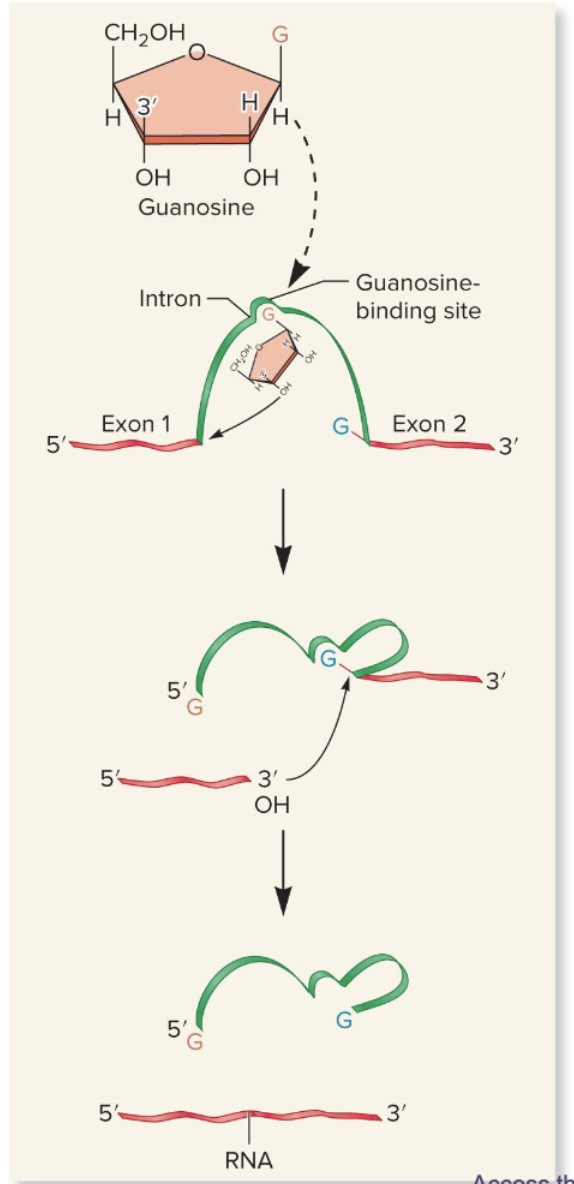
Group 2 Splicing
similar except that the 2’ OH group in adenosine begins catalytic process

Spliceosome
pre-mRNA splicing requires the aid of a multicomponent structure known as the spliceosome
It is composed of several subunits known as snRNPs (pronounced “snurps”)
Each snRNP contains small nuclear RNA and a set of proteins
What are the functions of the spliceosome
Bind to an intron sequence and precisely recognize the intron-exon boundaries
Hold the pre-mRNA in the correct configuration
Catalyze the chemical reactions that remove introns and covalently link exons
Occurs via a metalloribozyme (a ribozyme that requires Mg 2+ ) in the U6 SnRNP
Alternative Splicing
pre-mRNA with multiple introns can be spliced in different ways:
generate mature mRNAs with different combinations of exons
Two (or more) polypeptides can be derived from a single gene
organism to carry fewer genes in its genome, yet have a large diversity of polypeptide
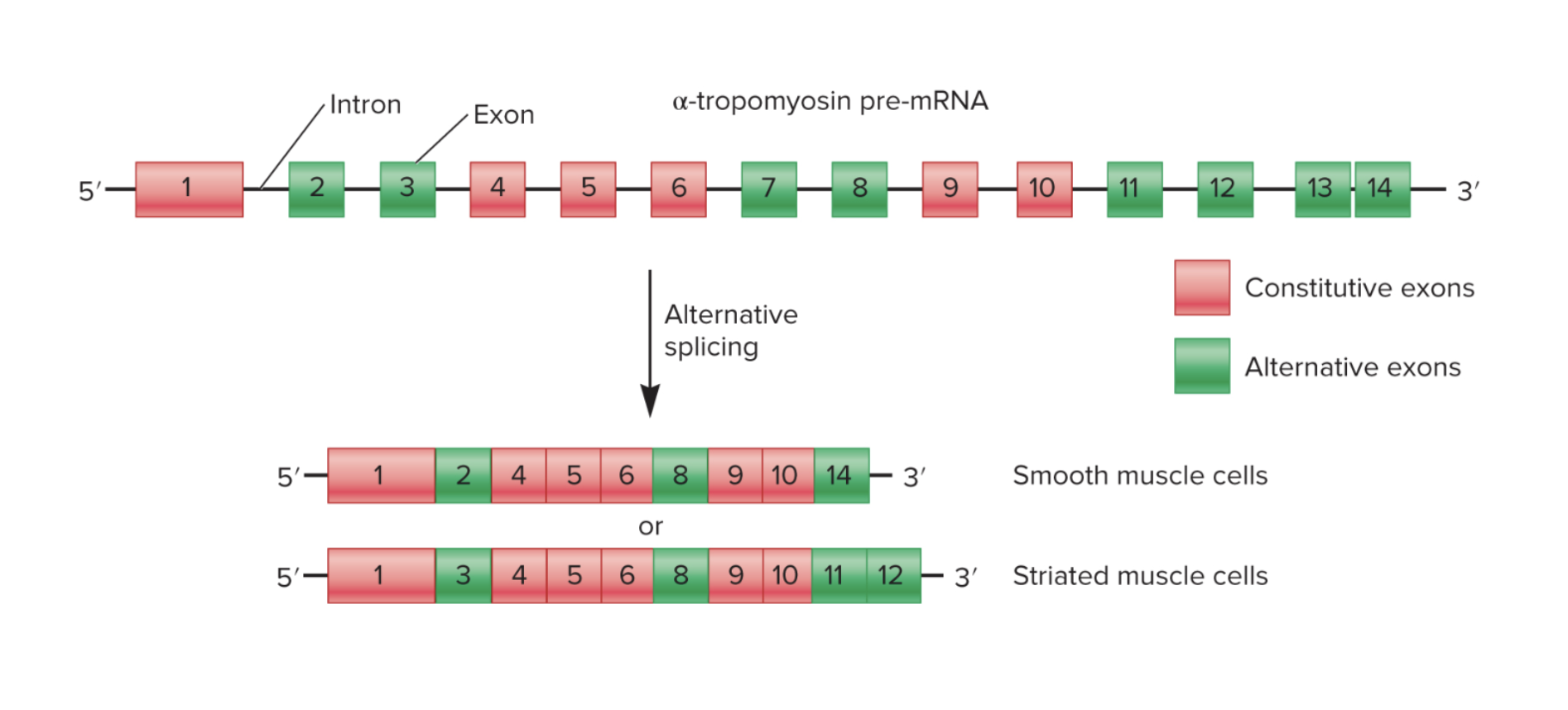
Splicing Factors
proteins that regulate alternative splicing
Splicing Repressors: prevent splicing
SPlicing Enhancers: facilitate splicing