Physiology of Neurons
 Call Kai
 Learn
 Practice Test
 Spaced Repetition
 Match
 Flashcards
 Knowt Play
1/23

There's no tags or description
Looks like no tags are added yet.
24 Terms
What are the Characteristics of Electrical Synapse?

Why is there NO Amplification in Electrical Synapses?

What is Spatial Summation of Chemical Signals?
Spatial summation
A neuron determines whether to fire based on the “add together” of all the tiny signals it is receiving from several other neurons synapsing on it (from both excitatory and inhibitory inputs).
In this way small depolarisations (if there are many) can reach threshold
See convergent neuronal signalling
What is Temporal Summation of Chemical Signals?
Temporal summation
When the input neuron is firing fast enough so that the receiving neuron can “add together” the many tiny signals, ultimately reaching threshold.
This happens when the receiving neuron’s ability to recover from the tiny input (depolarisation) is slow enough that the next signal arrives while the receiving neuron has not yet recovered from the previous signal (i.e. it is still slightly depolarized)
Coding of Intensity by Neurons

What is Excitability of Neurons?
Excitability = how easy to start nervous signalling
-“sensitivity” in sensory cells
-“irritability” in muscle or effector cells
-Risk of seizure or spasms
What Effect does Increased Threshold have on Excitability?
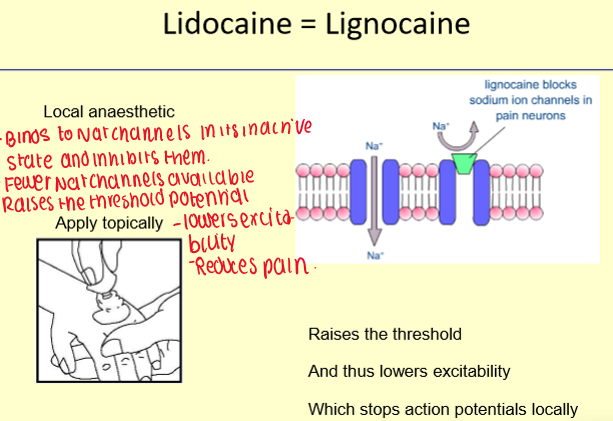
Increased threshold lowers excitability
Threshold = voltage above which action potential fires
Excitability Changes are the Basis of Psychotropic Pharmacology
2 ways to increase firing rate: (1) receptor, (2) excitability
Changes in threshold have profound health & behavioural effects
What is Membrane Voltage?
Membrane voltage is described in terms of what happens to the intracellular face of the membrane
-When the inside of the membrane is positive with respect to the extracellular facing part of the membrane, we say, “The membrane is positive”
-The extracellular space of all cells is electrically joined and thus has the same voltage everywhere
-The extracellular fluid is considered the electrical ground
Voltage Depends of Permeability
When Na+ channels open, the membrane tends to become positive inside
[Na+] is higher outside the cell than inside
When K+ channels open —> the membrane tends to become negative inside
K+ ions travel from inside to outside
Due to the chemical gradient
Because [K+] is higher inside than outside the cell
This exit of K+ causes the membrane to become negative inside
When Ca2+ channels open —> the membrane tends to become positive inside
[Ca2+] is higher outside than inside
Calcium passively goes inward
What is the Action of Lidocaine?
What is Carbamazepine?

Question

What are the Two Forces on Each Ion?

What is the Equilibrium Potential- Ek?
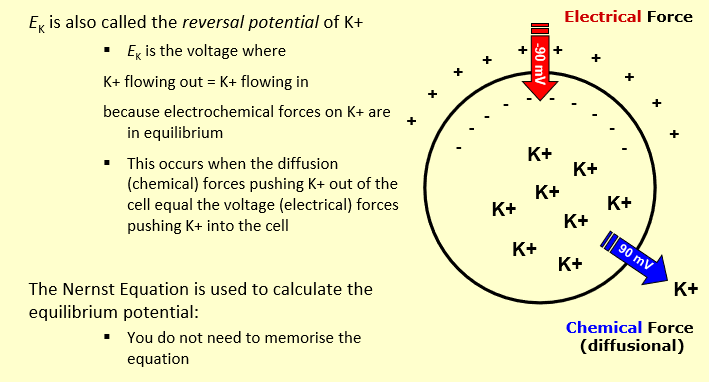
What are the Equilibrium Potentials?

What are Action Potentials?

What are Graded Potentials?

How do Graded Potential Transmit Signals?

How do Graded Potentials Transmit Action Potentials?
Electrotonic conduction (graded potentials) transmits signal along the length of the axon.
The AP is a way for re-amplifying that signal
What is Saltatory Conduction?

What is Conduction Velocity?

What are the Clinical Uses of Conduction Velocity?
Nerve conduction studies are used for evaluation of paraesthesia
numbness, tingling, burning
Evaluation of weakness of the arms and legs
Summary
