Professor Messer 5.2 | Cable Connectivity
 Call Kai
 Learn
 Practice Test
 Spaced Repetition
 Match
 Flashcards
 Knowt Play
1/9

There's no tags or description
Looks like no tags are added yet.
10 Terms
Using the right cable
In networking, various cables are used for different purposes, each with specific specifications.
Speed or bandwidth refers to the theoretical maximum data rate, usually measured in bits per second, which represents the size of the pipe.
Throughput indicates the actual amount of data transferred in a given time, also measured in bits per second, but OS file transfers often use bytes per second, how much water is flowing through the pipe.
Distance limitations vary depending on the type of cable, such as copper or fiber, and the use of repeaters, how long is the pipe.
Unshielded and shielded cable:
In copper Ethernet cabling, abbreviations indicate the type of shielding:
U: Unshielded
S: Braided shielding
F: Foil shielding
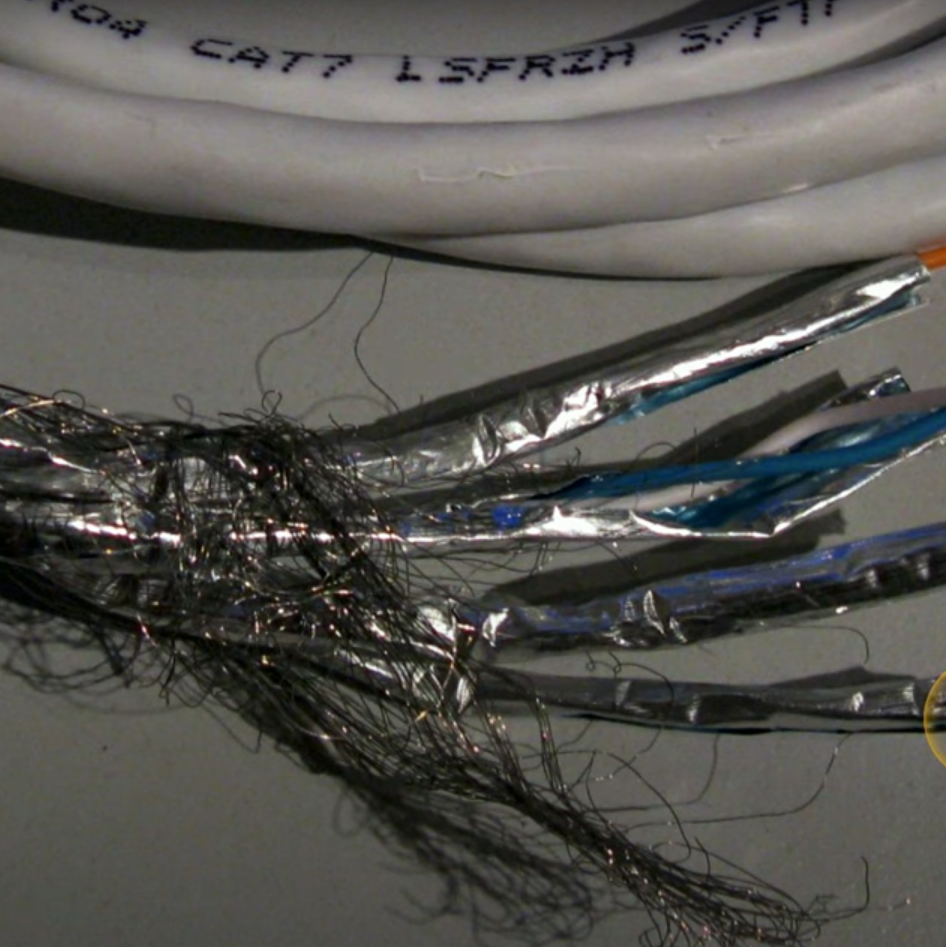
If you look at the outside of the cable, you’ll see abbreviations that describe how this cable is constructed. We usually will write this as: (Overall cable) / (Individual pairs) TP. I.e braided shielding around the entire cable and foil around the pairs is S/FTP.
Plenum Space
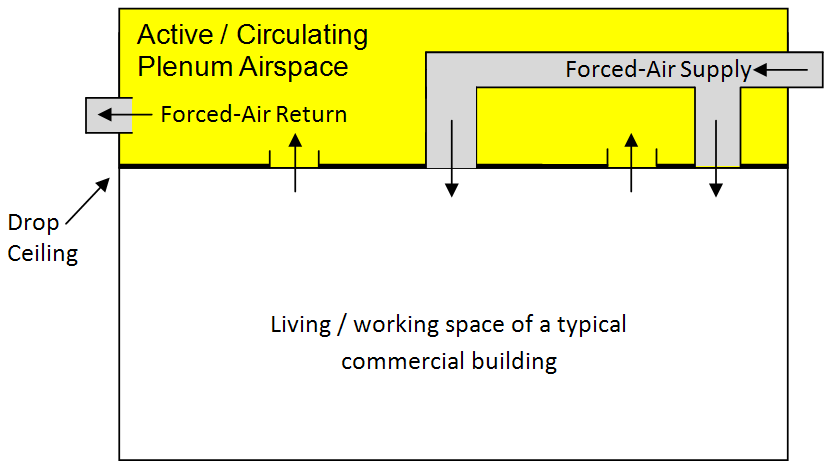
Space in a building allows air circulation for heating and air conditioning, providing pathways for airflow.
In a non-circulating airspace, cables aren't exposed to forced air supply or return systems, reducing fire risk. However, in a plenum space, shared airspace could circulate smoke and toxic fumes if cables catch fire.
Plenum-rated cable
Designed for use in spaces where air circulates, such as ceilings
Traditional-rated cables use polyvinyl chloride (PVC), while fire-rated plenum cables have jackets made of fluorinated ethylene polymer (FEP) or low-smoke PVC.
These cables may be less flexible and have a limited bend radius, which must be considered when planning cable routes.
Are crucial for worst-case fire safety planning.
Serial console cables
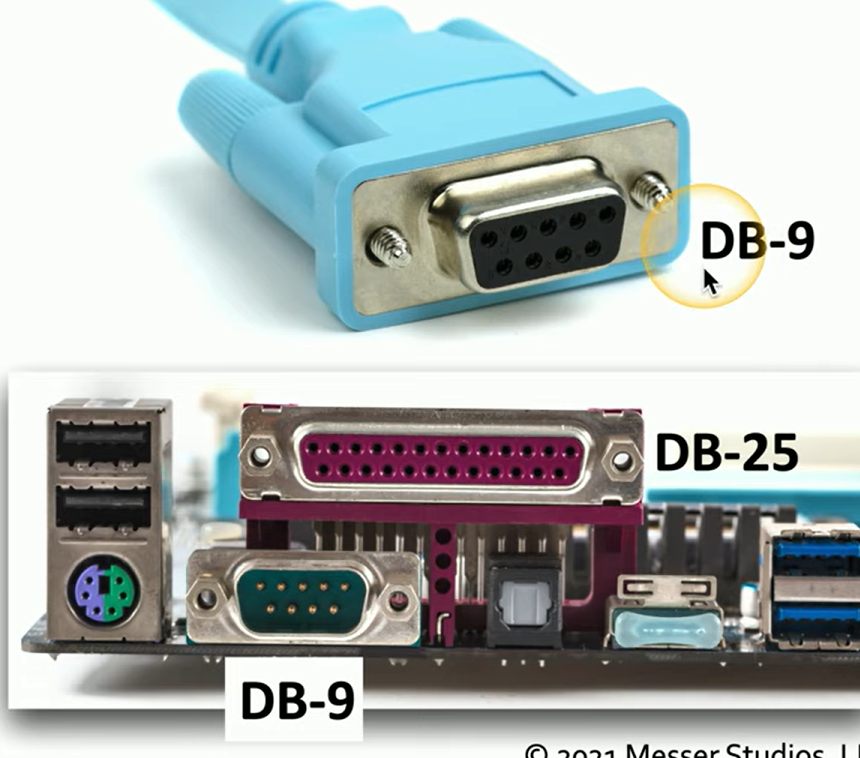
Often referred to as D-subminiature or D-sub cables, are shaped like the letter "D," with the number in the name indicating the number of pins on the connector.
These cables transmit RS-232 signals, an industry standard since 1969 for serial communication.
Originally designed for modem communication, RS-232 was also used for devices like printers, mice, and networking equipment. Today, it's commonly used as a configuration port for various devices.
“Rollover” cable
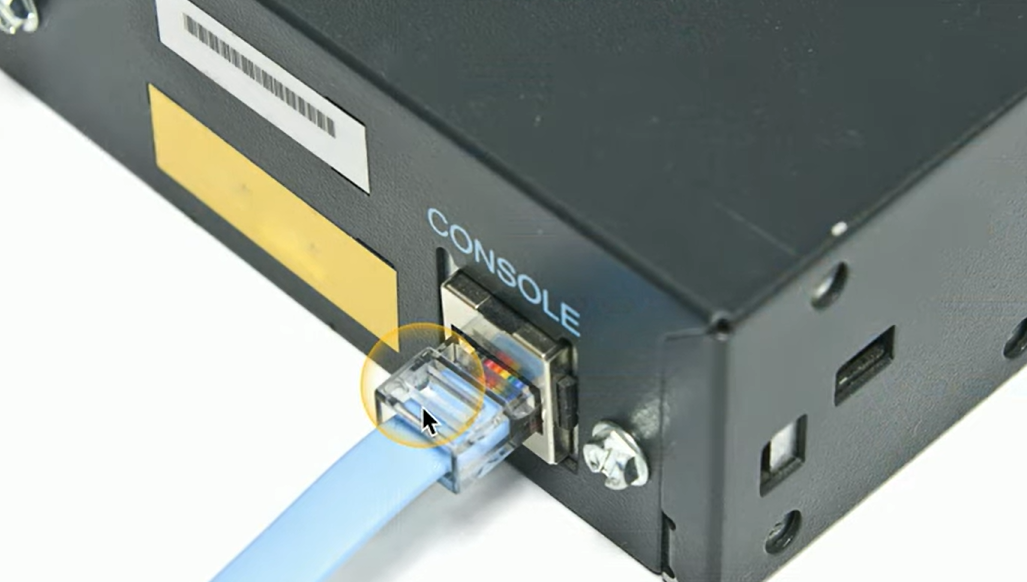
Also known as a Cisco console cable or Yost cable, is a serial cable standard proposed by Dave Yost.
It is commonly used to manage Cisco networking equipment, allowing RJ-45 connections to access the switch or router's management port
This cable is a standard for RJ-45 serial communications and is used with serial port connectors. If you see a console connection with an RJ-45 link on a switch or router, it's likely that a rollover cable is in use.
Ethernet crossover cables
Are used to connect Ethernet devices directly without a switch, often serving as an alternative to using serial ports or management ports.
They can be especially useful when you don't have the appropriate serial cable or connector.
Having a crossover cable or an adapter with a crossover cable on hand can be a practical solution for connecting to network devices.
Power over Ethernet (PoE)
Delivers electrical power along with data over an Ethernet cable, allowing devices like phones, cameras, and wireless access points to be powered without separate power sources.
Can be supplied in two ways: Endspans, which provide built-in power directly from the switch, and Midspans, which use an in-line power injector to add power to the Ethernet connection.
Power modes:
Mode A: Power is delivered on the same pairs used for data transmission (common-mode data pair power).
Mode B: Power is supplied on the spare pairs of the cable, if available.
4-pair: Power is transmitted using all four pairs of the Ethernet cable, providing power on all data pairs. (usually gigabit ethernet)
PoE standards
PoE (IEEE 802.3af-2003): The original PoE specification, providing 15.4 watts of DC power with a maximum current of 350 milliamps.
PoE+ (IEEE 802.3at-2009): An enhancement to the original standard, delivering 25.5 watts of DC power with a maximum current of 600 milliamps.
PoE++ (IEEE 802.3bt-2018): The latest standard, offering two types: Type 3 provides 51 watts with a maximum current of 600 milliamps, and Type 4 provides 71.3 watts with a maximum current of 960 milliamps. This standard is commonly used for high-power applications, including 10 Gigabit Ethernet connections.