Chapter 26: Blood Flow
 Call Kai
 Learn
 Practice Test
 Spaced Repetition
 Match
 Flashcards
 Knowt Play
1/27

Earn XP
Description and Tags
28 Terms
Renal system is involved, fluid in electrolytes, etc.
Baroreceptors
Chemoreceptors
Fight or flight
Renin Angiotensin Aldosterone System → RAAS
Regulation of Blood Pressure
Returning back to the heart.
Venous side
Going away from the heart.
Arterial side
___ becomes hardened, thick, not as elastic.
Don’t stretch as much anymore.
Develop plaque.
BP increase: The walls are thick, and pressure to squeeze blood through is higher.
Cholesterol buildup: More squeezing will happen because you have narrow space.
Arterial as it ages
Buildup of plaque in the arteries.
When plague begins to build up, it blocks flow. Eventually, a piece of plaque can travel and block other flows.
Atherosclerosis
Cells that are dependent on RBC become starved. They become starved because of lack of oxygen → Makes you fatigue, shortness of breath, chest discomfort, chest pain.
If RBC is deprived from coronary arteries, then you cannot deliver oxygen to make blood flow.
A piece of plaque breaks off and travels to smaller capillaries and blocks off blood flow.
What happens because of atherosclerosis?
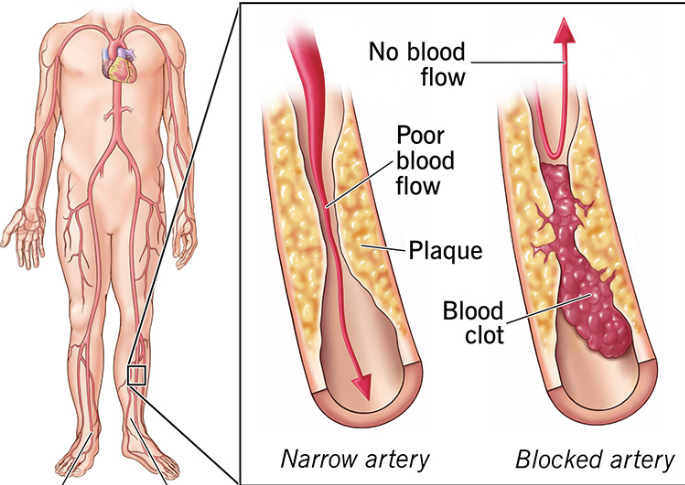
Disease: Clots profuse → Excessive blood clotting or hypercoagulation in the arteries.
Prevents blood flow in your lower extremities.
Example of this feeling: Leg asleep, impact blood flow, discomfort.
In need of good perfusion.
Has no good pulse.
Peripheral Artery Disease
Symptoms of Peripheral Artery Disease
Pale/bluish skin color.
Weak/absent pulses in the legs/feet.
Shiny skin, with loss of hair on legs.
Sore/wounds on the toes, feet, or legs that won’t heal.
What is this?
Fingers turn white because there is not enough oxygen.
Everything is clamping down & poor perfusion to extremities as a result of cold temperatures or stress.
Raynaud’s Syndrome
Raynaud’s Syndrome:
Occurs alone, no evidence of associated disorder.
Is this primary or secondary?
Primary
Raynaud’s Syndrome:
Associated with the illness (e.g, lupus, systemic sclerosis).
Is this primary or secondary?
Secondary
Symptoms of Raynaud’s Syndrome
1: Fingers turn white.
2: As tissues lose oxygen, fingers turn a bluish hue.
3: You’ll experience tingling, swelling, and/or painful throbbing.
Weakening in the wall of the vessel.
Develops a lump → Weakness in the arterial walls.
Heart/blood flow pushing leads to displacement.
As blood starts to push on the walls, it causes the __ to grow more, like a balloon.
Leads to internal bleeding.
Aneurysm
What is this is?
Dilated abnormally veins.
Inadequate return flow to heart.
Varicose Veins
Stages of Varicose Veins
1: Reticular veins or spider veins
2: Varicose veins/venous nodes
3: Edema of lower legs
4: Varicose eczema or trophic ulcer
Virchow's Triad
Hypercoagulability, vessel wall injury, stasis of blood.
Which part of Virchow's Triad is this?
Cancer, thrombophilia, inflammatory disease.
Virchow's triad —> Hypercoagulability
Which part of Virchow's Triad is this?
Surgery, chemical irritation, inflammation.
Virchow's triad —> Vessel wall injury
Which part of Virchow's Triad is this?
Immobility, varicose veins, venous obstruction.
Virchow's triad —> Stasis of blood
Developing a clot in the lower extremities.
Blood can’t return to the heart because of the clot.
Stuck.
Life threatening because it can develop an embolus.
Venous Thrombosis
DVT
Discomfort and continued swelling of the leg.
Can be more painful/hurts when standing and walking.
Become warm and red.
Deep vein thrombosis.
Problem is returning back to the heart.
Appearance: Varicose veins, swelling, and darkened, hard, or leathery skin.
Symptoms: Pain & heaviness, restless leg syndrome, leg cramps or spasms, and itchy skin.
Venous Statistics
Condition: As we age, walls become harder.
Blood cannot be pushed through very easily, it becomes squeezed.
Plaque build up.
Hypertension
Normal healthy BP:
120/80
Persistent high BP.
Losing perfusion: Brain, heart, eyes, blood, and kidneys.
Changes in vision.
Heart pushes harder, overworked.
Kidneys become irritated.
Hypertension Complications
What is this?
When a patient goes from sitting/laying down, they become very light-headed when they stand up.
Your body doesn’t make the correction quick enough.
Drop in BP decreases, makes them feel light.
Heart is increasing the heart rate.
Orthostatic hypotension
Blood is being delivered away from the heart.
Arterial
Blood is returning
Venous