AP Psych Unit 2
 Call Kai
 Learn
Learn Practice Test
 Spaced Repetition
 Match
Match Flashcards
 Knowt Play
1/43

There's no tags or description
Looks like no tags are added yet.
Name | Mastery | Learn | Test | Matching | Spaced | Call with Kai | Chat |
|---|
No analytics yet
Send a link to your students to track their progress
44 Terms
chronological order of how a message gets sent (neurons)
Dendrites (recieves msg from other cells)
Soma (cell body)
Axon (passes msgs away from the cell body to other neurons, muscles, or glands)
Terminal branches of neuron (form junctions w other cells)

what is the myelin sheath
a layer of fatty cells segmentally encasing the fibers of many neurons; enables vastly greater transmission speed of neural impulses
if it deteriorates you get MS
things to know about axons
axon
transmits electrical impulses away from the cell body to other neurons, muscles, or glands.
generally one axon per cell
no ribosomes
myelin sheath
branch further/longer from cell body
things to know about dendrites
bring info to the body
many per cell
ribosomes
no myelin sheath
branch near the cell body
types of neurons?
Sensory
Interneurons (found exclusively within spinal cord & brain) → stimulated by signals reaching them from sensory neurons, other interneurons, or both
Motor Neurons (transmit impulses— send msgs from CNS to muscles, glands)
what are glial cells
holds neurons together, supports them, protects them, removes waste, allows them to work more efficiently. There are more glial cells than neurons.
main difference between sensory & motor neurons?
sensory → afferent → carry incoming info from sense receptors to the CNS
motor → efferent → carry outgoing info from the CNS to muscles & glands
interneurons connect the two neurons
what is action potential
a brief electrical charge that travels down an axon and is generated by the movement of positively charged atoms (Na & K) in and out of channels in the axon’s membrane
what is a reflex
simplest form of neural transmission
afferent (s) & efferent (m) nerve fibers fire msgs via interneurons to the spinal chord
(ex— hand touches candle flame)
Sensory (Afferent) Neurons in your skin detect the extreme heat and fire an action potential.
They carry this electrical signal straight to your spinal cord.
Inside the spinal cord, a short neuron called an Interneuron acts like a processing shortcut. It immediately triggers a response.
Motor (Efferent) Neurons instantly receive the signal from the interneuron and command your biceps to contract, pulling your hand away.
while hand jerks immediately, don’t fully “feel” the pain until later
Continues traveling up the spinal cord, through the brainstem, and into the thalamus (your brain's sensory relay station). From the thalamus, the signal is directed to the somatosensory cortex in your parietal lobe.
acetylcholine (ACh)
enables muscle action, learning, and memory
malfunctions— ex: ACh producing neurons deteriorate w Alzheimers
dopamine (the chase)
influences movement, learning, attention, and emotion
excess dopamine receptor activity → linked to schizo
starved of dopamine → tremors + decreased mobility of parkinson’s
serotonin (catch)
affects mood, hunger, sleep, arousal
undersupply = depression
prozac and other antidepressant drugs raises serotonin levels
norepinephrine
helps control alertness + arousal
undersupply can depress mood
GABA
major inhibitory neurotransmitter (decreases likelihood of action potential)
undersupply linked to seizures, tremors, and insomnia
glutamate
major excitatory neurotransmitter, involved in memory
oversupply can overstimulate brain, producing migraines or seizures (why some people avoid MSG)
how do drugs/toxins work (4)
some reduce the amt. of neurotransmitters in the synaptic gap
some speed up (excite) the release of transmitter chemicals into the synaptic space
some work directly on receptor sites
ex: LSD → inhibits serotonin => dream like state
some block receptors
curare => blocks Ach receptors, produces paralysis
agonist vs antagonist
agonist
mimics or enhances the effects of a neurotransmitter
binds to and activates receptor sites on a post-synaptic neuron, encouraging neural firing. It can also work by blocking re-uptake
ex: LSD, SSRI
antagonist
blocks or inhibits the effects of a neurotransmitter
binds to receptor sites, but does not activate them. Just occupies the space to prevent the real neurotransmitter from binding & reduce neural firing.
ex: curare
what is a complex neural network
Interconnected neurons form networks in the brain. These networks are complex and modify with growth and experience.

what is plasticity
the brain’s ability to modify itself after some type of injury or illness
brainstem
begins where the spinal cord swells and enters the skull
responsible for automatic survival functions
(contains midbrain, pons, & medulla)

thalamus
brain’s sensory switchboard, located on top of the brainstem
directs messages to the sensory areas (except for smell) in the cortex & transmits replies to the cerebellum and medulla
cerebellum
the “little brain” attached to the rear of the brainstem. It helps coordinate voluntary movements & balance
the limbic system
doughnut shaped system of neural structures at the border of the brainstem and cerebrum
associated w fear, aggression, and drives for food and sex
includes hippocampus, amygdala, and hypothalamus

medulla
base of the brainstem that controls heartbeat + breathing
reticular formation
nerve network in the brainstem that plays an important role in controlling arousal
amygdala
two almond shaped neural clusters linked to fear, anger, aggression
hypothalamus
below thalamus
eating, drinking, body temp, control of emotions (mantainance activities)
helps govern endocrine system via pituitary gland
spinal cord
complex cable of neurons that run down the spine, connecting the brain to most of the rest of the body. Made up of bundles of long nerve fibers
functions (2)
permits reflex movements
carry msgs to and from brain
cerebral cortex
fabric of interconnected neural cells that covers the cerebral hemispheres
ultimate control & info processing center
4 lobes (each brain hemisphere is divided into) + functions
frontal: judging, planning, problem solving, etc.
temporal: listening & comprehension
occipital: field of vision + visual processing
parietal: integrates sensory info

motor vs sensory cortex
motor: area at the rear of the frontal lobes that controls voluntary movements
sensory: recieves info from skin surface & sense organs
broca’s vs wernicke’s area
broca
located in the frontal lobe, directs muscle movement in speech
language motor area → manages movements to produce spoken language
wernicke
located in left temporal lobe
language comprehension
aphasia
impairment of language due to damage of Broca’s or Wernicke’s area
(expressive— broca. sensory— wernicke)
brain lesion + ex
destroys brain tissue to study animal/human behavior after such destruction
ex: cutting the corpus callosum in half. seizures on the left side stay localized, can’t cross the bridge
become ‘split brain patients’
tools for studying the brain (5)
clinical observation
EEG
PET Scan
MRI
CT Scan
clinical obsv
observe effects of specific brain diseases/injuries (but person has to be dead)

EEG
measures electrical activity in brain (jagged graph)

PET Scan
position emission topography
detects radioactive form of glucose while the brain performs a task (red = hot spots)
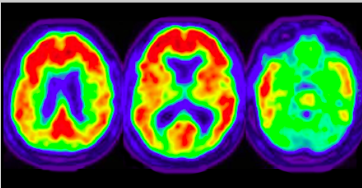
MRI
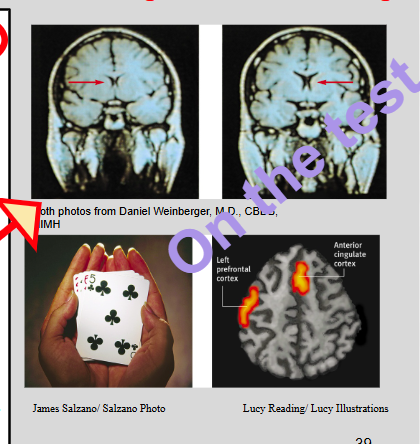
magnetic resonance imaging
produces comp generated images that distinguish among diff types of brain tissue
top images → ventricular enlargement in schizo patient
fMRI (functioning MRI) → unlike regular MRI, it shows structural detail and active areas
CT Scan
takes series of X-Ray images and uses computer processing to create cross sectional images of bony structures + tissue. More detail than X-Rays
good for detecting things like tumors

‘AP Psych Master Formula for Split Brains’
Right Visual Field → Left Hemisphere → Can SAY it.
Left Visual Field → Right Hemisphere → Can DRAW POINT to it with the Left Hand (but cannot say it).
nervous system parts (2)
nervous system: consisting of all the nerve cells, it’s the body’s speedy communication sys
divided into
CNS (central) → consists of brain & spinal cord
PNS (peripheral)
PNS
sensory & motor neurons that connect CNS & rest of body
body’s input/output machine. Sends & receives info throughout the entire body

endocrine system parts to know
hypothalamus → controls pituitary gland (base of brain), bridge between nervous & hormone systems
thyroid → metabolism, in neck
pituitary → right under hypothalamus, growth hormones. secrets other hormones that affects other glands
adrenal → fight or flight