Dental Terminology, Elevations & Depressions, Handout #1, & Handout #2
 Call Kai
 Learn
Learn Practice Test
 Spaced Repetition
 Match
Match Flashcards
 Knowt Play
1/463

There's no tags or description
Looks like no tags are added yet.
Name | Mastery | Learn | Test | Matching | Spaced | Call with Kai | Chat |
|---|
No analytics yet
Send a link to your students to track their progress
464 Terms
The study of the development, morphology, function, and identity of each of the teeth in the human dentitions
Definition of dental anatomy
Maxillary because they are in the upper jaw, which is the maxilla
The teeth in the upper arch are termed:
Mandibular because they are set in the lower jaw, which is the mandible
The teeth in the lower arch are termed:
The mandible is the moveable member of the two jaws, while the maxilla is stationary
Is the mandible or maxilla moveable?
Midline
The imaginary vertical line, which divides each arch, as well as the body, into two approximately equal halves:
Median plane (midline, midsagital plane)
Identify the plane:

Maxillary (Upper) Right
Maxillary (Upper) Left
Mandibular (Lower) Right
Mandibular (Lower) Left
What are the four quadrant names?
Upper right
Identify the quadrant in blue

Upper left
Identify the quadrant in yellow
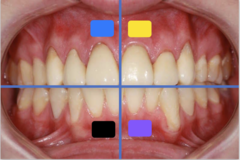
Lower right
Identify the quadrant in black

Lower left
Identify the quadrant in purple
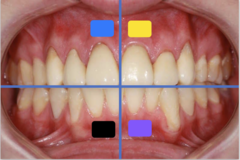
Primary dentition
Type of teeth present from 6 months to 6 years:
Mixed dentition (primary & permanent)
Type of teeth present from 6 years to 12 years:
Permanent dentition
Type of teeth present from 12 years until loss of teeth
Deciduous dentition
The teeth of the first or primary dentition:
Permanent dentition
The teeth of the second or adult dentition:
20
How many total deciduous teeth are there?
32
How many permanent teeth are there?
I 2/2 (incisor)
C 1/1 (canine)
M 2/2 (molar)
*represents one side of upper and lower arches
Primary dentition dental formula:
I 2/2 (incisor)
C 1/1 (canine)
P 2/2 (pre-molar)
M 3/3 (molar)
*represents one side of upper and lower arches
Permanent dentition dental formula:
Succedaneous teeth
Permanent teeth that replace primary teeth:
Permanent incisors
Canines
Premolars
Which teeth are succedaneous?
Permanent molars
Which teeth are non succedaneous?
Incisors: central and lateral
The two teeth of each quadrant which are closest to the midline:
Cutting and incising
Function of the central and lateral incisor:
There are four permanent incisors per arch and a total of eight in the mouth
How many permanent incisors per arch? in mouth?
7, 8, 9, 10, 23, 24, 25, 26
What teeth numbers are the permanent incisors?
Canine (aka cuspid)
The third tooth from the midline in each qudrant:
Its function in mastication is cutting, tearing, piercing, and holding
Function of the canine:
There are two permanent canines per arch, and a total of four in the mouth
How many canines per arch? in mouth?
6, 11, 22, 27
What number teeth are canines?
Premolars (aka bicuspids or first and second premolars)
The fourth and fifth teeth from the midline:
Their masticatory purpose is tearing, holding, and grinding
Function of the premolars:
There are four per arch, and eight total premolars
How many premolars per arch? in mouth?
4, 5, 12, 13, 20, 21, 28, 29
What number teeth are premolars?
Molars (first, second, and third molars OR six-year molars, twelve-year molars, and wisdom tooth)
The sixth, seventh, and eighth teeth from the midline:
Grinding
Function of molars:
There are six permanent molars per arch and twelve total molars
How many molars per arch? in mouth?
1, 2, 3, 14, 15, 16, 17, 18, 19, 30, 31, 32
What number teeth are molars?
8 total incisors which are named central and lateral incisors
Incisors of the deciduous dentition:
D, E, F, G, N, O, P, Q
What letter teeth are incisors of the deciduous dentition?
4 total canines (or cuspid)
Canine of the deciduous dentition:
C, H, M, R
What letter teeth are the canines of the deciduous dentition?
8 total molars which are named first and second molars
Molars of the deciduous dentition:
A, B, I, J, K, L, S, T
What letter teeth are the molars of the deciduous dentition?
5 per quadrant
10 per ach
20 total
There are ___________ deciduous teeth per quadrant, ___________ per arch, and a total of ___________ in the primary dentition
1st molar
which tooth is termed 6-year molar?
2nd molar
which tooth is termed 12-year molar?
3rd molar
which tooth is termed wisdom tooth?
anterior teeth
the teeth from canine to canine:

posterior teeth
the teeth from 1st premolar and back:

right maxillary 3rd molar
tooth #1:
right maxillary 2nd molar
tooth #2:
right maxillary 1st molar
tooth #3:
right maxillary 2nd premolar
tooth #4:
right maxillary 1st premolar
tooth #5:
right maxillary canine
tooth #6:
right maxillary lateral incisor
tooth #7:
right maxillary central incisor
tooth #8:
left maxillary central incisor
tooth #9:
left maxillary lateral incisor
tooth #10:
left maxillary canine
tooth #11:
left maxillary 1st premolar
tooth #12:
left maxillary 2nd premolar
tooth #13:
left maxillary 1st molar
tooth #14:
left maxillary 2nd molar
tooth #15:
left maxillary 3rd molar
tooth #16:
left mandibular 3rd molar
tooth #17:
left mandibular 2nd molar
tooth #18:
left mandibular 1st molar
tooth #19:
left mandibular 2nd premolar
tooth #20:
left mandibular 1st premolar
tooth #21:
left mandibular canine
tooth #22:
left mandibular lateral incisor
tooth #23:
left mandibular central incisor
tooth #24:
right mandibular central incisor
tooth #25:
right mandibular lateral incisor
tooth #26:
right mandibular canine
tooth #27:
right mandibular 1st premolar
tooth #28:
right mandibular 2nd premolar
tooth #29:
right mandibular 1st molar
tooth #30:
right mandibular 2nd molar
tooth #31:
right mandibular 3rd molar
tooth #32:
universal dental numbering system
identify the numbering system:

zsigmondy/palmer numbering system
dentify the numbering system:
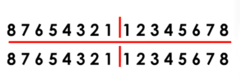
Maxillary right central incisor
In the zsigmondy/palmer notation system, identify the tooth:

Mandibular left first premolar
In the zsigmondy/palmer notation system, identify the tooth:

Federation Dentaire Internationale (FDI) system
identify the numbering system:

anatomical crown
portion of the tooth which is covered by enamel, regardless of whether it is erupted or not:
clinical crown (the clinical crown may, or may not correspond to the anatomical crown, depending on the level of the tooth's investing soft tissue)
portion of the tooth which is visible in the mouth:
Clinical crown
Only part of the crown that is seen above the gingiva:
anatomical root
portion of the tooth which is covered with cementum:
clinical root (as with the crown, the anatomical root may, or may not, correspond to the clinical root)
portion of the tooth which is not visible in the mouth:
Clinical root (may be shorter or longer than the anatomical root)
The part of a tooth which is under the gingiva and is not exposed to the oral cavity:
enamel
The hard, non-vital highly mineralized tissue, which covers the dentin of the anatomical crown of a tooth:
enamel
hardest tissue of the body:
Enamel
Composed of over 96% inorganic material by weight and 4% water and organic material by weight:
Enamel
Identify the structure

Dentin
Identify the structure

dentin (or dentine)
The hard, cellular, vital tissue which forms the main body of the tooth: