Cetacean Ecology: Quiz 2 Material
 Call Kai
 Learn
Learn Practice Test
 Spaced Repetition
 Match
Match Flashcards
 Knowt Play
1/91

There's no tags or description
Looks like no tags are added yet.
Name | Mastery | Learn | Test | Matching | Spaced | Call with Kai | Chat |
|---|
No analytics yet
Send a link to your students to track their progress
92 Terms
What is the scientific name for Bottlenose Dolphins?
Tursiops truncatus

Where are Bottlenose dolphins located globally?
Worldwide distribution except polar regions

What is the IUCN classification for Bottlenose Dolphins (Tursiops truncatus)?
Least Concern (LC)
What ecotypes (oceanic environmental conditions) do Bottlenose dolphins occupy?
Pelagic and Coastal (Preference to continental shelf areas)

What is the common length for Bottlenose dolphins?
2.5-3.5 meters
NOTE: Some sub-populations and ecotypes can have >4m extremes
What is the average weight for Bottlenose dolphins?
300kg (150-650kg range)
What is the common coloration for Bottlenose dolphins?
NOTE: Dorsally, laterally, and ventrally
Dorsally: Dark grey (various hues brownish or blueish)
Laterally: Gradually paler grey tones than dorsal coloration
Ventrally: Almost white (may appear pink)

What is the average lifespan for male Bottlenose Dolphins?
40-45 years
NOTE: Females outlive males up to 20 years
What is the average lifespan for female Bottlenose Dolphins?
50-55 years (extreme cases: >60 years)
NOTE: Bottlenose dolphins in captivity only live 25-29 years
What is the average age that Bottlenose Dolphins males reach sexual maturity?
10-15 years
NOTE: Females reach sexual maturity before males typically
What is the average age that Bottlenose Dolphins females reach sexual maturity?
10-12 years
NOTE: Females are able to become sexually mature as young as 5
During what time of year do Bottlenose Dolphins breed?
Globally and specially in the Mediterranean
Globally: year-round
Mediterranean regions: Summer months (May-August)
NOTE: Mediterranean has warmer temperatures which proves beneficial to calves that are born with lower blubber levels
How long is the gestation period for Bottlenose Dolphins?
12 months
How long is the weaning period for Bottlenose Dolphins?
18 months
How long is the nursing period for Bottlenose Dolphins?
3-5 years
How do Bottlenose Dolphins rank in Encephalization quotient (EQ) among other cetaceans?
Ranked highest among other cetaceans
NOTE: Abilities in self-recognition, symbol recognition, artificial language syntax, complex behaviors, and tool-use/culture (dolphins using sponges on their noses for protection when digging on the ocean floor)
What is vertical cultural transfer?
Spreading of knowledge/behaviors from mother to offspring
What is horizontal cultural transfer?
Spreading of knowledge/behaviors between conspecifics within or between groups
NOTE: Cultural is unique to a certain subpopulation (habitat influence) rather than something spread between subpopulations
What is a behavioral budget?
The amount of time that an individual/group will allocate towards certain behaviors (ex: feeding, socializing, dive travel, etc.)
What type of behavior do Bottlenose Dolphins spend the majority of their time doing?
Dive Travel (DT)
What is an opportunistic feeding ecology in Bottlenose dolphins?
They are adaptable to different environments and food sources dependent on what is available
What are the common prey sources for Bottlenose dolphins?
Benthic and epipelagic fish (commonly schooling fish and cephalopods species)
NOTE: Cephalopods are present worldwide accommodating the worldwide present of Bottlenose outside of polar regions
Do Bottlenose dolphins tend to be more social or isolated species?
Highly social species

Do Bottlenose dolphins tend to form groups divided by sex (only interactions during mating season) or mixed sex groups?
Mixed sex groups
What is the average group size in Bottlenose dolphins?
NOTE: Varies between subpopulations
What are communities in Bottlenose dolphin groups?
Individuals who associate with each other more than other individuals within a (sub)population
NOTE: Females tend to stick together more often in groups for group babysitting purposes
Do communities of Bottlenose dolphins tend to have discrete or shared home ranges?
Both
What is the main determining factor in Bottlenose dolphins spatial ecology?
Distribution of prey sources
What is the spatial ecology for Bottlenose dolphins specializing in Pelagic ecotypes?
Wider ranging habitats
WHY? Pelagic ecotypes tend to have less predictable prey sources resulting in more territory needing to be hunted in
What is the spatial ecology for Bottlenose dolphins specializing in costal ecotypes?
Site fidelity toward smaller and more specific habitat ranges
WHY? Costal ecotypes tend to have more predictable prey presence allowing dolphins to use the specific area rather than searching around wider ranges
How do physiographic features affect Bottlenose dolphins spatial ecology?
Continental shelf width, seabed slope, water depth, and distance from the coast all help influence dolphin spatial ecology, home ranges, and group social structure
What types of human activities can influence spatial ecology in Bottlenose dolphins?
Underwater noise; trawler boats and purse-seiners; and fish farms
NOTE: Some dolphin subpopulations live entirely on fish farms or depredation of fishing nets
What is the common migration patterns for Bottlenose dolphins?
They generally do not have migration patterns
What is a home range for Bottlenose dolphins?
An area that is regularly used by an individual or a (sub)population to satisfy all the animal's needs (food, shelter, mating, nursing)
What is residency in Bottlenose dolphins?
Describes how much time can animal spends in a certain area
What is site fidelity in Bottlenose dolphins?
Describes how often an animal uses an area
What is a resident in terms of Bottlenose dolphins?
An individual that spends most of their time in an area of interest
What is a transient in terms of Bottlenose dolphins?
An individual that only occasionally visits an area of interest
What is the approximate abundance and population trend for Bottlenose dolphins in the Mediterranean Sea?
Low 10,000s with a decreasing population trend
What is the approximate abundance and population trend for Bottlenose dolphins in the Adriatic Sea?
Around 10,000 with a stable population trend
NOTE: Around 200 dolphins in the Lošinji area
How many communities of Bottlenose dolphins are in the Adriatic Sea?
Three communities (travel between these communities occur)

What are inter-annual variations?
Population fluctuations through the year (not actually changing population size
What affects inter-annual variations in Bottlenose dolphins?
NOTE: Not actual change in population size; only fluctuations
Prey availability and anthropogenic factors
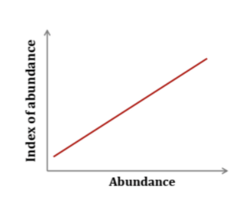
What kind of "abundance" estimations are Indices?
Relative and indirect measurements. A proportional count that shows trends without telling you the exact total
EX. Someone saw 3 whales per hour this year compared to 1 whale per hour last year. Relative only to one observer
What are some of the benefits of Indices (indirect abundance measurements)?
HINT: 3
1. Simpler than abundance estimates (cheaper procedure)
2. Usable when species of interest are difficult to sample
3. General trends are able to be detected
What are some of the downsides of Indices (indirect abundance measurements)?
HINT: 2
1. No information can be obtained about general species abundance
2. Only linear and constant dependence trends are able to be detected. No seasonal/year fluctuations
What are ERs?
NOTE: Common method in Cetacean Research
Relative Encounter Rates
NOTE: Number of samples per unit of research effort
How are Relative Encounter Rates (ERs) calculated?
The number of "samples" per "unit of research effort"
Samples: sample count or sample size
Unit of research effort: days of field work, days of fishing effort, surveyed area size, distance covered in research

What is a census during abundance estimation?
When all the animals in the entire study area can be counted
NOTE: Extremely rare
What is a sample plot census during abundance estimation?
When all the animals in a "sample(s) of the study area" can be seen. These samples can then be scaled up to the whole study area
NOTE: Sample plots can be square, strips, circular, etc
What are the difference between census and sample plot census?
Census can count all the animals in the whole study area (Counts=N), while sample plot census can count all animals in a sample of the study area and then can be scaled up to the whole area (Estimates=Ň)
What are the two necessary assumptions for Sample Plot Census?
1. All animals within sample plot were actually observed
2. All animals within the whole study area have the same independent probability of being observed
NOTE: Assumption 2 is difficult with mothers/calves
What two methods can be used for abundance estimation when NOT all individuals in an area are seen?
Capture (capture-recapture) and Transect (distance sampling)
What is distance sampling?
Instead of counting animals (like in sample plot census), the probability of observing animals is calculated. This is used as an additional factor in scaling up
How is distance sampling conducted?
All animals directly on the transect are detected with the principal that detection drops with increasing distance
What are the four assumptions for distance sampling?
1. All animals directly on the transect are seen
2. Animals are only counted once and do not move before being sighted (repeated sightings will not occur)
3. Perpendicular distances are measured exactly
4. Sighting are independent (one animal doesn't influence the movement of another→difficult with mother/calves)
What is the most common research method on cetacean species when the animals are individually identifiable?
Mark-recapture
What is the primary requirement for mark-recapture to occur?
Individually identifiable animals (naturally or artificially)
Where does mark-recapture research tend to be the most commonly used and easy to use?
NOTE: Animals are accessible with smaller boats and animals can be approached
Coastal areas
What other two parameters are able to be estimated with mark-recapture methods?
NOTE: Other than abundance estimates
Migration and survival rates
What are capturing occasions in mark-recapture?
Another name for a sample during mark-recapture data collection
What is a simple estimator in Mark-Recapture research?
When there are two samples/capture occasions
NOTE: Two samples is the minimum amount required
What are Models in Mark-Recapture research?
When there are more than two samples/capture occasions
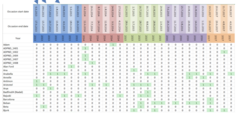
What are the four steps in all Mark-recapture methods?
1. Capture animal(s)
2. Mark animal(s)
3. Release animal(s)
4. Repeat
*NOTE: Ensure you give time for a species to disperse between steps 3 and 4
During mark-recapture events what is n1 representative of?
All the animals captured and marked in first sample
During mark-recapture events what is n2 representative of?
All the animals captured and marked in the second sample
During mark-recapture events what is m2 representative of?
The animals captured during the second sample which were caught/marked in the first sample
What are the general assumptions for mark-recapture experiments? (3)
1. Individuals are always correctly identified (no false negatives or false positives)
2. Capturing does not affect subsequent capture probability (none become trap-happy or trap-shy)
3. Individuals have the same and independent capture probabilities (difficult to ensure with mother/calves)
What is entailed with a closed population model?
The population size doesn't change during the study. There are no births/immigrations or death/emigrations
What is entailed with an open population model?
The population can change in size during the study. There are losses and gains that can be measured
How can the accuracy of mark-recapture increase from two-sample models?
More sampling (additional occasions, encounters, and captures)
When there are more than two samples in Mark-recapture modeling what is it based on rather than simple ratios?
Probabilities
What is the meaning of binary in mark-recapture models?
There are two potential outcomes (an animal is capture or is not captured during a specific sampling occasion)
What are model based on?
A set of assumptions
What are models a mathematical representation of?
An imaginary and ideal population
What are closed population models?
NOTE: Closed geographically or demographically
There are no births, no death, no immigration, and no emigrations. The population sizes remains the same during the duration of the study
What are open population models?
There are births, deaths, immigration, and emigrations. The population size is subject to change during the duration of the study
What is an age model?
NOTE: Mark-recapture model
Survival and recapture probabilities vary based on the age of the animal
What are dead recovery models?
NOTE: Mark-recapture model
Designed for studies where individuals are marked while alive, but data is only collected once the individuals are found dead.
What are nest survival models?
NOTE: Mark-recapture model
Used to estimate the probability that a bird nest will successfully hatch or fledge young
What are multi-state models?
NOTE: Mark-recapture model
When individual animals can move between different locations, behaviors, or life stages over time. Simultaneously calculates an animal's probability of surviving, changing states, or being recaptured based on current condition
What are the four common assumptions for Mark-recapture models?
NOTE: Assumptions for open AND closed models
1. Marks are not lost and are always correctly identified
2. Capturing/marking does not affect animals': survivability of behavior
3. All individuals have the same and independent probability of being captured. Difficult in natural populations due to mother/calf dependence
4. Capturing is instantaneous relative to duration of study
What is the return rate in Mark-recapture?
The rate of animals from the first encounter will be seen again during the second encounter
What are the three necessary steps/occasions to occur between the individual being caught/marked/released and being encountered for a second time?
Individual caught, marked, and released ↓
1. Individuals survives (alternative: death)↓
2. Individuals return to location (alternative:emigration)↓
3. Individual is available at time (alternative: hibernation)↓
Individual is encountered (alternative:not encountered)
What tactics/experiment structure can be adjusted to ensure a closed population (population does not change during the study)?
1. Duration of the study (shorter study periods)
2. Study area (selection of geographically isolated area)
What tactics/experiment structure can be adjusted to ensure a closed population's marks are not lost and always correctly identified?
1. Marking technique (artificial markings added)
2. Photo-identification
What tactics/experiment structure can be adjusted to ensure a closed population's doesn't have capturing/marking affect the animal?
1. Capturing technique (trap designed for select subject)
2. Model selection
What tactics/experiment structure can be adjusted to ensure a closed population's has all the same individuals with an independent probability of being captured ?
1. Study design (consistent capture efforts/tactics)
2. Model selection (model that accounts for variations: size, sex, age, behavior, etc)
3. Sub-sampling (random selection without preferances)
What does it mean that models are "data hungry"?
More data leads to better model accuracy
What is the general structure/principal for Pollock's Robust Design (RD)?
A combination of open and closed population models. Populations are open during "primary periods" and closed during "secondary periods".
NOTE: This requires longer study durations
-"Primary periods": big time intervals where the population can change (month long periods)
-"Secondary periods": repeated short sampling occasion where teh population is assumed to stay the same (days)
What are five important things to consider about species biology when planing mark-recapture experiments?
1. Life Cycle: generation time and species life span
2. Seasonality: hibernation and migration patterns
3. Ranging pattern: home range size and habitat use
4. Behavior: Sociability and trap shy/trap happy effects
5. Easy to capture/identify
What is the primary thing that must be considered in sampling design and mark-recapture models?
TIME. The overall duration of the study, duration of capturing occasions, and intervals between capturing occasions