Fatty acid metabolism (pt 1- beta oxidation and ketone body production)
 Call Kai
 Learn
 Practice Test
 Spaced Repetition
 Match
 Flashcards
 Knowt Play
1/270

There's no tags or description
Looks like no tags are added yet.
271 Terms
INTRODUCTION
what are the classes of lipids? (5)
Fatty acids
TAG
phospholipids
sterols
sterol hormones
what are the roles of lipids (4)
Fuel
Structure to bilayer membranes
Components of complex proteins
Signaling and regulatory molecules
all lipids are derived from what molecule?
acetyl CoA
1g of fat has how many kcals
9kcals
how much of the western diet is fat?
1/3 (33%)
how much of the energy we consume from fat get stored as TAG?
85%
where is most TAG storage?
adipose tissue (some in muscle)
lipids are stored efficiently with how much water
minimal
1g of lipid is stored with how much water in comparison to glycogen (and protein)
1g lipid is stored with 0.1g water
1 gram glycogen (and protein) requires 4 grams of water
why fat weighs less than muscle
OVERVIEW OF FA METABOLISM IN FED STATE

in fed state, what macros can contribute to TAG storage?
dietary fat and carbohydrate intake
why/when can CHO contribute to lipid synthesis?
when consumed in excess and glycogen stores are full, will be used to form FA de novo
fat and CHO are _________ and ________________ into the enterocytes
digested and absorbed
in the small intestines enterocytes, happens to dietary fat?
non-esterified FA’s are going to be re-esterified to form TAG which will be incorporated into the chylomicrons
Chylomicrons forms in the enterocytes will go where?
the lymph
lipids travel in the body?
from enterocyte enter lymphatic system —> go to heart—> go to tissues —> lastly, leftovers go to the liver
glucose, SCFA, and MCFA absorbed into enterocytes will go where?
directly into portal blood to go directly to liver
what is taken to the liver from digestion and absorption during fed state?
primarily glucose
In the liver, what lipogenic pathways/processes occur during fed state (3)
De novo lipogenesis (high CHO diet)
Esterification of NEFA's to form TAGs
VLDL synthesis (de novo TAG) and secretion to venous blood
TAG is stored in what molecules that travel through the body?
VLDL and chylomicrons
VLDLs (liver) and chylomicrons (diet) will go to the __(organ)__ and then __(fluid)___ to go to __(organs)___
VLDLs (liver) and chylomicrons (diet) will go to the heart and then arterial blood to go to adipose and muscle
for adipose tissue, what enzyme will be present to allow for uptake of FA’s from chylomicrons and VLDL?
adipose lipoprotein lipase
where is lipoprotein lipase located?
extracellular but found in capillaries, allowing it to act on VLDL and chylomicrons when close to the tissue cell
what will adipose lipoprotein lipase do?
breakdown chylomicron' and VLDL' TAG to release NEFA's and glycerol
adipose lipoprotein lipase is upregulated during what state?
fed state
why is lipoprotein lipase upregulated in the fed state for adipose tissue?
to promote uptake to form TAG for storage
what will happen to the NEFA and glycerol released from TAG (in adipose tissue)
FA’s will be absorbed into adipocyte while glycerol will be kicked out (absorbed and then kicked out)
why is glycerol “kicked out” of the adipose tissue?
adipocytes lack glycerol kinase (cannot trap it in the cell)
The NEFA absorbed into the adipose tissue will have what happen to it during fed state?
re-esterified into TAG for storage
for skeletal muscle, what enzyme will break down TAG from chylomicrons and VLDL?
muscle lipoprotein lipase
in what state is muscle lipoprotein lipase for muscle upregulated/inhibted?
LPL upregulated in fasted state
LPL in inhibited in fed state
why is LPL downregulated during fed state in muscle but upregulated in adipose?
lipoprotein lipase is upregulated in adipose tissue during fed state to promote uptake to form TAG for storage. In muscle, lipoprotein lipase is downregulated because it does not need to use lipids as fuel and will depend primarily on glucose (TAG can be distributed to adipose for storage)
what will happen to the NEFA and glycerol released from muscle lipoprotein lipase for the muscle? (if it occurs)
NEFA can be absorbed into muscle and glycerol will most likely be released into the blood
NEFA absorbed into muscle during fed state can have what happen to it? (2)
Complete oxidation to CO2 + H20 via beta-oxidation (for energy)
Re-esterification to form TAG for storage as intramyocellular (intramuscular) TAG
the removal of TAG from VLDL and chylomicrons will results in what 3 structures (think lipoproteins)
chylomicron remnants, IDL, and LDL
chylomicron remnants, IDL, and LDL will go where?
to the liver
chylomicron remnants can be degraded by what component of the cell?
lysosomes
chylomicrons also carry what lipids apart from TAG? (4)
phospholipids, some cholesterol, cholesterol esters, fat soluble vitamins
OVERVIEW OF FA AND TAG METABOLISM DURING FASTED STATE
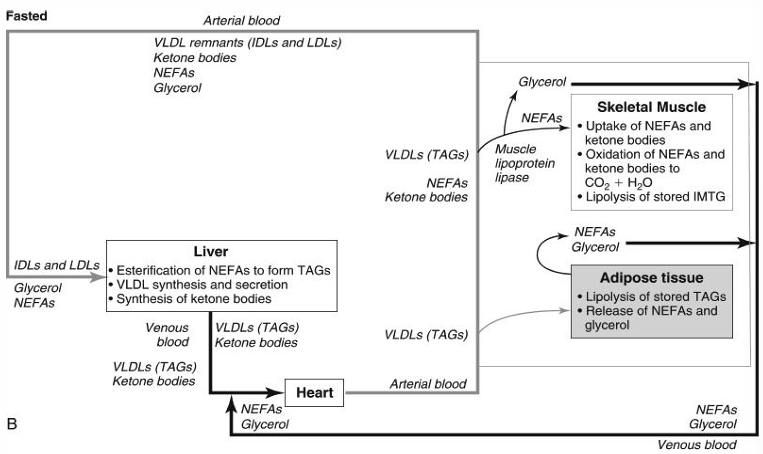
During fasted state, what hormones are high?
Glucagon and catecholamines
During fasted state, what processes occur in the liver regarding lipids? (3)
Esterification of NEFA's to form TAG
VLDL synthesis and secretion (de novo TAG)
Synthesis of ketone bodies (amount depends on length of fasting/starvation)
from the liver, what is released to the blood?
VLDLs (de novo TAGs) and ketone bodies
the ketone bodies and VLDL will go to the ____________ and then _________ and ____________
the ketone bodies and VLDL will go to the heart and then adipose and skeletal muscle
during fasting, what enzyme is not active for adipose tissue?
adipose lipoprotein lipase
during fasting, will adipose tissue uptake TAG from VLDL?
only a little bit (lacks adipose lipoprotein lipase during fasting state)
adipose tissue will mainly undergo which pathways during fasting state?
lipolysis of stored TAG
release of NEFA and glycerol to blood
during fasting state, what hormone in the adipocytes will allow for TAG hydrolysis to release NEFA and glycerol?
hormone sensitive lipase
hormone sensitive lipase is activated when what hormone is high?
glucagon
for the skeletal muscle, what enzyme is present to allow for lipid uptake during fasted state?
muscle lipoprotein lipase
during fasting state, muscle will uptake what (2)
NEFA’s from VLDL TAG
ketone bodies
the skeletal muscle undergoes what processes/pathways during fasting state related to lipid (3)
Uptake of NEFA's and ketone bodies from blood
Oxidation of NEFA's and ketone bodies to CO2 and H20
Lipolysis of stored IMTG (intramuscular TAG)
what molecules ultimately make it back to the liver after circulation? (4)
VLDL
ketone bodies
NEFA’s
glycerol

SOURCES OF FATTY ACIDS FOR THE CELLS
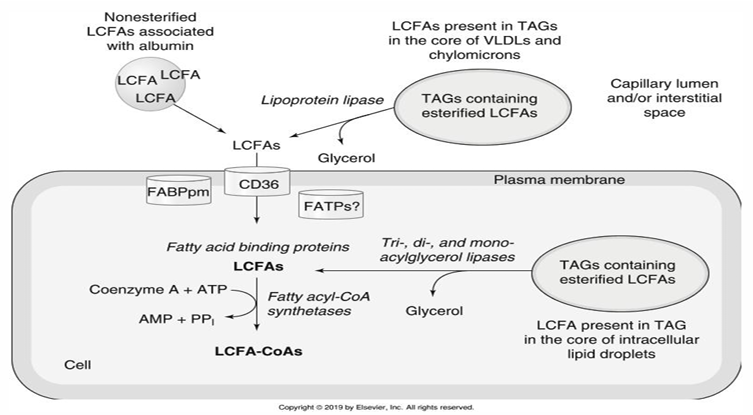
what are the sources of FA’s for the cell? (4)
non-esterified LCFA associated with albumin
LCFA present VLDL and chylomicron TAG
FA’s released from TAG in muscle and adipose tissue
de novo FA’s (palmitate)
what protein carried FA’s throughout the blood when non-esterified?
albumin
what tissues can release FA’s into blood during fasting state?
muscle and adipose tissue
UPTAKE OF LCFA’S INTO THE CELL
LCFA’s can come from what sources? (4)
non-esterified LCFA associated with albumin
LCFA present VLDL and chylomicron TAG
FA’s released from TAG in muscle and adipose tissue
de novo FA’s (palmitate)
free LCFA’s are taken up into the tissue cell via what transporter?**
cluster of differentiation 36 (CD36)
cluster of differentiation 36 (CD36) has what long term regulation?
excessive FA intake will increase its expression
cluster of differentiation 36 (CD36) has what short term regulation (activate)? (2 scenarios)
stimulated expression via exercise (muscle contraction) and insulin presence
once the LCFA is taken into the cell via cluster of differentiation 36, what happens to the FA’s?**
activated to become fatty acyl CoA’s
how are fatty acids converted into acyl CoAs?
LCFA —> LCFA-CoA’s (aka, has a CoA added)
what enzyme converts LCFA into fatty acyl CoA’s (LCFA-CoA)?**
fatty acyl CoA synthetase
LCFA —> LCFA-CoA via fatty acyl CoA synthetase requires
2 ATP (1ATP —> AMP)
what does the conversion of FA to FA-CoA do?
traps the fatty acid within the cell
same process as phosphorylating glucose (glu —> G6P)
fatty acyl CoA is considered**
activated
once we have activated FA (fatty acyl CoA), what can it undergo depending on the state of the cell? (2)
beta oxidation OR
esterification into TAG
TRANSPORT OF LCFA INTO MITOCHONDRIAL MATRIX
what is the first step of beta oxidation?
the transport of LCFA into the mitochondrial matrix
LCFA taken up by cluster of differentiation 36 (CD36) and activated are found where in the cell?
cytosol
where does beta oxidation occur in the cell?
mitochondrial matrix
when does beta oxidation occur (state of cell and hormones)
fasting state (high glucagon/catecholamines)
what is the overall process of transporting LCFA into the mitochondria
activated LCFA (fatty acyl CoA) is prepared in the cytosol via fatty acyl CoA synthetase
fatty acyl CoA will be converted to LCFA-carnitine via carnitine palmitoyltransferase 1 on the outer membrane of the mitochondria to enter the intermembrane space
LCFA-carnitine in the intermembrane space will be transported into the mitochondrial matrix via translocase
once in the mitochondria membrane, LCFA-carnitine will be converted back to LCFA-CoA via carnitine palmitoyltransferase 2
fatty acyl CoA can now undergo beta oxidation

activated LCFA is prepared where?
in the cytosol

activated LCFA (fatty acyl CoA) is made via what enzyme?
fatty acyl CoA synthetase (use 2 ATP)

fatty acyl CoA (active LCFA) enters the mitochondria (intermembrane space) as what molecule?
LCFA-carnitine

activated LCFA (fatty acyl CoA) enters the mitochondria (intermembrane space) via what transporter?
carnitine palmitoyltransferase 1 (CPT1)

what does carnitine-palmitoyltransferase 1 (CPT1) do?
will convert LCFA-CoA into LCFA-carnitine by removing CoA and adding carnitine

why must LCFA-CoA be converted into LCFA-carnitine to enter mitochondria?
CoA is too big and lacks transporters
carnitine palmitoyltransferase 1 is inhibited what molecule**
malonyl CoA (product of ACC)
malonyl CoA is needed for what process
starting substrate for FA synthesis cycles
carnitine palmitoyltransferase 1 (CPT1) transport FA’s of what length?
18 and 20C (mainly)
FA’s <12C enter cell mitochondria how?
do not need activation or transporter (enter via diffusion)
LCFA-carnitine is then taken where?
into the mitochondrial matrix
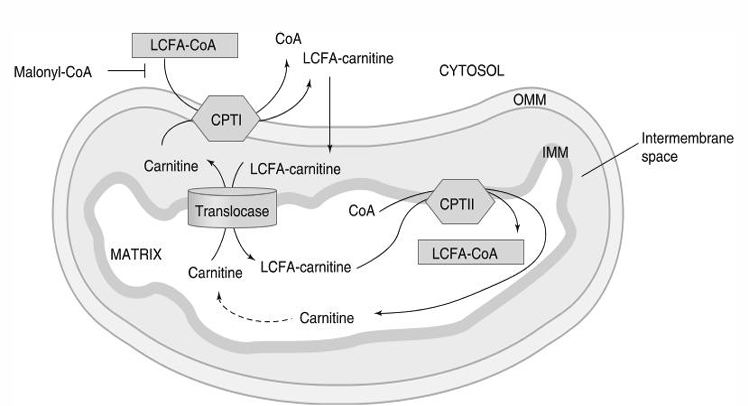
LCFA-carnitine enters the mitochondrial matrix via what transporter?
translocase

once inside the mitochondrial matrix, what happens to LCFA-carnitine?
is converted back into LCFA-CoA

what converts LCFA-carnitine back into LCFA-CoA?
carnitine palmitoyltransferase 2 (CPTII)
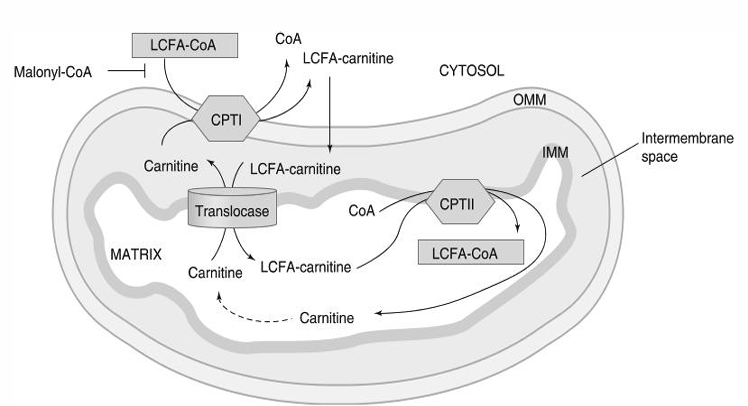
the Fatty acyl CoA can now do what
undergo beta oxidation

carnitine is derived via what dietary sources?
meat c
carnitine can be made where in the body?
liver and kidney (de novo)
carnitine synthesis in kidney and liver requires what cofactors (4)
niacin, iron, B6, vitamin C
premature infants and carnitine?
can have a carnitine deficiency due to their accelerated growth rate --> pre-me formulas will have additional carnitine (breastmilk supplies needed carnitine)
BETA OXIDATION
where does beta oxidation occur in the cell
mitochondrial matrix
beta oxidation produces what 3 things?
NADH, FADH2, and acetyl CoA
how does beta oxidation produce acetyl CoA (what does this mean)
it releases acetyl CoA (2C) from FA
how it makes it shorter each cycle
acetyl CoA produced from beta oxidation (released) can be used for what (2)
ketone body formation (if needed)
completely oxidized for energy
beta oxidation can also occur in what organelle in the cell?
peroxisomes