Chem 5021
 Call Kai
 Learn
 Practice Test
 Spaced Repetition
 Match
 Flashcards
 Knowt Play
1/29

Earn XP
Description and Tags
quantum mechanics
30 Terms
Wavelengths of coloured light
Violet: 380 to 450 nm
Blue: 450 to 495 nm
Green: 495 to 570 nm
Yellow: 570 to 590 nm
Orange: 590 to 620 nm
Red: 620 to 750 nm
Wavenumber
K = 2π/λ
de Broglie wavelength formula

Wave Velocity

Angular wave number

Angular frequency

Einstein wave equation
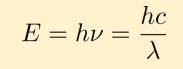
Einstein special relativity equation

The de Broglie relationship

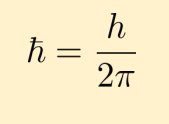
Reduced planks constant
Classical kinetic energy of electron

Schrodinger equation

Electron density

Free electron wavefunction

Heisenberg uncertainty principal

Particle In a box wavefunctions (unnormalized)

Derivatives

Integrals

Particle in a box wavenumber

Particle in a box energy

PIB model energy difference

Particle in a box probability densities

Normalised PIB states

Overlap integral
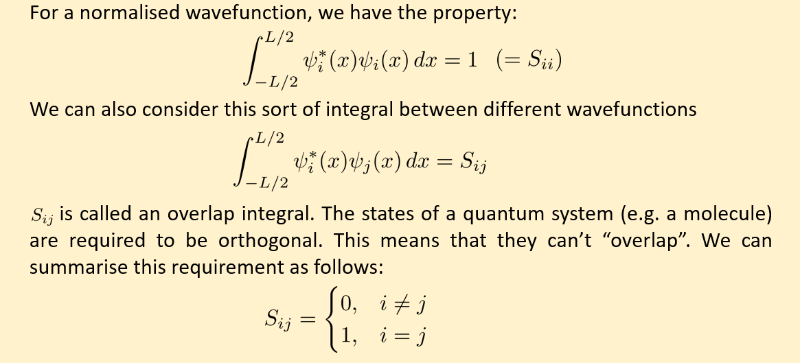
How to find out if states are orthogonal?
If the product of two states has odd parity we know (without doing the maths) that the states are orthogonal
For states with the same parity, we’d need to evaluate the overlap integral.

Particle on a ring
one-dimensional model
The boundary conditions are that the wavefunction is single valued and continuous
simple model of aromatic molecules in which the pi-electrons are delocalised around the ring
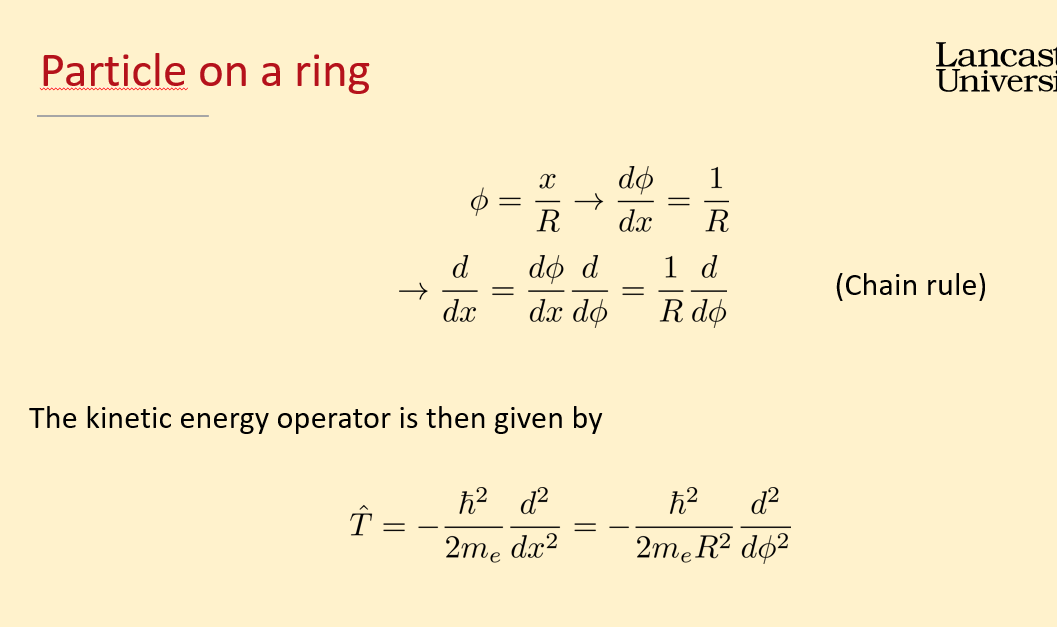
How are position and angle related
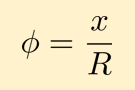
Evaluate kinetic energy operator in terms of angle
Normalised POR wavefunction

POR energy
