Diencephalon, CSF, VENTRICLE
 Call Kai
 Learn
 Practice Test
 Spaced Repetition
 Match
 Flashcards
 Knowt Play
1/24

There's no tags or description
Looks like no tags are added yet.
25 Terms
Prosencephalon (forebrain)
Forms the Telencephalon (becomes cerebrum) and Diencephalon.

Telencephalon
Cerebral cortex, basal ganglia, limbic system

Diencephalon
thalamus, hypothalamus, epithalamus

Mesencephalon (midbrain)
-processing of visual and auditory data
-generation of reflexive somatic motor responses
-maintenance of consciousness

Rhombencephalon (hindbrain)
metencephalon and myelencephalon
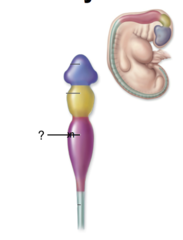
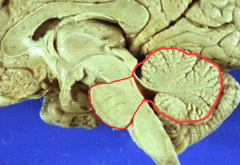
metencephalon
pons and cerebellum
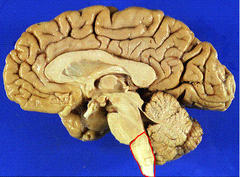
myelencephalon
medulla oblongata
Cerebrum
Largest part of the brain; responsible for voluntary muscular activity, vision, speech, taste, hearing, thought, and memory.
Association fibres
connect different parts of the same hemisphere

Commisural fibres
run from one cerebral hemisphere to the other, connecting functionally related structures
§corpus callosum

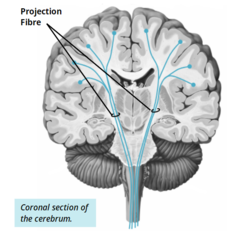
Projection fibres
pass between the cerebral cortex and subcortical structures e.g. thalamus, striatum, brain stem, spinal cord
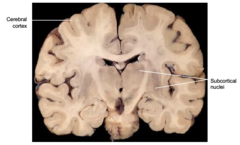
Subcortical grey matter
-neuronal cell bodies grouped in a nucleus (pl nuclei) below the cortex.
It includes
-Thalamus
-Hypothalamus
-Basal ganglia
-Limbic system
The third ventricle
the ventricle located in the center of the diencephalon
divides the diencephalon into two symmetrical halves.
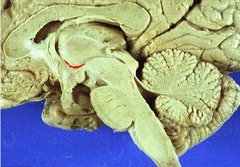
Hypothalamic sulcus
separates thalamus from hypothalamus
§Hypothalamic sulcus
§Ventral part - hypothalamus and subthalamus
Thalamus function
relay station for sensory impulses/pain, sensory switchboard; responsible for wakefulness and alertness.
§Regulates motor activity by its connections with Motor cortex, Cerebellum, Globus pallidum
Hypothalamus
A neural structure lying below the thalamus; it directs several maintenance activities (eating, drinking, body temperature), helps govern the endocrine system via the pituitary gland, and is linked to emotion and reward.
§Anteroinferiorly it forms the floor of third ventricle, presents optic chiasma, stalk of pituitary gland and mammilary bodies
§Lateral zone- contains nucleus which on stimulation induces eating
§Medial zone - stimulation produces satiety (satiety center)
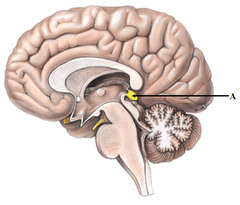
Pineal body
a structure found between the cerebral hemispheres of vertebrates; secretes melatonin
Meta thalamus
§Medial geniculate body
-relay station of audition.
-receive fibres from inferior colliculus
-Projects to auditory area
§Lateral Geniculate body
-Relay station of vision
-Receives fibres form optic tract
-Projects to visual area

ventricles of the brain
Canals in the brain that contain cerebrospinal fluid. Ventricles are also found in the heart. They are the two lower chambers of the heart.

lateral ventricles of brain
located in cerebral hemisphere
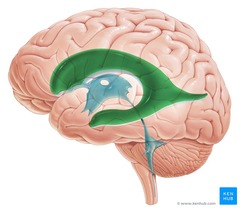
third ventricle of brain
Most central brain ventricle, ventral to the lateral ventricle, with the mesencephalic duct found inside it
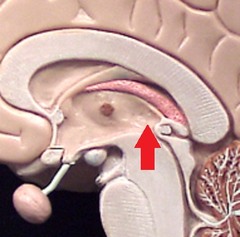
cerebral aqueduct of brain
connects the third and fourth ventricles
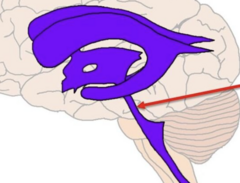
fourth ventricle of brain
The choroid plexus is located within this brain ventricle, found regionally under the cerebellum

Circulation of CSF
CSF from the lateral ventricles → interventricular foramina (forman of monro) → third ventricle → cerebral aqueduct → fourth ventricle → subarachnoid space (forman of lushka) or central canal.(forman of magendie)

Cerebrospinal fluid(CSF)
nourishes the brain and provides a protective cushion for it
Formation - Choroid plexus of Ventricles
Absorption - Arachnoid granulations