art history 482 final exam
 Call Kai
 Learn
 Practice Test
 Spaced Repetition
 Match
 Flashcards
 Knowt Play
1/56

There's no tags or description
Looks like no tags are added yet.
57 Terms
Doge
The elected chief magistrate and symbolic head of state of the Venetian Republic, serving for life alongside aristocratic councils and residing in the Palazzo Ducale (Doge's Palace).
Ottoman Empire
Powerful Islamic empire centered in Constantinople that served as both Venice's key luxury trading partner and fiercest naval rival; inspired depictions of turbans, silks, and carpets in Venetian painting.
scuole
Venetian lay religious confraternities (charitable brotherhoods) dedicated to civic devotion and mutual aid; wealthy Scuole Grandi commissioned large narrative canvas cycles celebrating relics and Venetian life.
gondola
Traditional flat-bottomed, narrow Venetian rowing boat steered by a single oar; frequently painted in Venetian cityscapes to capture everyday civic life along the canals.
Grand Canal
The main S-shaped central waterway and commercial artery of Venice, lined with patrician palaces and crossed by the famous Rialto wooden drawbridge (later rebuilt in stone).
Duke Alfonso d'Este
Ruler of Ferrara and major Renaissance patron who commissioned a famed cycle of mythological paintings (including bacchanals) from top Venetian masters for his private palace study.
studiolo
A small, intimate private study or cabinet room in an Italian Renaissance palace where wealthy collectors displayed books, antiquities, and sensual secular or mythological paintings.
Ovid
Ancient Roman poet whose epic "Metamorphoses" and "Fasti" served as the primary literary inspiration for Venetian Renaissance mythological scenes, bacchanals, and "poesie."
bacchanal
A wild, drunken mythological feast or revelry honoring Bacchus (Dionysus), god of wine, featuring nymphs, deities, and satyrs; popular in private Venetian palace studies.
satyr
In Greco-Roman mythology, a woodland creature with a human upper body and the horns, ears, tail, and legs of a goat; accompanies Bacchus to symbolize untamed nature and appetite.
disegno
Italian for "drawing" and "design"; the Florentine and Roman ideal prioritizing crisp outlines, anatomical study, linear perspective, and intellectual planning before applying paint.
colorito
The signature Venetian painting approach prioritizing rich, luminous color, warm oil glazes, and light applied directly onto canvas to build volume and mood rather than crisp preliminary outlines.
painterly
A technique (characteristic of Venetian colorito and late Renaissance style) using visible, loose, expressive brushstrokes where forms blend optically into atmosphere rather than sharp edges.
Poesie
Term meaning "visual poetry," describing sensual, atmospheric Ovidian mythological paintings (created especially for King Philip II of Spain) that prioritize mood, color, and imagination over strict moralizing history.
Protestant Reformation
16th-century religious schism (beginning in 1517) that challenged Catholic authority and sparked Northern European iconoclasm, pushing the Catholic Church to strictly police religious imagery.
Council of Trent
The Catholic Church's Counter-Reformation council (1545–1563) whose decree on art demanded that religious paintings be clear, scripturally accurate, emotionally devout, and free of pagan nudity or irreverent distractions.
The Inquisition
A Roman Catholic judicial tribunal tasked with rooting out heresy and enforcing Counter-Reformation rules; in Venice, it famously interrogated a painter in 1573 over secular figures placed in a sacred banquet scene.
Mannerism
Derived from the Italian "maniera" (style/stylishness); a 16th-century artistic movement (c. 1520–1600) reacting against High Renaissance harmony by using artificial elegance, elongated proportions, spatial compression, acidic colors, and twisting poses.
broken pediments
A classical triangular or curved architectural pediment whose apex or bottom cornice is deliberately split open in the center; a Mannerist device used to subvert Vitruvian classical rules and create visual tension.
brackets
Projecting scroll-shaped stone supports (consoles) normally used to hold up a cornice or balcony; in Mannerist architecture, they are placed beneath columns or windows as purely decorative elements that support no actual weight.
pietra serena
Dark gray-blue Florentine sandstone traditionally used in the Early Renaissance to clearly outline classical arches against white stucco walls, later used in Mannerist architecture to crowd and compress wall surfaces.
blind niches
Shallow, recessed architectural wall frames or window openings that are completely sealed and walled in rather than opening to the outside, creating claustrophobic Mannerist tension.
Clement VII
The second Medici pope (Giulio de' Medici, r. 1523–1534) whose reign saw the devastating 1527 Sack of Rome and Protestant Reformation; he commissioned the Laurentian Library in Florence and first planned the Sistine Chapel altar wall fresco.
vestibule
An architectural entrance lobby or anteroom ("ricetto") leading into a main building; in Mannerist architecture, it was transformed into a tall, compressed room dominated by a dramatic staircase.
recessed columns
Columns sunk backward inside cut-out rectangular wall niches rather than projecting forward in front of the wall; a Mannerist inversion of classical structural logic that makes load-bearing columns look trapped inside the wall.
volutes
Spiral, scroll-like architectural ornaments (classically found on Ionic capitals) used in Mannerist design for decorative wall consoles and curving, fluid staircase steps.
Paul III
Pope (Alessandro Farnese, r. 1534–1549) who officially launched the Catholic Counter-Reformation by convening the Council of Trent in 1545 and overseeing the completion of the Sistine Chapel altar wall fresco.
Counter-Reformation
The 16th-century Catholic resurgence following the Council of Trent that combated Protestantism through Church reform, the Inquisition, and religious art designed to be clear, scripturally orthodox, and emotionally stirring.
figura serpentinata
Italian for "serpentine figure"; an exaggerated, flame-like spiraling contrapposto pose in which a figure's legs, torso, shoulders, and head twist in opposing directions to showcase virtuoso complexity.

Vittore Carpaccio, Miracle at the Rialto, c. 1494
[Visual/Content] Tempera and oil on canvas; in an upper-left loggia, the Patriarch of Grado holds a golden relic of the True Cross to heal a possessed man, while most of the canvas showcases Venice's Grand Canal, gondolas, distinctive funnel chimneys, and international merchants around the wooden drawbridge. [Context] Painted for a Venetian lay confraternity (Scuola Grande di San Giovanni Evangelista) to celebrate miracles of their relic. [Significance] Subordinates the religious miracle to documentary Venetian civic pride, bustling commercial wealth, and early adoption of canvas over fresco.

Giovanni Bellini, San Zaccaria Altarpiece, Venice, 1505
[Visual/Content] Oil (originally on wood panel, transferred to canvas); a peaceful "sacra conversazione" showing the Virgin and Child beneath a Byzantine-style gold mosaic apse flanked by a musical angel and four meditative saints (Peter, Catherine, Lucy, Jerome), with open side arches revealing sunlit trees. [Context] Painted for a Benedictine convent church in Venice. [Significance] Marks the arrival of High Renaissance harmony in Venice, using warm glowing oil glazes (colorito) and soft natural light to unify figures across space.

Giovanni Bellini, Feast of the Gods, 1514
[Visual/Content] Oil on canvas; classical deities from Ovid's "Fasti" (including Mercury, Neptune, Silenus, a satyr, and Priapus creeping toward Lotis) feast and lounge in a sunlit forest clearing whose towering trees and rocky cliff were later repainted by a younger Venetian master. [Context] Commissioned by Duke Alfonso d'Este for his private Ferrara studiolo (Camerino d'Alabastro); the elder master's final major work. [Significance] Launches the Venetian Renaissance bacchanal tradition, blending classical Ovidian myth with relaxed, atmospheric naturalism and rich colorito.

Giorgione, Madonna & Child Enthroned between Saints, c. 1505
[Visual/Content] Oil on wood panel; the Virgin and Child sit atop an unusually tall, stepped throne draped in velvet overlooking a checkered floor, flanked by St. Nicasius (or Liberale) in gleaming steel armor and St. Francis in his brown habit before an open, misty pastoral landscape. [Context] Commissioned by condottiere Tuzio Costanzo for his family chapel in his hometown cathedral in the Veneto to honor his late son. [Significance] Breaks free from enclosed architectural church niches by placing the sacred throne outdoors in sunlit nature, uniting poetic calm with shimmering colorito.

Giorgione, The Tempest, 1508
[Visual/Content] Oil on canvas; in a brooding landscape split by a stream and broken classical columns, a fashionable young soldier with a staff stands at left while a nearly nude woman nurses an infant on the grassy bank at right, all beneath dark clouds split by a sudden jagged bolt of lightning. [Context] Painted for a private Venetian patrician collector. [Significance] Considered one of the first pure landscape/mood paintings in Western art—deliberately enigmatic with no clear biblical or mythological story, using atmospheric painterly colorito to make nature and mood the true subject.

Titian, Assumption of the Virgin, Santa Maria Gloriosa dei Frari, Venice, c. 1518
[Visual/Content] Massive oil on wood panel (~22.5 feet tall) organized into three ascending tiers: gesticulating Apostles below, the Virgin rising in crimson and blue on a cloud borne by cherubs, and God the Father waiting in blazing golden light above. [Context] Commissioned for the high altar of a major Franciscan church in Venice. [Significance] Combines Central Italian High Renaissance sculptural grandeur and dynamic movement with explosive Venetian colorito, using bold crimson triangles and radiant golden light to draw viewers up from earth to heaven.

Titian, The Pesaro Altarpiece, 1519–26
[Visual/Content] Oil on canvas; radically shifts the Virgin and Child off-center to the right atop steep diagonal steps framed by two colossal classical columns soaring into clouds. Below at left, St. Peter looks down at a kneeling Venetian bishop-admiral, an armored knight carrying a banner, and a turbaned Ottoman captive, while St. Francis introduces the patron's family at right. [Context] Painted for a prominent aristocratic family altar along the side aisle of a major Venetian Franciscan church, celebrating a naval victory over the Turks. [Significance] Shatters traditional symmetrical Renaissance altarpieces with a sweeping diagonal composition, soaring open-air architecture, and rich textile colorito.

Titian, Meeting of Bacchus and Ariadne, c. 1523
[Visual/Content] Oil on canvas; exploding from the right, the youthful god of wine leaps mid-air from his cheetah-drawn chariot amid a wild bacchanal of cymbal-playing maenads, a snake-wrapped figure inspired by the Laocoön, and a baby satyr, startling an abandoned Cretan princess at left beneath the starry crown constellation. [Context] Painted for Duke Alfonso d'Este's private Ferrara studiolo alongside an older master's mythological feast, drawing on Ovid. [Significance] Fuses dynamic High Renaissance classical motion with dazzling Venetian colorito (vivid ultramarine lapis sky, crimson, and golden flesh).

Titian, Danaë, 1546
[Visual/Content] Oil on canvas; a sensual reclining nude princess rests on white sheets looking up as Jupiter descends in a glowing golden shower of coins, accompanied by an elderly servant catching coins in her apron and a small sleeping dog (elements featured in the artist's famed Spanish Poesie version, evolving from his 1546 Roman commission for Cardinal Farnese). [Context] Painted as intimate mythological erotica for wealthy private patrons (first Farnese, later King Philip II of Spain as "poesia"). [Significance] Exemplifies soft, painterly Venetian colorito and sensual atmospheric light, intentionally contrasting Venetian color mastery against Roman sculptural disegno.

Titian, Charles V on Horseback, 1547
[Visual/Content] Oil on canvas; the Holy Roman Emperor rides a black stallion across a shadowy twilight river landscape wearing dark gilded armor, a red sash, and holding a lance, with a pale, weary, yet stoic face beneath a fiery sunset sky. [Context] Commemorates the Catholic Emperor's 1547 victory over German Protestant forces at the Battle of Mühlberg during the Protestant Reformation. [Significance] Redefines the Renaissance equestrian ruler portrait by combining painterly colorito and glowing twilight atmosphere with complex, vulnerable psychological realism.

Paolo Veronese, Feast in the House of Levi, 1573
[Visual/Content] Monumental oil on canvas (~18 x 42 feet); frames Christ and the Apostles beneath a grand three-arched classical loggia crowded with lavishly dressed contemporary nobles, German soldiers, a dwarf with a parrot, dogs, and servants. [Context] Originally painted as a "Last Supper" for a Venetian Dominican monastery refectory; after The Inquisition accused the painter of Counter-Reformation heresy for including irreverent secular figures, he kept the canvas unchanged and simply renamed it after a different biblical feast. [Significance] Highlights the tension between Council of Trent censorship and opulent Venetian civic pageantry, colorito, and architectural splendor.

Paolo Veronese, Mystic Marriage of St. Catherine, 1571
[Visual/Content] Oil on canvas; arranged along steep diagonal steps under soaring Corinthian columns and a billowing pink drape, the Virgin and Christ Child lean down from the left to place a ring on the finger of a kneeling princess saint clad in dazzling blue-and-gold brocade beside her martyr's wheel and palm, accompanied by musical angels. [Context] Painted for the high altar of a Venetian convent church dedicated to the saint. [Significance] Merges Counter-Reformation mystical devotion with dynamic diagonal composition and aristocratic Venetian textile colorito.

Paolo Veronese, Apotheosis of Venice, Grand Council, Palazzo Ducale, Venice, c. 1585
[Visual/Content] Monumental oil on canvas set inside an ornate oval ceiling frame; viewed steeply from below ("sotto in su"), a regal golden-robed personification of Venice sits enthroned on clouds between spiraling columns as Victory crowns her amid allegorical virtues, towering over joyful Venetian citizens and heroic soldiers on rearing horses below. [Context] Painted for the ceiling of the main legislative council hall inside the Venetian Doge's Palace following a 1577 fire. [Significance] Culminates Venetian state propaganda and illusionistic colorito, glorifying the stability, wealth, and divine favor of the Venetian Republic itself rather than an individual ruler.
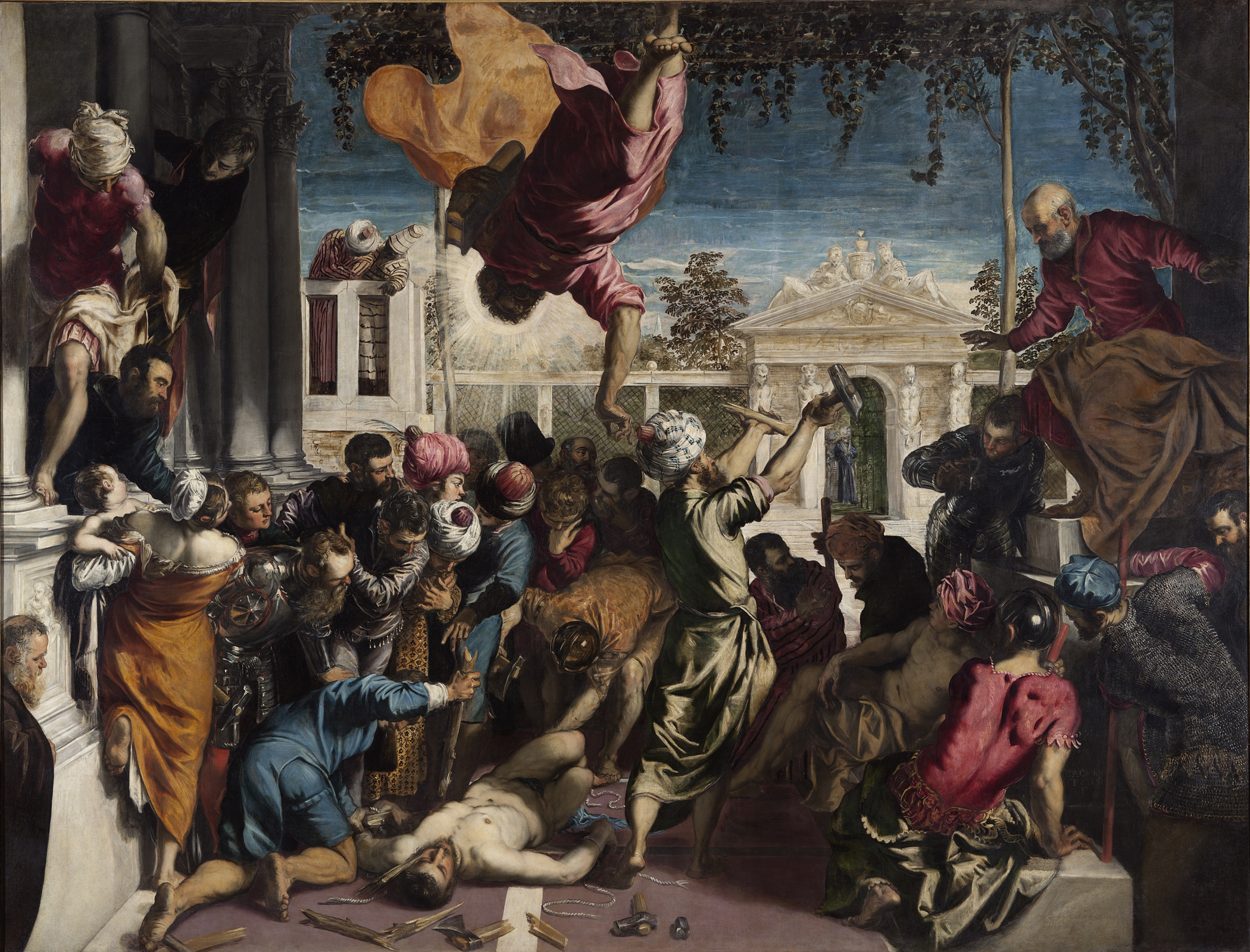
Tintoretto, St. Mark Freeing a Christian Slave, 1548
[Visual/Content] Oil on canvas; Venice's patron saint plunges headfirst down from the sky in extreme inverted foreshortening to rescue a naked, foreshortened Christian servant lying on the ground as the executioner holds up shattered torture tools before a stunned crowd and enthroned judge. [Context] Painted for a major Venetian lay confraternity (Scuola Grande di San Marco); the artist's breakout work. [Significance] Combines central Italian muscular foreshortening and Mannerist torsion with dramatic Venetian colorito and theatrical spotlighting.

Tintoretto, Adoration of the Shepherds, Scuola di S. Rocco, Venice, 1581
[Visual/Content] Oil on canvas; splits the barn interior horizontally into two rustic levels: peasants and livestock stand in the shadowed ground floor below, while above in an elevated hayloft hammock, the Virgin lifts a veil to reveal the Christ Child to shepherds as supernatural light beams slash through the wooden rafters. [Context] Painted for the upper hall of a wealthy Venetian charitable confraternity dedicated to a plague saint. [Significance] Replaces High Renaissance classical symmetry with an unconventional two-story diagonal perspective, dramatic chiaroscuro, and humble Counter-Reformation emotional immediacy.

Tintoretto, The Last Supper, San Giorgio Maggiore, Venice, 1594
[Visual/Content] Oil on canvas; sets the banquet table on a steep, plunging diagonal inside a dark Venetian tavern where a glowing Christ stands handing the Eucharistic bread to an apostle, while smoke from a hanging oil lamp turns into swirling translucent angels above busy servants and animals. [Context] Painted in the artist's final year for the chancel wall beside the high altar of a major Venetian Benedictine monastery church. [Significance] A quintessential Counter-Reformation masterpiece: replaces Leonardo's calm frontal symmetry with a dynamic diagonal, dramatic dark-and-light contrast, and mystical angels that visually defend the miracle of Transubstantiation.

Palladio, Villa Rotunda, near Venice, c. 1570
[Visual/Content] Bilaterally symmetrical, centrally planned square country house crowned by a Pantheon-inspired central hemispherical dome, featuring four identical classical Roman Ionic temple porticoes with six columns and pediments projecting from all four sides. [Context] Built on a hilltop in Vicenza (Venetian mainland) as a rural retreat and entertaining pavilion for a retired papal prelate. [Significance] Revolutionized Western architecture by putting a sacred temple dome and four classical temple fronts onto a secular domestic house, maximizing 360-degree landscape views and Vitruvian mathematical harmony.

Michelangelo, Laurentian Library vestibule, Florence, 1524–59
[Visual/Content] Tall, cramped entrance hall constructed of dark gray pietra serena and white stucco, dominated by a massive triple staircase with curving volutes that pours down like lava; the walls feature paired recessed columns sunk into niches, blind niches, tapering broken pediments, and decorative scroll brackets that hold up no weight. [Context] Commissioned by Medici Pope Clement VII attached to the church of San Lorenzo in Florence to house the Medici manuscript collection. [Significance] The foundational work of Mannerist architecture, deliberately violating every Vitruvian classical rule to create physical compression and psychological tension.

Michelangelo, Last Judgment, Sistine Chapel, Rome, 1534–41, fresco
[Visual/Content] Colossal buon fresco covering the entire altar wall without painted architectural frames; over 300 massive, twisting figures swirl around a beardless, muscular Christ the Judge as the saved rise at left, the damned are beaten into hell by Charon at right, and St. Bartholomew holds his own flayed skin containing the artist's anguished self-portrait. [Context] Conceived under Pope Clement VII after the 1527 Sack of Rome and completed under Pope Paul III at the dawn of the Counter-Reformation (later censored with painted loincloths). [Significance] Marks the end of High Renaissance optimism, replacing rational harmony with Mannerist anxiety, crushing muscular bulk, and spiritual terror.

Parmigianino, Madonna and Child with Angels, 1534
[Visual/Content] Oil on wood panel (famously nicknamed "Madonna with the Long Neck"); an artificially elongated, swan-necked Virgin in cool metallic drapery holds a stretched, limp Christ Child beside five crowded angelic youths holding a liturgical urn at left, while a tiny miniature prophet unrolls a scroll before unfinished columns in the distant lower right. [Context] Commissioned by noblewoman Elena Baiardi for her private family chapel in a church in Parma. [Significance] The textbook example of courtly Italian Mannerism—rejects High Renaissance natural proportions and rational perspective in favor of hyper-elegant elongation, figura serpentinata, and spatial ambiguity.

Pontormo, Deposition, Capponi Chapel, Florence, 1528
[Visual/Content] Oil on wood panel; eleven weightless, twisting figures on tiptoe swirl in a vertical pinwheel around a hollow central void of grieving hands as youths carry Christ's body toward a swooning Virgin; features no cross, no tomb, and no spatial ground plane, painted in jarring, acidic pastel pinks, blues, and greens. [Context] Painted for a private family altar in the church of Santa Felicita in Florence. [Significance] Completely subverts the grounded High Renaissance pyramid (like the 1500 Pietà), using an unstable, gravity-defying composition, ambiguous space, and artificial neon-like pastel colors to evoke Mannerist spiritual anguish.
THEME: Venetian Colorito vs. Florentine/Roman Disegno
Florentine/Roman Renaissance art (Michelangelo, Raphael) championed "disegno": intellectual preliminary drawing, crisp sculptural contours, idealized heroic anatomy, and linear perspective. Venetian Renaissance art (Bellini, Giorgione, Titian, Veronese) championed "colorito": building three-dimensional form, glowing atmosphere, and emotional mood directly through rich, layered oil colors, light, and painterly brushwork.
THEME: Why Canvas & Oil Dominated Venice (Medium & Climate)
Unlike Florence and Rome, where artists painted wall frescoes onto damp plaster and tempera on wood panels, Venice's humid, salty lagoon climate quickly destroyed plaster frescoes. Venetian masters therefore pioneered painting in slow-drying oil on stretched woven canvas, which resisted dampness, allowed massive portable civic narratives (for scuole and palaces), and enabled rich colorito glazes.
THEME: Evolution of the Venetian Altarpiece (Symmetry to Diagonal)
Early Venetian High Renaissance altarpieces (Bellini's "San Zaccaria") maintained calm, front-facing symmetry within unified sunlit space. Later Venetian masters shattered that static symmetry: first elevating the throne outdoors (Giorgione), then adding explosive upward motion ("Assumption"), and finally tilting the entire composition onto a dramatic diagonal anchored by towering columns ("Pesaro Altarpiece" and "Mystic Marriage of St. Catherine").
THEME: The Venetian Renaissance & Counter-Reformation Art
As the Protestant Reformation challenged Catholic imagery, the Council of Trent (1563) and The Inquisition demanded clear, devout, non-distracting religious art. While Titian answered with dramatic Catholic state portraits ("Charles V"), Veronese clashed directly with the Inquisition over his theatrical, luxurious banquet scenes, proving Venice's enduring love of color, spectacle, and civic splendor.
THEME: High Renaissance vs. Mannerism (Style & Space)
High Renaissance art (c. 1490–1520) valued natural anatomical proportions, grounded pyramidal stability, rational one-point linear perspective, and harmonious balance. Mannerism (c. 1520–1600, emerging after the death of Raphael and the 1527 Sack of Rome) rejected naturalism in favor of "maniera" (artificial stylishness): elongated or bulky figures in twisting "figura serpentinata" poses, compressed or irrational space, hollow or off-center compositions, and acidic, clashing pastel colors.
THEME: Comparison of the Three "Last Suppers" (Leonardo vs. Veronese vs. Tintoretto)
(1) High Renaissance (Leonardo, c. 1495): Calm frontal horizontal table, strict one-point perspective converging on Christ's head, focused on human psychological reactions ("moti mentali") to betrayal. (2) Venetian Pageantry (Veronese, 1573, renamed "Feast in the House of Levi"): Horizontal three-arched classical loggia filled with luxurious Venetian silk pageantry, dogs, dwarfs, and soldiers that sparked an Inquisition trial. (3) Counter-Reformation / Late Venetian (Tintoretto, 1594): Plunging diagonal table in a dark tavern, glowing chiaroscuro light, and smoky apparitions of angels celebrating the mystical miracle of Transubstantiation.
THEME: Classical Architecture vs. Mannerist Architecture (Palladio vs. Late Michelangelo)
Palladio ("Villa Rotunda") upholds Vitruvian classical clarity, mathematical symmetry, and serene natural harmony, applying clear Ionic temple fronts and a Pantheon dome to a secular cube. By contrast, Late Michelangelo ("Laurentian Library vestibule") pioneers Mannerist anti-classicism, intentionally breaking Vitruvian rules with recessed columns trapped in the wall, blind niches, broken pediments, and weightless brackets to make the viewer feel anxious and compressed.