Tuberculosis
 Call Kai
 Learn
 Practice Test
 Spaced Repetition
 Match
 Flashcards
 Knowt Play
1/59

There's no tags or description
Looks like no tags are added yet.
60 Terms
Most cases occur in South-East Asia, Africa, and Western Pacific regions.
most common locations of TB infection
Airborne spread via respiratory droplets.
Risk of infection depends on exposure duration, bacterial load, and host immunity.
transmission of TB
Mycobacterium tuberculosis
Most common cause of human TB worldwide.
Causes pulmonary and extrapulmonary TB.
Mycobacterium africanum
Endemic in West Africa.
Less virulent than M. tuberculosis but still causes TB-like disease.
mycobacterium bovis
Zoonotic, from unpasteurized milk or contact with cattle.
Can cause GI TB.
Historically important in Europe; now rare in countries with milk pasteurization.
Organized collection of immune cells (macrophages, epithelioid cells, Langhans giant cells, lymphocytes).
Purpose: Body's attempt to wall off the TB bacilli.
define what a granuloma formation is and what is its purpose
Th1 cells release IFN-γ, activating macrophages.
TNF-α helps maintain granuloma integrity.
immune mediators of granuloma formation
caseation necrosis
Type of necrosis within granulomas where tissue has a "cheese-like" gross appearance.

Acellular, amorphous, eosinophilic debris surrounded by granulomatous inflammation.
histology of caseation necrosis
casaeating necrosis
Classic hallmark of tuberculous granulomas (though not specific).
Ghon focus
the formation of a granuloma, or walled off area of bacteria, which is considered the primary lung lesion in tuberculosis

Primary site of infection, usually a subpleural lesion in the mid/lower lung zones.
where does the ghon focus usually form?
ghon complex
Ghon focus + hilar lymph node involvement.
Seen in primary TB.

ranke complex
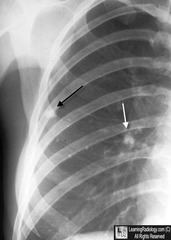
A healed Ghon complex that has undergone fibrosis and calcification (seen on CXR).
Hematogenous spread of MTB to the spine.
Causes destruction of intervertebral discs and vertebral collapse → spinal deformity ("gibbus deformity")
describe the pathology of Pott's disease
Chronic back pain, spinal tenderness.
Neurologic deficits (if spinal cord compressed).
clinical features of potts disease
Pott's disease
MRI shows destructive lesions in vertebral bodies, possible paraspinal abscesses
-intensive phase (2 months of RIPE therapy)
-continuation phase (2 months of rifampin andd isonizaid)
what are the two phases of treatment for active TB?
Rifampin (RIF)
Isoniazid (INH)
Pyrazinamide (PZA)
Ethambutol (EMB)
name the members of RIPE therapy
pyridoxine
supplement to prevent isoniazid neuropathy
Rifampin (RIF)
Isoniazid (INH)
Pyrazinamide (PZA)
what RIPE drugs require monitoring of LFTs
directly observed therapy
health care worker or caregiver wacthes patient take every medication. helps prevent infection spread, adherence to drug therapy, and controls spraed worldwide
-recomended in tx of active TB
Rifampin + Isoniazid for 4 months following the 2 months of RIPE
meds in continuation phase of TB
3 months INH + Rifapentine (3HP), once weekly (DOT or self-administered).
4 months Rifampin (4R) daily.
OR
6-9 months Isoniazid (6H/9H) daily.
treatment regimens for latent TB
primary TB
Hilar/mediastinal lymph node enlargement, patchy lower/mid-lung opacities.

latent TB CXR
Healed fibrotic lesions or calcified nodules (Ranke complex).
No active infiltrates or cavities.
Appearance: Old scars or calcifications in lung apices or hilar nodes.

Cavitation + fibrosis, often bilateral upper lobes.
findings of reactivation TB
Miliary TB
hematogenous dissemination of TB
Miliary TB on CXR
numerous 2-3 mm nodules scattered difffusely throughout both lungs

Normal exam in latent TB.
No abnormal lung sounds, no lymphadenopathy, no cachexia.
If exam findings present → evaluate for active TB instead.
physical exam findings of latent TB
≥5 mm: HIV+, recent TB contacts, immunosuppressed.
≥10 mm: Recent immigrants, IVDU, healthcare workers, children
positive thresholds for tuberculin skin test
False positives with BCG vaccine or NTM exposure; false negatives in immunosuppressed.
cause of false positive/negative PPD
Blood test measuring IFN-γ release by T-cells in response to MTB antigens.
what does the IGRA test measurue?
More specific (no false positives from BCG vaccine).
Requires single visit.
advantages of IGRA TB gold test
Symptom screen (cough, fever, night sweats, weight loss).
Chest X-ray (look for infiltrates, cavities).
If abnormal → sputum AFB smear/culture.
before diagnosing latent TB, you must rule out active TB by
Children
the PPD skin test is preferred in what population?
HIV-infected persons.
Recent close contacts of active TB.
Immunosuppressed (organ transplant, TNF-α inhibitors, steroids).
Abnormal chest X-ray consistent with prior TB.
≥5 mm = Positive in what populations?
Recent immigrants (
≥10 mm = Positive in what populations?
Persons with no known risk factors.
≥15 mm = Positive in what populations?
Isoniazid (INH)
Rifampin (RIF)
multi-dru resistant TB is defined as strains resistant to at least
isoniazid and rifampin
These are the two most powerful first-line anti-TB drugs, so resistance requires use of second-line agents (fluoroquinolones, aminoglycosides, etc.).
Isoniazid and Rifampin (MDR-TB) PLUS
Any fluoroquinolone AND
At least one of the second-line injectable drugs (amikacin, kanamycin, or capreomycin).
extensively drug resistant TB is defined as TB that is resistant to
prior incomplete treatment, contact with MDR-TB case, HIV/immunosuppression, endemic exposure, systemic treatment failures.
risk factors of drug resistant TB
Negative pressure isolation room.
Healthcare workers use N95 respirators (or powered air-purifying respirators).
Patient should wear a surgical mask when leaving the room
isolation precautions for pts with active TB
On effective therapy, clinical improvement, and 3 consecutive negative sputum smears (usually after 2-3 weeks of therapy)
maintain isolation precautions for active TB until
BCG vaccine
Used in high-prevalence countries to prevent severe TB in children (not widely used in U.S. because of low prevalence).
Adherence support: DOT to prevent incomplete therapy.
Avoid monotherapy (always use combination therapy).
Ensure access to high-quality anti-TB drugs (not counterfeit/expired).
Complete the full course of therapy even if symptoms improve.
prevention strategies against MDR-TB
HIV
the strongest risk factor for developing active TB.
HIV causes depletion of CD4+ T cells, weakening granuloma formation → MTB more likely to escape containment.
why does HIV predispose pts to MDR-TB
rifampin, isoniazid, leading to subtherapeutic levels and resistance development.
HIV can cause malabsorption of these TB drugs
rifampin
______, CYP450 inducer lowers levels of manny ART drugs
Constitutional symptoms: fever, night sweats, weight loss, fatigue.
Pulmonary symptoms: chronic cough, hemoptysis, chest pain
symptoms of reactivation TB
Renal TB: sterile pyuria (WBCs in urine but negative bacterial culture).
Adrenal TB: adrenal insufficiency (Addison's disease).
GI TB: ileocecal involvement → abdominal pain, obstruction.Renal TB: sterile pyuria (WBCs in urine but negative bacterial culture).
Adrenal TB: adrenal insufficiency (Addison's disease).
GI TB: ileocecal involvement → abdominal pain, obstruction.
describe renal, adrenal, and GI TB manifestations
inhibits RNA polymerase
MOA of rifampin
Orange-red secretions (urine, tears, saliva), hepatotoxicity, CYP450 inducer (drug interactions)
side effects of rifampin
Inhibits mycolic acid synthesis
MOA of isoniazid
Peripheral neuropathy (prevent with B6), hepatotoxicity, drug-induced lupus
side effects of isoniazid
Hepatotoxicity, hyperuricemia (gout)
"Pyrazinamide = Pain in joints"
side effects of pyrazinamide
Inhibits arabinosyltransferase → ↓ cell wall synthesis
MOA of ethambutol
Optic neuritis (red-green color blindness, decreased visual acuity)
"Eye-thambutol"
side effects of ethambutol