Molecular and Cell Biology - Ch. 5: DNA & Chromosome Structure
 Call Kai
 Learn
 Practice Test
 Spaced Repetition
 Match
 Flashcards
 Knowt Play
1/26

There's no tags or description
Looks like no tags are added yet.
27 Terms

Where are the 5’ carbon and 3’ carbon on a nucleotide? (2)
C. 3’
E. 5’

Identify the 3 components of a nucleotide on this diagram: (3)
yellow: phosphate group
blue: sugar ring
green: base
What are the nucleotide base pairs in DNA and RNA? (4)
DNA:
Adenine - Thymine
Guanine - Cytosine
RNA:
Adenine - Uracil
Guanine - Cytosine

Identify the type of bond that forms between sugar and phosphate groups and the 5’ and 3’ end of the nucleotide polymer: (3)
A. phosphodiester (COVALENT) bond
B. 5’ End
C. 3’ End
How many H-bonds are in-between each pair? (2) bonus: what would that mean for the melting point of something rich in the pair content? (1)
A - T = 2 H bonds
G - C = 3 H bonds
Rich in GC = higher melting point than AT
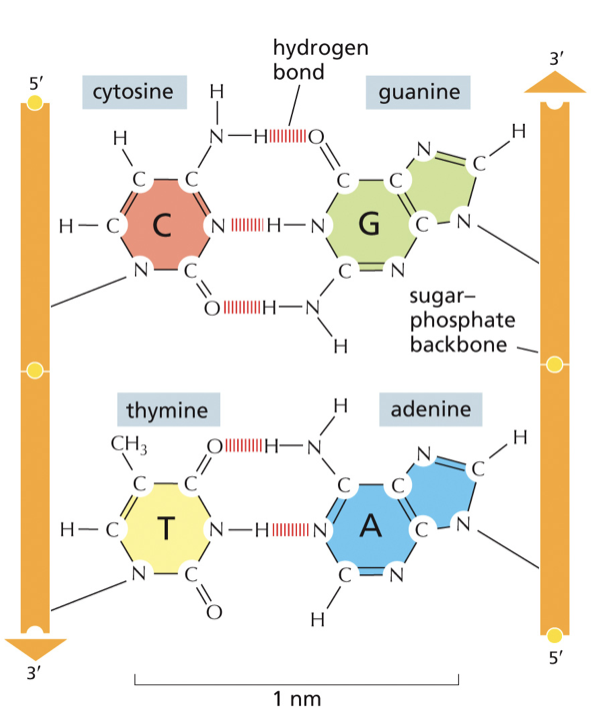
What is the structure of DNA and orientation of the strands? (2)
double helix
antiparallel, one 5’ to 3’ and other 3’ to 5’
How are DNA strands held together?
bases in opposite strands H-bond
What is the backbone and in the middle of DNA? (2)
sugar-phosphate backbone
middle: nitrogenous bases w/ H-bonds
What is a gene?
segment of DNA that encodes for a functional product, (protein, RNA)
What is the difference in chromosomes for eukaryotes vs prokaryotes?
eukaryotes: linear
prokaryotes: circular

What is at the end and center of eukaryotic chromosomes?
end: telomeres
center: centromeres

What are do telomeres do? What are they important for? (2)
serve as the end cap (buffer zone) that prevents and protects important DNA from being degraded
important for replication and stability
What happens at the centromere? (1)
DNA sequence where mitotic/meiotic spindle attaches
What is their structure inside of the cell during interphase? (3 characteristics)
decondensed
have their own special territory in nucleus
if encodes ribosomal RNA, it will have a loop in the nucleolus

What is their structure inside of the cell during mitosis? (2)
condensed, tightly coiled
forms a long continuous strand of DNA + the proteins that organize it (looks like X)
What are the functions of nucleosomes? (1×2)
Organizes DNA:
packs DNA tightly for nuclear division
regulation of gene expression
What are the components of nucleosomes?
histone octamer + linker DNA
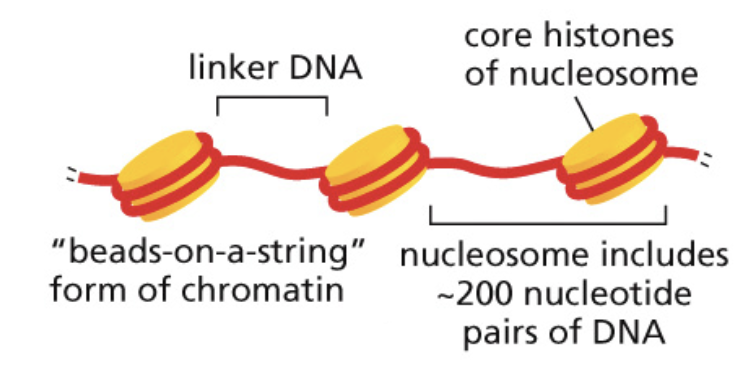
What do histone subunits have and what charge does this create? Why is it good that this is the charge? (2)
histone subunits have lots of positively charged amino acids
DNA has a negative charge, so the DNA binds to the histones via electrostatic attraction

What part of the nucleosomes interacts with nearby DNA/nucleosomes? (2)
histone subunit tails that project out from the entire structure
tails have positively charged AAs on them to help bind beads together in a structure with DNA/nucleosomes nearby
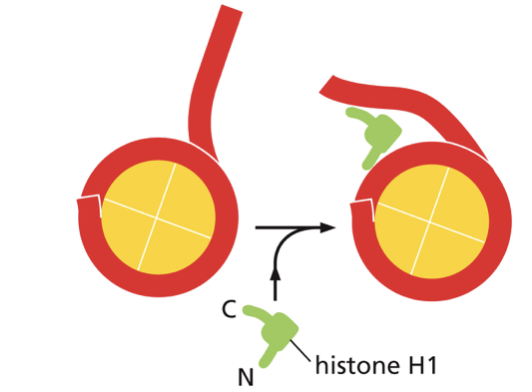
How can a linker histone change the path of DNA as it exits nucleosome? (2)
help pull nearby nucleosomes together
= more condensed chromatin
Why do we remodel chromatin? What are two ways we can?
Tightly packed DNA means transcription proteins can’t be accessed which means gene product can’t be made, so we need to remodel to access the DNA
Chromatin-remodeling complexes
Modifying histone tails
How do we change the relative position of the nucleosome on DNA? (1×2)
Chromatin-remodeling complexes
use ATP to change nucleosome position on DNA
moving DNA around a spool of histone to expose DNA that was not previously exposed before
What do the 2 ways of modifying histone tails do? (2)
Forces tails to interact with DNA → pull things closer together
Adds acetyl, methyl, phosphate group to tails which would change the interaction being more/less bound
If we add an acetyl group to a lysine, what happens and will the DNA be more or less tightly bound?
Lysine binds to acetyl with an oxygen on it, lots of electronegativity, we get rid of positive charge, binds less tightly, loosens or decondenses chromatin
How do we condense chromatin for mitosis/meiosis?
condensing (+ATP hydrolysis) makes loops
What is the difference between heterochromatin and euchromatin?
Heterochromatin: chromatin that is inaccessible, tightly packed
Euchromatin: open, accessible chromatin (transcription proteins can access and make those products with euchromatin]
![<ul><li><p>Heterochromatin: chromatin that is inaccessible, tightly packed</p></li><li><p>Euchromatin: open, accessible chromatin (transcription proteins can access and make those products with euchromatin]</p></li></ul><p></p>](https://assets.knowt.com/user-attachments/0dc4d51d-244b-4214-8288-8b872436571a.png)
What is the difference between constitutive heterochromatin and facultative chromatin? (2×2)
constitutive:
location: chromatin on the telomeres/centromeres
permanence: permanently condensed
facultative:
location: specific regions where genes need to be turned off
permanence: conditionally condensed and reversible