Properties of Water
 Call Kai
 Learn
 Practice Test
 Spaced Repetition
 Match
 Flashcards
 Knowt Play
1/33

There's no tags or description
Looks like no tags are added yet.
34 Terms
Chemical formula for water
H2O
Polarity of Water
has polar covalent bonds; H is partially positive, O is partially negative

Polar Covalent Bond
A covalent bond in which electrons are not shared equally
Hydrogen Bond
Intermolecular bond in which there is an attraction between a slightly positive hydrogen atom and a slightly negative atom on another molecule

Four
Number of bonds one water molecule can form with others
Electronegativity
A measure of the ability of an atom in a chemical compound to attract electrons

Cohesion
Attraction between molecules of the same substance
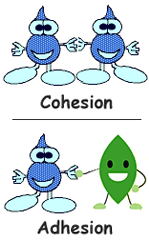
Adhesion
An attraction between molecules of different substances

Surface Tension
Caused by hydrogen bonding; a measure of the film that forms on the surface of a body of water

Capillary Action
Combination of adhesion and cohesion; allows water to move up a vessel; driven by evaporation

Less Dense as a solid
Water molecules expand as water gets cooler than 4 Celsius. At 0, they lock into place. Ice floats!

4 degrees Celsius
Temperature at which water is most dense
Universal solvent
All the chemical reactions that take place in organisms take place in water
High heat capacity
Water has the ability to absorb a lot of heat without having the temperature rise too quickly
Specific heat of water
4.184 joules
One calorie
Equal to the specific heat of water; 4.184 joules

Kilocalorie
The "calories" found on food labels - food calories are equal to 1,000 scientific calories

Phase changes
Water is the only substance on earth found naturally in all three states: solid, liquid and gas

70%
The amount of the earth's surface that is covered in water; also the relative amount of water found in each of our cells
pH
-log

Solution
A homogeneous mixture of two or more substances

Solvent
A liquid substance capable of dissolving other substances

Solutes
substance dissolved in a solution

Acid
any compound that forms H+ ions in solution
Base
A substance that decreases the hydrogen ion concentration in a solution.
Buffer
compound that prevents sharp, sudden changes in pH

Between 6 - 8
pH of most body fluids
Proton hopping
Hydrogen ions rapidly transfer from one molecule to the next in a vessel of water

Alkaline or basic
Referring to substances with a greater concentration of OH- ions

Hydrophilic
Having an affinity for water.

Hydrophobic
Having an aversion to water; tending to coalesce and form droplets in water.

Evaporative cooling
As a liquid evaporates, its remaining surface cools; sweat demonstrates this

Specific heat of a substance
the amount of energy required to raise 1 g of that substance by 1ºC
Dissociation of water
Breaking apart of the water molecule into two ions of opposite charge; happens spontaneously ~once every 550 million molecules