Alkene Reactions

0.0(0)
Studied by 0 people
call kaiCall Kai
learnLearn
examPractice Test
spaced repetitionSpaced Repetition
heart puzzleMatch
flashcardsFlashcards
GameKnowt Play
Card Sorting

1/10

encourage image

There's no tags or description

Looks like no tags are added yet.

11 Terms

1
New cards

Syn Dihydroxilation

- 2 OH groups added across alkene
- syn addition
- OsO4 and KMnO4, NaOH are the most common reactants

<p><span>- 2 OH groups added across alkene</span><br><span>- syn addition</span><br><span>- OsO4 and KMnO4, NaOH are the most common reactants</span><br></p>
2
New cards

Ozonolysis

- O3 is the reactant with DMS
- each alkene is split into two molecules with an O-double bond on each one
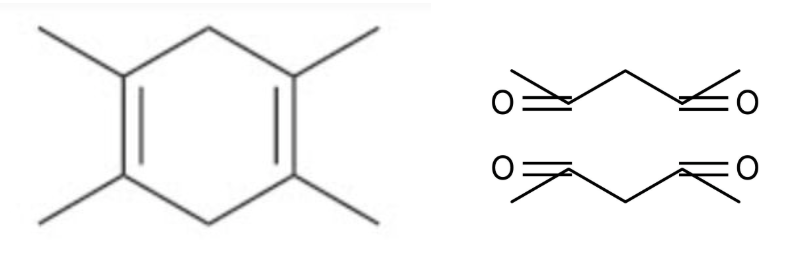
<p><span>- O3 is the reactant with DMS</span><br><span>- each alkene is split into two molecules with an O-double bond on each one</span></p>
3
New cards

Hydrohalogenation

- The addition of HCl or HBr to a double bond

- Markovnikov product UNLESS (HBr- ROOR)

- 2 steps: protonation, nucleophilic attack

- Hydrogen is normally added to the less substituted side

- CAN have carbocation rearrangements

<p>- The addition of HCl or HBr to a double bond</p><p>- Markovnikov product UNLESS (HBr- ROOR)</p><p>- 2 steps: protonation, nucleophilic attack</p><p>- Hydrogen is normally added to the less substituted side</p><p>- CAN have carbocation rearrangements</p>
4
New cards

Hydroboration - Oxidation

- add OH and H across alkene
- anti- markovnikov
- syn addition

<p><span>- add OH and H across alkene</span><br><span>- anti- markovnikov</span><br><span>- syn addition</span></p>
5
New cards

Halohydrin Formation

- Addition of Br and OH across alkene
- OH is at more substitued carbon
- anit- addition
- Br2 and H2O are reactants
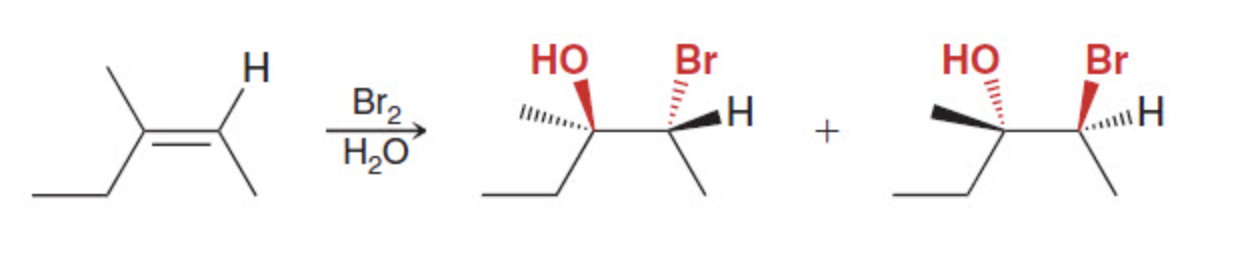
<p><span>- Addition of Br and OH across alkene</span><br><span>- OH is at more substitued carbon</span><br><span>- anit- addition</span><br><span>- Br2 and H2O are reactants</span></p>
6
New cards

Changing the position of a Pi bond

- 2 Steps: Addition + Elimination
- Addition removes Pi bond
- Elimination adds it back in a different locaiton
- HBr = markovnikov
- HBr, ROOR = anti-markovnikov
- Hinderance = Hoffman
- No hinderance = Zaitsev

7
New cards

Changing Halogen Positon or OH group

- 2 Steps: elimintation + addition
- elimination creates and alkene, addition deletes it
- eliminaton requires nucleophile (strong = E2) (weak = E1)
- OH group requires (TsCL, pyridine) or (Conc. H2SO4 + heat) to leave
- steric hinderance = hoffman
- no hinderance = zaitsev
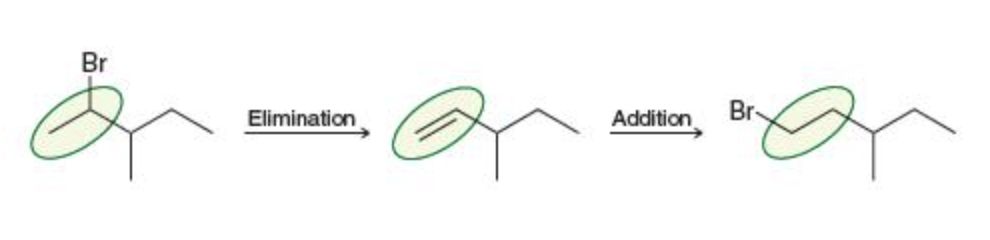
<p><span>- 2 Steps: elimintation + addition</span><br><span>- elimination creates and alkene, addition deletes it</span><br><span>- eliminaton requires nucleophile (strong = E2) (weak = E1)</span><br><span>- OH group requires (TsCL, pyridine) or (Conc. H2SO4 + heat) to leave</span><br><span>- steric hinderance = hoffman</span><br><span>- no hinderance = zaitsev</span></p>
8
New cards

Catalytic Hydrogenation

- Adds two H across alkene
- looks almost like nothing has been added
- syn addition
- catalyst is almost always a metal
- H2 is the reagent
- new chiral centers may be formed

<p><span>- Adds two H across alkene</span><br><span>- looks almost like nothing has been added</span><br><span>- syn addition</span><br><span>- catalyst is almost always a metal</span><br><span>- H2 is the reagent</span><br><span>- new chiral centers may be formed</span></p>
9
New cards

Acid-Catalyzed Hydration

- OH and H added across an alkene
- Presence of an acid (represented by H3O+)
- 2 Steps: protonaition, nucleophilic attack
- OH goes on most stable
- Markovnikov addition

<p><span>- OH and H added across an alkene</span><br><span>- Presence of an acid (represented by H3O+)</span><br><span>- 2 Steps: protonaition, nucleophilic attack</span><br><span>- OH goes on most stable</span><br><span>- Markovnikov addition</span></p>
10
New cards

Epoxidation

  • Converts double bonds into epoxides (3-membered rings with an oxygen in the middle)

  • Adds an oxygen atom to a double bond

  • electron needs to be oxygen deficient

  • syn- addition


<ul><li><p>Converts double bonds into epoxides (3-membered rings with an oxygen in the middle)</p></li><li><p>Adds an oxygen atom to a double bond</p></li><li><p>electron needs to be oxygen deficient</p></li><li><p>syn- addition</p></li></ul><p></p>
11
New cards

Anti- Dihydroxilation

  • follows epoxidation with epoxide being intermediate

  • H3O+ serves as catalyst by turning oxygen into alcohol

  • in case of cyclohexane: 2 trans diols are formed
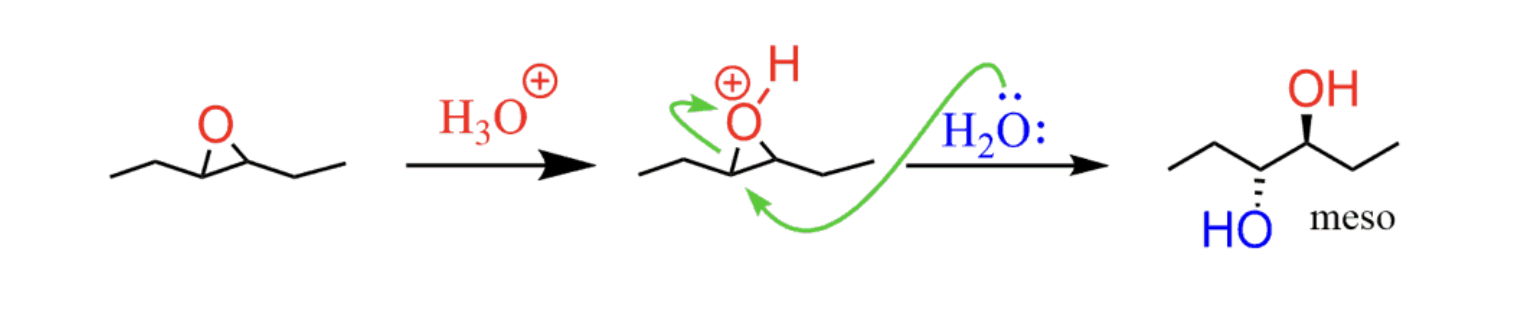

<ul><li><p>follows epoxidation with epoxide being intermediate</p></li><li><p>H3O+ serves as catalyst by turning oxygen into alcohol</p></li><li><p>in case of cyclohexane: 2 trans diols are formed</p></li></ul><p></p>



