(3) Reabsorption and secretion in the proximal tubule
 Call Kai
 Learn
 Practice Test
 Spaced Repetition
 Match
 Flashcards
 Knowt Play
1/59

There's no tags or description
Looks like no tags are added yet.
60 Terms
3 epithelial characteristics that affect solute movement
ultrastructure of the tubule cell, asymmetrical distribution of membrane channels and transporters, and kinetic properties of the transporters
What aspects of the ultrastructure of tubule cells can affect solute movement?
surface area and tightness of epithelium
What does it mean that there is an asymmetry in the distribution of membrane channels and transporters?
different membrane channels and transporters are expressed on the apical(luminal) vs basolateral (extracellular/blood) sides of an epithelial cell
How does the ultrastructure of early PCT differ from that of the late PCT?
early PCT has enhanced membranes, abundance of mitochondria and organelles and a “leaky” epithelium. The late PCT is less complex but is still “leaky”.

What does being a “leaky” epithelium mean?
tight junction strands are leaky so substances like water or chloride can move across. Makes it hard to generate a potential between the apical/lumen and basolateral/blood-side
t/f usually, the more complex or cuboidal the cell, the more that the cell is active in reabsorption or secretion
true
Show the difference in channels and transporters for Na+ reabsorption between the apical and basolateral membrane in the PT
interstitial space= “blood-side”. Apical side has a sodium channel and the basolateral side has Na+ pump. This creates an overall reabsorption of Na+ (movement of Na+ from apical to basolateral)

t/f transporters in the kidney do not show saturation kinetics
false

Threshold
plasma concentration at which the solute first appears in urine

Tm
the value at which reabsorption rate is saturated
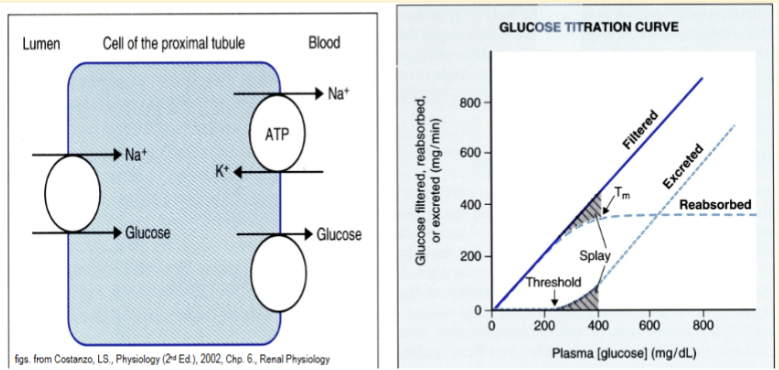
Splay
the gradual approach to Tm, (area between threshold and Tm)

Maximum rate by which the PT can reabsorb glucose. What does this value represent?
about 350 mg/min; the Tm of glucose

What are some examples of transcellular movement across an epithelium(5)?

What are some examples of paracellular movement across an epithelium(2)?

The lumen in the early PT is slightly (negative or positive) compared to the blood. Why?
negative; a lot of sodium/ amino acid transporters on the apical side of cell generate a net electrogenicity (as they move a positive charge across the cell), creating a negative charge on the luminal side
Solvent drag
paracellular route where solutes are swept along with a moving stream of solvent, typically water
The proximal tubule (reabsorbs or secretes) the most NaCl, water, and many other solutes
reabsorbs
Na+ reabsorption drives both — and — reabsorption in the PT
Cl- and water
Show how much of the filtered load of Na+ is reabsorbed in each segment of the nephron

In the early PCT, Na+ reabsorption is coupled to movement of what other molecules?
reabsorption of glucose, amino acids, phosphates, sulfates, carboxylates; and acid/base movement

Na+ “back leak”
about 30% of Na+ that is reabsorbed through transcellular mechanisms of the early PCT paracellularly “leaks” back into the lumen due to the lumen’s more negative charge
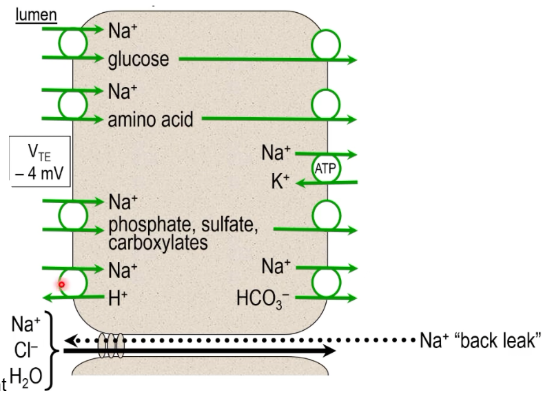
Difference in tubule fluid between the early and late PCT
in the early PCT, most glucose, amino acids, and HCO3- is reabsorbed so those substance will not be found in the tubule fluid of the late PT
The lumen of the late PT is slightly (positive or negative). Why?
positive; chloride concentration is much higher in the PT, so more of it moves through the paracellular route (and some transcellular route) and negative charge leaving the lumen causes it to have a positive charge

Show the transcellular pathway of NaCl reabsorption in the late PT
includes exchangers cotransporters and a Cl- channel
Isosmotic reabsorption
total solute reabsorption is proportional to water reabsorption. This makes it so that the osmolality stays the same all along the tubule.
Water passively follows the reabsorption of solutes across the — then — membranes. — provides the driving force for capillary reabsorption
apical(1) then basolateral(2a,b); higher πc (colloid osmotic pressure)

Why is there a higher πc in peritubular capillary and what does this provide the driving force for?
provides the driving force for capillary reabsorption; there is a higher πc (colloid osmotic pressure) because peritubular capillaries are downstream of the glomerular capillary tuft and thus there is a high protein conc. In its blood (because proteins are not filtered by kidneys due to their size)

t/f solute reabsorption matches water reabsorption in the PCT
true
t/f osmolality does not change as you move down the PT
true


Why does the concentration of each solute in the graph change the way that it does as you move down the PT (inclduing the Vte)?
inulin conc rises as water is reabsorbed and it is unable to also be reabsorbed

Glomerulotubular balance
dominant regulatory mechanisms of the PT. ensures the same percent of Na+ is absorbed along the PT regardless of filtered load. Therefore, the reabsorbed amount is proportional to the filtered fraction
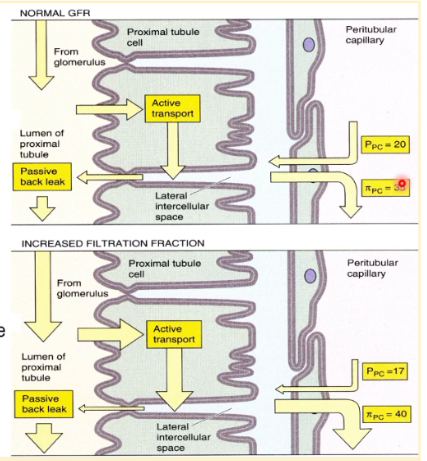
Describe the peritubular factors of GT balance under increased filtration fraction
increased filtration fraction leads to higher πpc (colloid osmotic pressure) and lower Ppc(hydrostatic pressure) as more fluid is filtered. This enhances reabsorption and decreases Na+ back leak

Describe the luminal factors of GT balance under increased filtration fraction
increased filtration leads to higher tubule flow which leads to slowing of a solute’s concentration decrease along the tubule and higher reabsorption of sodium in more distal portions of the PT

t/f glucose, amino acids, and carboxylates are reabsorbed ONLY in the PT
true

How is glucose reabsorbed in the PT
transport involves secondary active transporters and facilitated diffusion (FD)

How are amino acids reabsorbed in the PT
transport involves secondary active transporters and facilitated diffusion (FD)

How are carboxylates reabsorbed in the PT
transport involves secondary active transporters

The PT reabsorbs —- and — via receptor-mediated endocytosis
low-MW peptides and proteins
Hyperaminoacidurias
excessive amount of amino acids in urine
Hyperargininemia
Hyperaminoaciduria. A Metabolic defect causes high plasma levels of arginine. Arg levels in plasma can get so high that the threshold for reabsorption in the PT is reached and arginine is found in urine. Other amino acids get dumped in urine as well as they can use the same transporters as Arg.
Cystinuria, type 1
Hyperaminoaciduria. Abnormal Na-cationic amino acid transport leads to excessive amino acids in urine and can lead to kidney stone formation.
Show how potassium is handled by the nephron
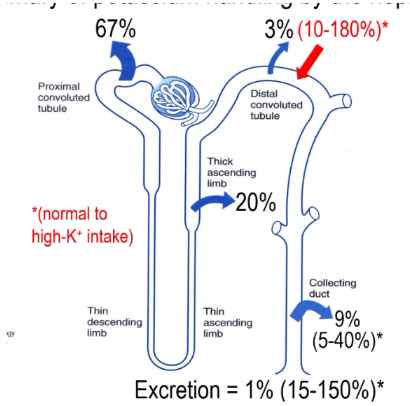
Potassium is one of the most dominant solutes in the final urine. Why?
normal to high intake of potassium leads to secretion of potassium in the distal tubule (equivalent to 10%-180% of filtered fraction)
Potassium is mainly reabsorbed in the PT due to what?
solvent drag with H2O
t/f there is a secretion mechanism for potassium in the PT, but it plays a minimal role in potassium handling by the nephron
true
Show how calcium in handled by the nephron

Show magnesium in handled by the nephron
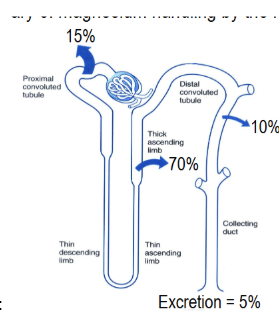
Ca2+ reabsorption in the PT is about –% paracellular and –% transcellular
80 ; 20
Show the transcellular route for calcium reabsorption in the PT
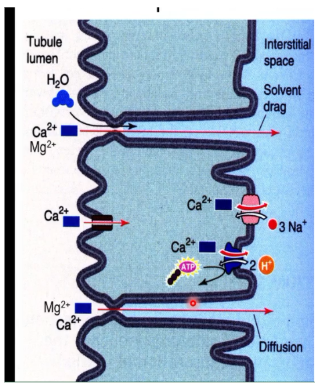
The predominant way that Ca2+ and Mg2+ is reabsorbed in the PT is through what route?
paracellular
Show how phosphate is handled by the nephron

How is phosphate reabsorbed in the PT?
mediated by secondary active transporters on the luminal membrane (NaPi) and mechanism of transport across the basolateral membrane is unknown. Reabsorption is Tm limited.

If plasma phosphate increases slightly, how is reabsorption in the PT affected?
the phosphate transporters on the apical side become saturated and more phosphate is dumped in the urine

Show how HCO3- is handled by the nephron

t/f we normally reabsorb almost all of our HCO3- in nephrons
true
Show how HCO3- is reabsorbed in the PT

PAH
para-amino-hippurate. Synthetic exogenous anion that is transported by organic anion transporters. Readily secreted in the int PT. secreted rate is greater than filtered rate at low concentrations (more is secreted from peritubular capillaries than is filtered by glomerulus. can be used to calculate renal blood flow

Show how organic anions are secreted in the PT
dicarboxylate-coupled exchange (basolateral) and anion-coupled exchange (luminal)

Show how organic cations are secreted in the PT
facilitated diffusion (basolateral) and H+-coupled exchange (luminal)

A lot of exogenous organic anions/cations are what?
drugs