Lecture 4 - Genetics of Obesity Part 2
 Call Kai
 Learn
Learn Practice Test
 Spaced Repetition
 Match
Match Flashcards
 Knowt Play
1/21

There's no tags or description
Looks like no tags are added yet.
Name | Mastery | Learn | Test | Matching | Spaced | Call with Kai | Chat |
|---|
No analytics yet
Send a link to your students to track their progress
22 Terms
What is the importance of studying the genetic basis of obesity?
Understand inter-individual variability regarding disease phenotype, but also response to interventions → Lifestyle, pharmaceutical, bariatric surgery, etc.
• Can influence gene expression and function • Gene dosage effects (i.e., the number of copies of a gene in the genome is correlated with the amount of mRNA / protein made)
• Determine genes underlying obesity and related complications → identify new genetic targets for pharma
• Understand how the risks of obesity are passed on from one generation to the next
What is the genetic influence on the weight loss response?
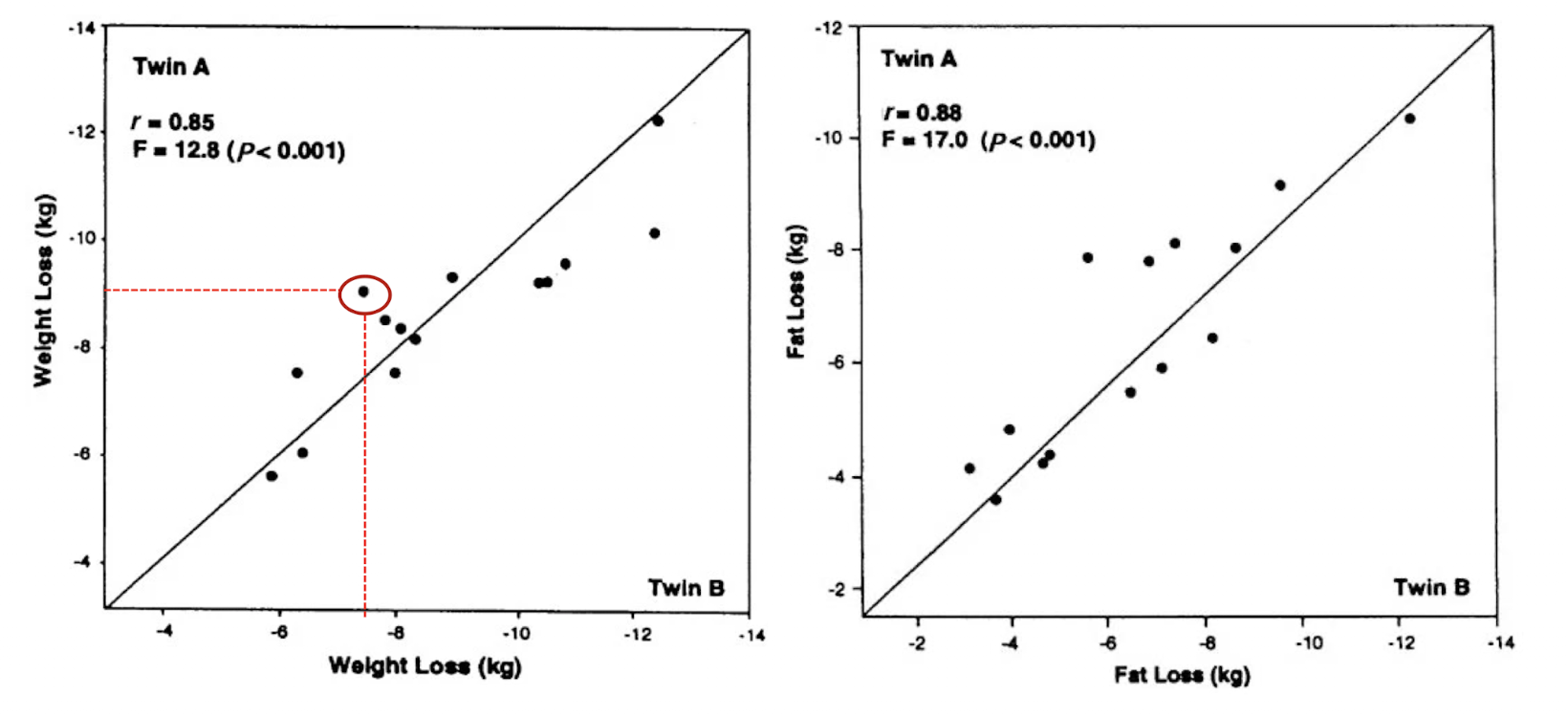
14 pairs of identical twins studied after 28 days of a VLCD (380 kcal/d) (low calorie diet) for weight and fat loss.
Weight and fat losses were more similar within identical twin pairs than across different pairs
This indicates that some people will lose more weight than others on the same diet, but people with a similar genotype will respond in a similar way to a diet
What are chromosomal variation?
Aneuploidy → abnomrla number of chromosomes (eg trisomy)
Heteromorphism - Visible regions of a chromosome that varies in size or morphology
What is structural variation?
Copy number variants (CNVs) and segmental duplications → differences in DNA copy number or the presence of duplicated DNA segments
Inversion
Translocation
What are inversions?
a region of DNA with reverse orientation compared other the rest of the chromosome
What are translocations?
regions of DNA that change position in the genome without changing sequrence
What are small scale variants?
Single nucleotide polymorphism (SNPS) → single base pair changes
Where do genetic variants occur?
in both coding and non-coding regions
What is non-coding DNA?
Non-coding DNA (98-99% of the genome) can regulate protein-coding DNA through:
• Non-coding functional RNAs (tRNAs, rRNAs, siRNAs, miRNAs, etc.)
• Promoter and repressor sequences
• DNA sequence folding in 3-dimensional space
What are copy number variants (CNVs)?
DNA segments whose copy number differs from a reference genome
• Include insertions, deletions and duplications
• Constitute ~12% of the human genome
• Extra copies may be adjacent or located elsewhere in the genome
What are segmental duplications?
Large DNA segments repeated within a single set of chromosomes, with at least 90% sequence identity between copies
• Constitute ~5% of the human genome
• Copies may be adjacent or dispersed. Their similarity can facilitate misalignment and rearrangement
• Unevenly distributed across the genome, with higher concentrations in certain regions
• e.g., chromosome 3 is made up of ~2% SDs and chromosome 22 is made up of ~12% SDs

What is the distribution and frequency of CNV?
10% of protein coding genes have CNVs!
270 subjects from HapMap (4 populations: Nigeria, USA, Japan and China)
What is non-allelic homologous recombination?
Non-allelic homologous recombination (NAHR) is a type of genetic recombination that happens between two similar DNA sequences that are not alleles (not at the same position on matching chromosomes)
How do CNVs and SDs happen?
recombination within a chromosme
recombination between two non-homologous chromosome
Similar repeated DNA sequences at different genomic locations can misalign during recombination, leading to deletions, duplications or rearrangements

How does recombination within the chromosome occur?
when nearly identical repeats sit at different locations, the cell's recombination machinery can mistakenly pair up the wrong copies
Because they orange and pink arrows are similar but not the same alleles, when they cross over they either cuase a duplication or a deletion
recombination between two homologous copies of the same chromosome type — one inherited from mom and one from dad.
one duplicates and the other is deleted

How does recombination between non-homologous chromosomes occur?
for example is chromosome 3 and 22 have matching parts they swap the DNA and translocate it

What is the direct effect of CNVs and SDs?
By influencing gene expression (i.e., dosage sensitive genes) - common in genes involved in immune function and defense responses to bacteria
What is the indirect effect of CNVs and SDs?
By causing structural rearrangements within chromosomes
Alpha Amylase (AMY1)
Amylase breaks dietary polysaccharides into disaccharides
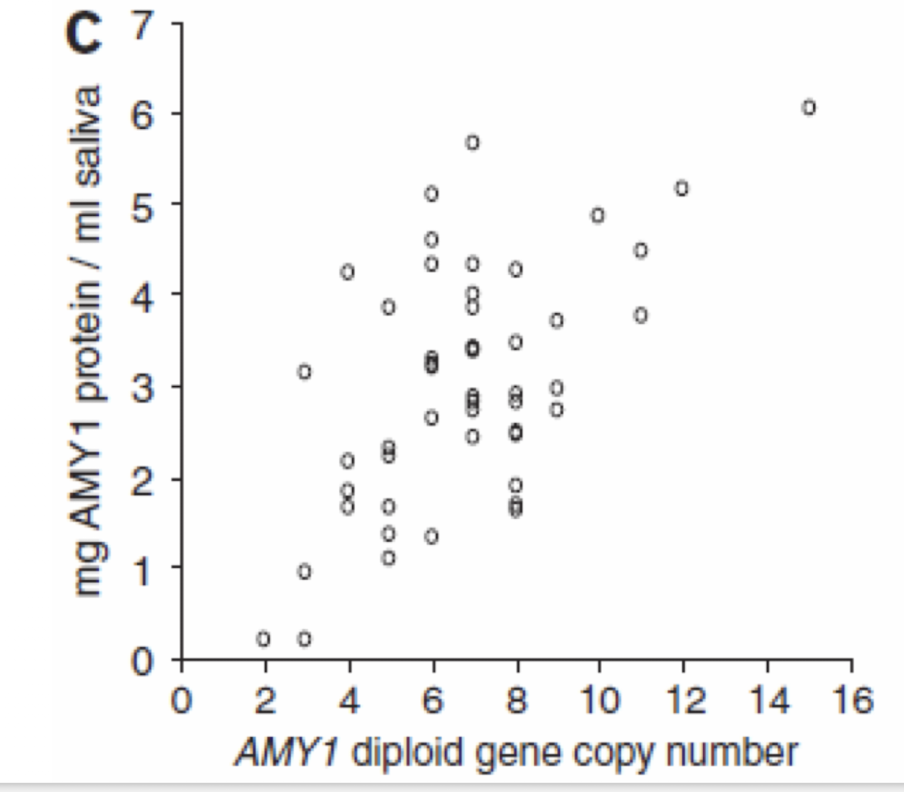
• The amount of amylase in saliva is positively associated to AMY1 copy number
• Higher copy number in populations that consume a high starch diet
• Is starch consumption an evolutionary pressure?
Dose -response gene (the more copies of the AMY1 gene, the more protein)

Study: Prevalence of CNVS in subjects with obesity?
First round of analyses looked at the # of CNVs, gene disrupting CNVs, exonic CNVs, and rare CNVs → found nothing of significance
• Second round of analyses stratified CNVs by size and found: • 5 individuals with obesity had large CNVs (> 2Mb), 0 in lean controls
• 3 deletions, 2 duplications
Study: Prevalence of CNVs in subjects with obesity and control subjects (16 000 subjects)?
31 subjects were heterozygous for deletions (i.e., reduced copy number) of a 590kb region on chromosome 16, which contains 28 genes associated with eating behaviours
• Rare variant with a strong effect on phenotype
this region is associated with over eatting and learning disabilities
They only had 1 copy left and they reported that some of them already had obesity or the likely hood was really high
What happens with increased copies on chromosomes 16?
