R10- pharmacology of steroid receptors
 Call Kai
 Learn
 Practice Test
 Spaced Repetition
 Match
 Flashcards
 Knowt Play
1/29

Earn XP
Description and Tags
- glucocorticoid receptor,hormone,what happens,how it works
30 Terms
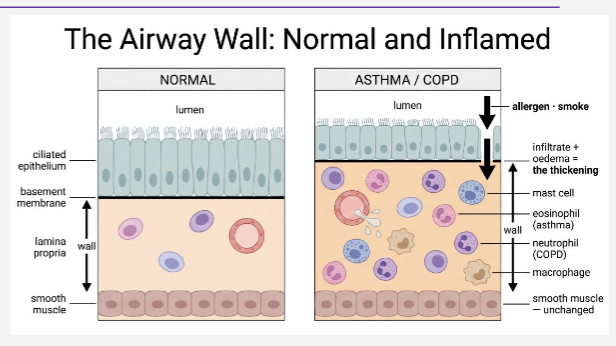
Why is the wall inflamed and thickened in repiratory diseases?
Asthma - allergies cause inflammation
the airway epithelium release cytokines; this causes inflammatory cells to enter the airway
Eosinophils in asthma release inflammatory mediators ( the microvessels leak ) = inflammation, oedema, thickening
The cells between the lamina propria: mast cells, neutrophils ( elastase ), macrophages
Key note - cells cause diseases , narrow airways

Which inflammatory cells are particularly associated with asthma and COPD?
Asthma → mainly eosinophils.
COPD → mainly neutrophils.
Mast cells are also present in the airway wall.
Why does inflammation cause narrowing of the airway?
Inflammatory cells and oedema thicken the airway wall. This reduces the radius of the airway lumen, increasing resistance to airflow and making breathing more difficult
What are ways to control the inflammation in the wall?
Block the mediator, or reduce the cells that release it
• Antihistamine (R16)
• Leukotriene antagonist (R17)
• Anti-inflammatory — fewer cells ·
• Bronchodilator → the muscle (R6)
What is cortisol?
Cortisol is the body's endogenous glucocorticoid steroid hormone. It is produced by the adrenal cortex from cholesterol and normally helps restrain inflammation
Secreted continuously
Lipophilic - crosses every membrane
What is the important structural property allows cortisol and corticosteroids to enter cells?
They are lipophilic steroid molecules, so they can diffuse across the phospholipid cell membrane
Why can steroids not be stored ?
• Lipophilic — would diffuse straight out of any vesicle
• Output set by rate of synthesis, not by release
• Medulla → adrenaline held in granules (ANS17) → seconds, in bursts
• Cortex → cortisol made on demand → continuous, on a rhythm
How does cortisol work?
Ligand crosses the membrane -
Binds to GR
It is physically carried into the cell and transported to the nucleus
DNA is bound - cortisol acts as a transcriptional factor
mRNA is transcribed; certain genes can be turned off
Protein is made.
Note: The receptor is not on the cell surface.
That is why it takes hours.
Where is the glucocorticoid receptor (GR) located?
The GR is an intracellular receptor located in the cytoplasm, rather than on the cell surface.
What type of receptor is the glucocorticoid receptor?
It is a nuclear receptor that acts as a transcription factor, meaning it can alter which genes are transcribed- turning some genes off,on
What are the main structural domains of the glucocorticoid receptor?
The GR contains an N-terminal domain (AF-1), a zinc-finger DNA-binding domain, a hinge region, and a ligand-binding domain
How is the receptor held in the cytoplasm before binding? What are the two proteins associated with the receptor?
Held by proteins including Hsp90 and FKBP51. Hsp90 maintains the receptor in a shape that can bind cortisol.

What happens when cortisol binds ?
The proteins swap FKBP51 to be replaced by FKBP52. FKBP52 links the complex to dynein, allowing the GR complex to travel toward the nucleus.
FKBP52 binds to dynein so it physically moves using atp into the nucleus
In the nucleus, it binds DNA and changes which genes are transcribed.

What happens when the corticosteroid–GR complex reaches the nucleus?
The receptor binds to specific DNA sequences called glucocorticoid response elements (GREs) and changes which genes are transcribed
How does cortisol act as a transcription factor?
enters the nucleus
binds to GR in a dimer at GRE on dna
either activates gene A ( increased transcription, more mRNA or reduces transcription )
What is a glucocorticoid response element (GRE)?
A GRE is a specific DNA sequence that the glucocorticoid receptor binds to in order to regulate gene transcription. Two GR molecules bind together at the GRE
How do corticosteroids reduce airway inflammation overall?
They change gene transcription so that anti-inflammatory proteins increase while pro-inflammatory genes decrease. This leads to fewer cytokines, fewer inflammatory cells and less airway-wall inflammation
Which important anti-inflammatory proteins are increased by corticosteroids? - things that are turned on
The lecture highlights increased production of MKP-1, SLPI, and β₂-adrenoceptors.
What does MKP-1 do?
MKP-1 is a phosphatase. In inflammatory cells, it helps stop the production of inflammatory signals such as cytokines, resulting in less inflammatory cell recruitment.
Fewer signals → fewer cells → quieter wall
What does SLPI do in the airways?
Secretory leukoprotease inhibitor (SLPI) blocks proteases released by inflammatory cells. This reduces damage to proteins and the epithelial lining of the lungs.
SLPI blocks them → less damage
How do corticosteroids complement β₂ agonists?
Corticosteroids increase transcription of the β₂-adrenoceptor, producing more β₂ receptors on airway smooth muscle. This gives β₂ agonists more receptors on which to act.
more receptor made available = lumen opens up
Which pro-inflammatory transcription factors are suppressed by corticosteroids?- things that are decreased
The GR suppresses NF-κB and AP-1, two transcription factors responsible for activating many inflammatory genes.
Which inflammatory products are reduced when NF-κB and AP-1 are suppressed?
There is reduced transcription of iNOS, eosinophil-recruiting cytokines such as eotaxin, and COX-2. This means fewer inflammatory cells and mediators are produced.
How do corticosteroids ultimately make the airway less narrow?
Fewer inflammatory signals → fewer inflammatory cells recruited → fewer mediators such as histamine and leukotrienes → less oedema and inflammation → thinner airway wall and less narrowing.
Do corticosteroids directly relax airway smooth muscle?
No. Corticosteroids are not bronchodilators. They do not directly act on the smooth-muscle contractile mechanism; instead, they gradually reduce airway inflammation.
Why do corticosteroids take hours to work whereas β₂ agonists work in seconds?
β₂ agonists act on a cell-surface receptor and modify proteins already present. Corticosteroids must enter the cell → bind GR → travel to the nucleus → bind DNA → change transcription → produce new proteins. Therefore, corticosteroid effects take hours rather than seconds.
Why must inhaled corticosteroids be taken regularly even when the patient feels well?
Their main purpose is to control the underlying airway inflammation, and their effects develop over hours to months. They are therefore controllers rather than rapid symptom-relief drugs.
Why do corticosteroids work less effectively in COPD than asthma?
In COPD, the corticosteroid can still bind the GR, enter the nucleus and bind DNA. The problem occurs when inflammatory genes need to be switched off. This requires HDAC2, and cigarette-smoke-induced oxidative stress reduces HDAC2, so inflammatory genes remain more active.
What is the key difference between corticosteroid action in asthma and COPD?
In asthma, corticosteroids effectively suppress inflammatory gene transcription, so the airway wall settles. In COPD, reduced HDAC2 means inflammatory genes cannot be switched off as effectively, so cytokine production and airway inflammation persist. The GR itself still works—the downstream machinery is impaired.
key mechanism
Key mechanism to remember for your exam
Corticosteroid → crosses cell membrane → binds cytoplasmic GR → complex travels to nucleus → binds GRE on DNA → changes gene transcription → ↑ anti-inflammatory proteins + ↓ inflammatory proteins → fewer inflammatory cells/mediators → thinner, less inflamed airway wall.
And the key COPD point:
Smoking → oxidative stress → ↓ HDAC2 → GR struggles to switch inflammatory genes OFF → corticosteroids are less effective in COPD