Pre-Film Eval
 Call Kai
 Learn
 Practice Test
 Spaced Repetition
 Match
 Flashcards
 Knowt Play
1/21

There's no tags or description
Looks like no tags are added yet.
22 Terms

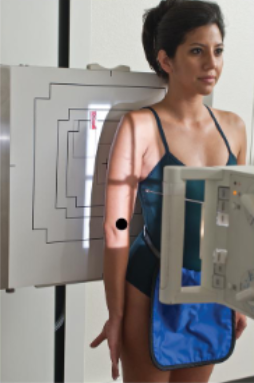
projection/position
CR
AP projection of Humerus - External Rotation
(epicondyles are parallel + equidistant from IR)
CR midpoint of humerus
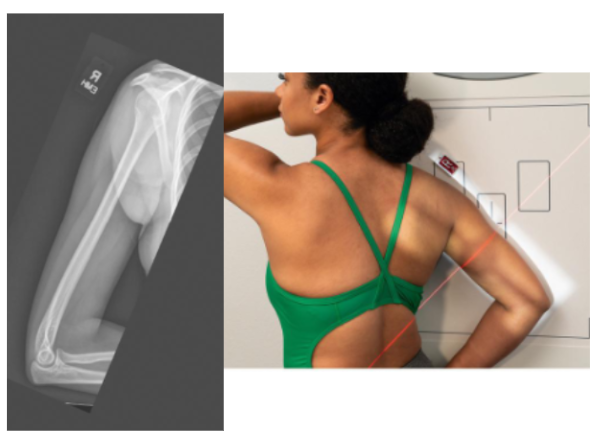
projection/position
CR
Lateromedial projection of Humerus - Internal Rotation
CR midpoint of humerus
projection/position
elbow degree
oblique degree
CR
Mediolateral projection of Humerus
elbow 90
patient oblique 20-30 from PA
CR midpoint of humerus

projection/position
CR
elbow degree
why this projection instead of ‘normal’
Trauma Horizontal Beam Lateromedial Mid-to-Distal Humerus
ensure horizontal beam is 90 from AP view
CR to distal 2/3 humerus
elbow flexed 90, shoot this when elbow is unable to extend

projection/position
arm position
CR
if arm can not be raised
Trauma Transthoracic Lateral projection of Humerus
affected arm in neutral position
CR mid-diaphysis of humerus
if unable to reach arm over head, CR 10-15 cephalad angle

projection/position
CR
AP projection of Shoulder - External Rotation
CR 1 inch/2.5 cm inferior to coracoid process

projection/position
CR
AP projection of Shoulder - Internal Rotation
CR 1 inch/2.5 cm inferior to coracoid process

projection/position
CR
Trauma AP projection of Shoulder - Neutral Rotation
CR to midscapulohumeral joint = ¾ inch inferior + slightly lateral to coracoid process

projection/position
patient position
CR
if arm cannot extend, what do you do
Inferosuperior Axiolateral projection of Shoulder - Lawrence Method
shoulder raised 2 inches from table + elbow 90 + arm in external rotation
CR medially 20-30, centered to axilla + humeral head
if arm less 90, CR medial angle is 15-20

projection/position
reasoning for this
shows Hill-Sachs defect
Inferosuperior Axial projection of Shoulder - Lawrence Method w/ exaggerated External Rotation
BUT HAS ALTERNATIVE POSITION = exaggerated external rotation

projection/position
elbow degree
hand position
CR
Superoinferior Transaxillary projection of Shoulder
elbow 90 + pronate hand
CR to glenoid fossa = 5-15 toward elbow

projection/position
oblique degree
arm position
IR
CR
AP Oblique projection of Glenoid Cavity of Shoulder - Grashey Method
body 35-40 oblique + arm in neutral position
IR 2 inches above shoulder + 2 inches from lateral side of humerus
CR to scapulohumeral joint = 2 inches inferior + 2 inches medial from superolateral border of shoulder
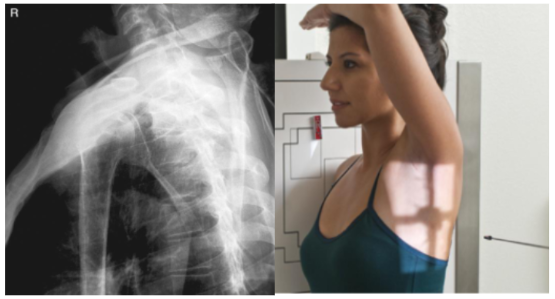
projection/position
CR
Trauma Transthoracic Lateral projection of Proximal Humerus
CR to surgical neck

projection/position
position oblique
CR
Trauma PA Oblique Projection of Scapular Y Lateral of Shoulder
anterior oblique until imaginary line of superior angle of scapula + AC joint articulation perpendicular to IR = range of 45-60
CR to scapulohumeral joint = 2 inches/5cm below AC joint

which image is the dislocation
left
humerus should be in middle of scapy-y

projection/position
patient position
CR
reason for projection
Trauma Tangential projection of Supraspinatus Outlet of Shoulder - Neer Method
anterior oblique until imaginary line of superior angle of scapula + AC joint articulation perpendicular to IR
CR 10-15 caudal
CR 1 inch superior to medial aspect of scapular spine
use this projection to see impingement syndrome

projection/position
CR
if opposite projection, what is CR
[top] AP projection of Clavicle
CR to midclavicle
[bottom] AP Axial projection of Clavicle
CR to midclavicle + 15-30 cephalad angle
if PA axial projection of clavicle, CR is caudal 15-30

projection/position
CR
IR
AP projection of AC joints
top of IR 2 inches above shoulder
CR midpoint of AC joints = 1 inch above jugular notch
for unilateral center CR 1 inch below AC joint

projection/position
IR
arm degree
hand position
CR
AP projection of Scapula
top of IR 2 inches above shoulder + side of IR 2 inches from lateral margin of rib cage
arm 90 + supinate hand on forearm
CR to midscapula = 2 inches inferior to coracoid process + 2 inches medial from lateral border of patient

projection/position
reason for this
rotation degree
CR
Lateral Position of Scapula
shows body of scapula so arm is placed in front w hand on opposite shoulder
typical rotation 45 LAO
CR to midvertebral border of scapula
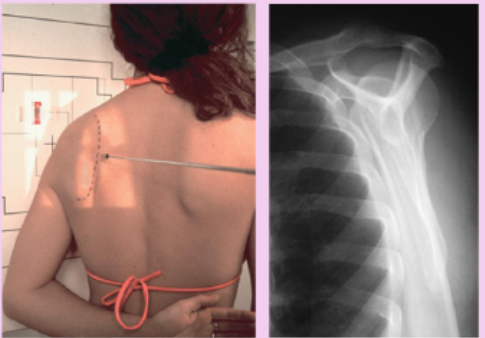
projection/position
reason for this
degree rotation
CR
Lateral Position of Scapula
shows Acromion + Coracoid Process so arm is behind back at an angle
typical 60 LAO
CR to midvertebral border of scapula

projection/position
CR
Lateral Position of Scapula - Patient Recumbent
just to see body of scapula
CR midscapula lateral border