s&p exam 3
 Call Kai
 Learn
 Practice Test
 Spaced Repetition
 Match
 Flashcards
 Knowt Play
1/36

There's no tags or description
Looks like no tags are added yet.
37 Terms
What is light
The region of electromagnetic radiation spectrum that humans can typically see (400 to 700 nm)
Wave-like and particle-like properties
Transverse wave
Stadium-style
Up and down
Electromagnetic energy
Longitudinal wave
Oscillations are parallel to the direction the wave travels
Low energy photons
Travel a long distance over the course of each oscillation, so they have long wavelengths
Red
The four F’s of evolutionary survival
• Fighting
• Fleeing
• Feeding
• Reproduction
What are the evolutionary advantages of being sensitive to electromagnetic energy (versus some other energy form)
Electromagnetic energy travels quickly, thereby conveying (almost) immediate information about distant objects, food, predators, potential mates, etc.
Electromagnetic energy tends to move in straight lines, thereby preserving information about the shape of objects, food, predators, potential mates, etc..
What are the evolutionary advantages of being sensitive to light, per se (versus some other part of the E.M. spectrum)?
Light is “bouncy”. Unlike longer-wave energy, which passes through many opaque objects, light can be reflected (‘bounced’) off of objects, making them visible. Light’s a better messenger.
• On our planet, light is plentiful. By contrast, shorter-wave energy tends to be absorbed by our atmosphere (i.e., by oxygen and nitrogen), and is less plentiful.
Summary of evolutionary advantages to using light as the “messenger”.
Plenty fast.
Plenty straight.
Plenty bouncy.
PolAnd just-plain-old, PLENTY!
Polarization
Some eyes are sensitive to the manner in which light is polarized --that is-- to the plane of polarization (plane of oscillation). Bow-&-Arrow Demo
Some birds and insects have eyes that can pick-up polarization information.
Humans, other mammals, and other so-called “higher vertebrates” are blind to polarization information.
What’s happening with the polarized filters?
• On a given pair of filters, one filter blocks certain
planes of polarization, and “passes” others.
• The other filter does the same for a complimentary
set of planes.
• By properly orienting two polarized filters, you can
block all the light.
What’s happening with the “smoked” filters?
On the first pair, your filter partially attenuates all planes of polarization equally.
Your second filter does the same. It attenuates whatever is remaining from the first filter. Again, all planes of polarization are equally attenuated.
• Unlike polarized filters, orientation makes no difference for smoked filters.
Point of smoked vs polarization filter demos
• If I placed just one of the filters before your eye, you could NOT determine whether (A) the light was reduced equally across all planes of polarization, or (B) the reduction was polarization-plane specific.
• This is because, as a mammal, you are “polarization blind”.
• Not all animals are polarization blind.
• In principle, sensitivity to the plane of polarization could guide migration patterns in birds.
luminance-by-polarization profile for polarized filters.
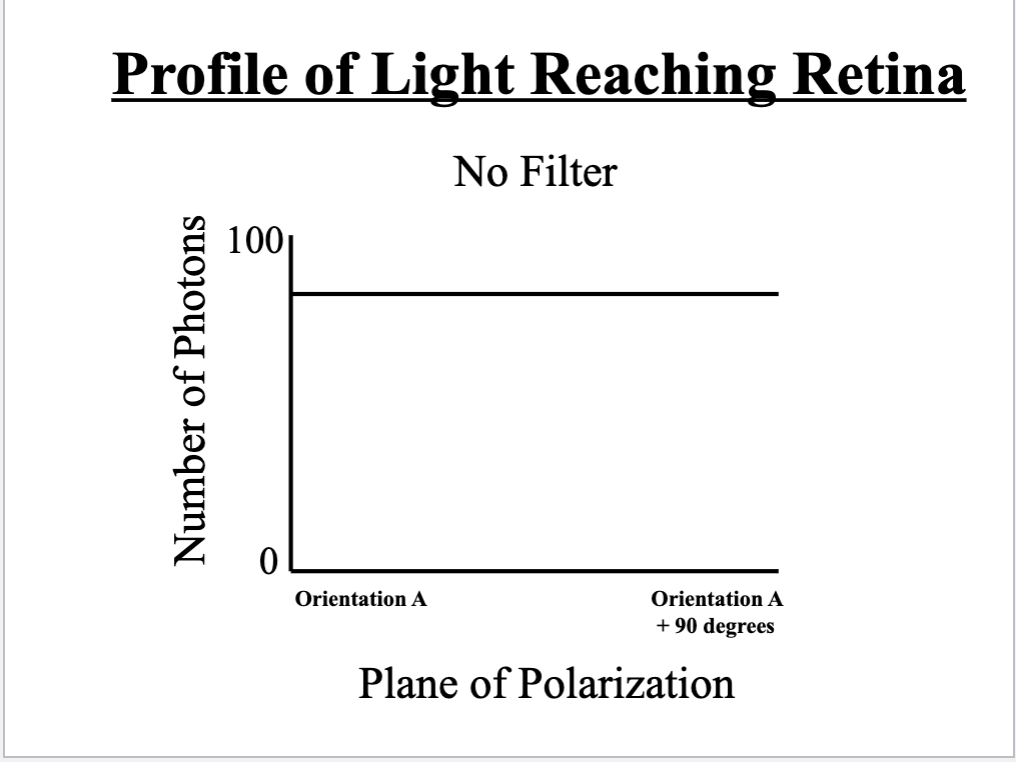

luminance-by-polarization profile for “smoked” filters.
study

The eye is said to have two optical components:
The Cornea & The Lens
The cornea
Image formation on the retina depends on this
It refracts (bends) light
Is convex, it makes incoming light rays converge to a focal point
The refractive power is measured in dipopters
Diopter
= 1 / focal length in meters
Focal length
is the distance from the
optical device, to the focal poi

Crystalline lens
Unlike the cornea, can change shape, providing additional optical power of 10 to 30 diopters
Variability in its shape is called accommodation
Together, the cornea and the lens provide refraction ranging from __ and _ diopters --at least in healthy, young eyes.
50 - 70
Myopic
Near-sighted
The eye ball is “too long”, given the refraction
Hyperopic
Far-sighted
The eyeball is “too short”, given the refraction
Presbyopic
“Old Sight”
Caused by sclerosis (hardening) of crystalline lens, i.e., reduced refraction
Corrected with bifocals
How is image size measured on the retina?
Size (or retinal subtense) is expressed in degrees of
visual angle.
If a 1-centimeter long stimulus is viewed from 57.29
centimeters away, the stimulus subtends 1 degree of visual angle on the retina.
One degree of visual angle corresponds ~300 micrometers (millionths of a meter) on the retina.
Visual Angle = Arctan (stimulus size / viewing distance)
“Rule of thumb” - your thumb nail subtends approximately 1 degree of visual angle, when your arm is fully extended.
Blind spot
a perceptual phenomenon that arises from the optic disc (an anatomical structure on the nasal side of each retina).
it is vulgar to call the optic disk ‘the blind spot’.
approximately 6 degrees of visual angle in diameter, so the optic disk subtends about 1,800 micrometers on the retina.
Retina
retina originates from the same tissue that spawns all neurons.
Like other brain cells, cells here cannot be repaired.
Location of phototransduction
Photoreceptors face the wrong way
The most central part contains only cones. Cone density decreases with eccentricity, and in the far periphery, only rods are found
__ outnumber _ by approximately 100 million to 5 million in each eye
Rods, cones
photoreceptor density (overall) decreases with ____. So, vision is less sharp in the periphery.
eccentricity
For vertebrates, light increments lead to _______, and light decrements lead to ________: Invertabrates, vice-versa.
Hyperpolarization
Depolarization
____ in rods responds best to 500 nm wavelengths
Opsin
The three different cone-opsins respond best to ___, ___,, and ___ nm wavelengths
440, 530, 560
Principle of univariance
All wavelength information is lost at photo-transduciton.
Any cone absorb any wavelength.
Be able to identify three reasons why it is inaccurate
(“Vulgar”) to refer to our three cone types as red, green,
and blue.
3) Newton said so
“The rays are NOT colored.”
2) The Peaks don’t match perception
440 nm looks violet, not blue!
530 nm looks green…OK…but,
560 nm looks yellow, not red!
1) Univariance
Three layers of the retina
Photoreceptors;
Middle-layer (horizontal, bipolar, amacrine);
Ganglion cells.
Ganglion cells
Involved in extracting meaningful visual information
the most meaningful information for an organism would be the identification of object boundaries and edges.
specialize in detecting those luminance boundaries, and reporting them to later portions of the visual system.
LGN Projections
The temporal projections stay on “their side”, but the nasal projections criss-cross at the optic chiasm.
After the optic chiasm, the optic nerve is called the “optic tract”.
There is a left and a right optic tract, each projects to its respective Lateral Geniculate Nucleus (LGN).
The LGN has six layers, neatly organized.
For a given LGN, ipsilateral (‘same side’) inputs project to layers 2, 3, and 5.
For a given LGN, contralateral (‘opposite side’) inputs project to layers 1, 4, and 6.
Neighboring areas of the LGN correspond to neighboring areas on the retina.
The LGN is therefore said to be “retinotopic”.

Color Opponency in LGN
1. Many cells in the LGN exhibit center-surround antagonism based on color.
2. Some of these cells are red-green opponent, and others are blue-yellow opponent.
3. As we have seen before, other LGN cells are simply luminance opponent (not color opponent)
4. Color opponent LGN cells help to identify color-based edges. (Example: red berries on green leaves.)
5.Cells in the LGN project via that “Optic Radiations” to the primary visual cortex