Economics and Policy 2
 Call Kai
 Learn
 Practice Test
 Spaced Repetition
 Match
 Flashcards
 Knowt Play
1/12

There's no tags or description
Looks like no tags are added yet.
13 Terms
Pharmacy Coverage
Exception to traditional insurance principals.
The event must result in a substantial loss.
Large number of small claims → High administrative costs
Why covered?
Drug therapy is often preventive in nature and thus prevents more expensive future costs → Overall cost decrease
Fee-for-Service (FFS)
Health insurance makes a payment to a provider for each service.
Examples: Commercial plans (EGHPs, Exchange Plans), original Medicare, and some Medicaid.
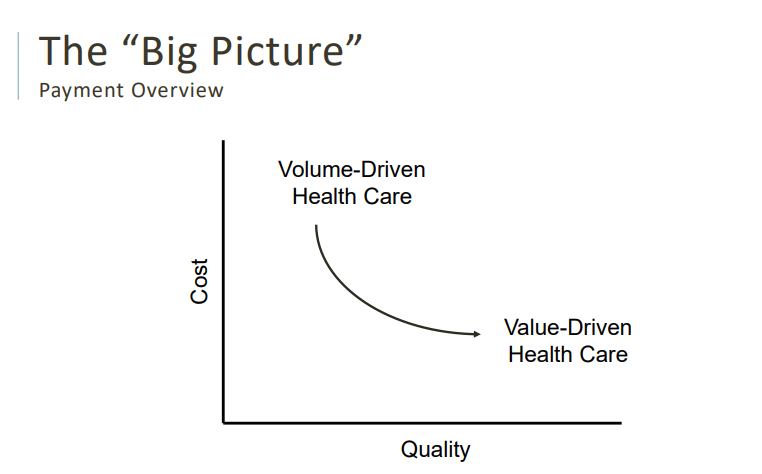
Volume-Drive vs. Value-Driven Health Care
Prospective Payment Models (PPS)
Health insurance makes a fixed payment to a provider for services for each patient, per fixed time period.
Examples: Pockets of use (capitation, DRGs)
Value-Based Payment System
Health insurance makes a payment to a provider for services for each patient, but payment varies based on quality and total cost of care.
Examples: Bundled payment system, accountable care organizations, pay for performance, and many more…
Payment Programs Passed from ACA
HVBP: Hospital Value-Based Purchasing Program
HRRP: Hospital Readmissions Reduction Program
HACRP: Hospital-Acquired Condition Reduction Program
VM: Value Modifier or Physician Value-Based Modifier (PVBM)
Medicare Advantage Flow of Money
Medicare (Capitated + Bonus Payment)/Patient (Premiums) → Health Insurance → Health Provider ← Patient
Medicare contracts with private companies to manage a patient’s health insurance.
Medicare Advantage Five-Star Rating Program
In 2012, CMS began a demonstration program to assess the impact of quality measure reporting and plan ratings on delivery of care.
Aimed to encourage “plans to improve performance to various star rating levels” and to test whether “providing scaled bonuses will lead to more rapid and larger YoY quality improvements in Medicare Advantage program quality scores.”
Allows for comparison of health plans using objective information. Five-point scale used to score plans on quality of care provided.
Why is the Five-Star Rating Program Important?
Calculate bonus payments.
Access to special enrollment periods.
Penalties for plans that perform poorly for 3 years (administrative holds, termination).
What does the star rating do? (?)
Number of stars indicates how large of a rebate an insurance plan can receive from the government and bonus payment (Health Reform Law 2012). Depending on the rating, they receive an amount between the plan bid they propose and the original benchmark set by the government for that care. (73% rebate for 5-star, 67% for 3-star)
Measuring Quality of Medicare Advantage Plans
Value-based reimbursement requires a way to measure quality.
Numerous national measurement programs that capture the different dimensions of plan performance and health outcomes.
Examples: HEDIS (Healthcare Effectiveness Data and Information Set), CAHPS, HOS
Five-Star Rating Calculation (Don’t memorize numbers but memorize categories)
Health Services → 36 topics in 5 categories
Drug Services → 15 topics in 4 categories
Health and Drug Services → All topics above (48 in total)
Health Services Categories: Preventative care, management of chronic conditions, member experience, operational measures, health plan customer service
Drug Services Categories: Patient safety and accuracy of drug pricing, member experience, operational measures, drug plan customer service