APAH Unit 1: Global Prehistory (30,000–500 BCE)
 Call Kai
 Learn
Learn Practice Test
 Spaced Repetition
 Match
Match Flashcards
 Knowt Play
1/10

Earn XP
Description and Tags
Name | Mastery | Learn | Test | Matching | Spaced | Call with Kai | Chat |
|---|
No analytics yet
Send a link to your students to track their progress
11 Terms
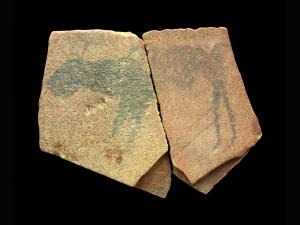
Apollo 11 Stones
Charcoal on stone from Namibia (c. 25,500–25,300 BCE). Art mobilier. Therianthrope.

Great Hall of the Bulls
Charcoal and ochre on rock. Lascaux, France (c. 15,000–13,000 BCE). showing a twisted perspective and used for hunting/shamanic rituals.

Camelid sacrum in the shape of a canine
Camelid bone. Tequixquiac, Central Mexico (14,000-17,000 BCE).
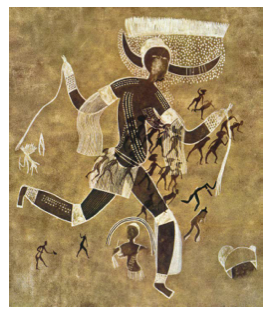
Running horned woman
Pigment on rock. Algerian portion of the Sahara, bordering Libya and Niger (6000-4000 BCE). goddess of fertility or agriculture.

Beaker with ibex motifs
Painted terracotta. Susa 1 period, necropolis, acropolis mound, Susa, Iran (4,200-3,500 BCE). the animals were deeply revered.

Anthropomorphic stele
Sandstone. Arabian peninsula. 4th millennium (4000-3001 BCE). burial marker.

Jade cong
Carved jade. Liangzhu, China (3,300-2,200 BCE). used for burial w/ the upperclass.

Stonehenge
Bluestones (from Wales) and sarsen stone (from nearby). Salisbury Plain, Wiltshire, England (2500-1600 BCE). trilithon shape (2 posts and a lintel).

The Ambum Stone
Greywacke. Ambum Valley, Enga Province, Papua New Guinea (1500 BCE). mortar and pestle or used in burial.

Tlatilco female figurine
Caramic w/ traces of pigment. Tlatilco, Mexico (1200 - 900 BCE). duality. tlatilco - place of hidden things.

Terracotta fragment
Red-slip earthenware. Lapita. Reef Islands, Solomon Islands. 1000 BCE. Terra cotta (incised).