Unit 5 - Heredity
 Call Kai
 Learn
 Practice Test
 Spaced Repetition
 Match
 Flashcards
 Knowt Play
1/54

There's no tags or description
Looks like no tags are added yet.
55 Terms
Polygenic Trait
A trait that is influenced by multiple genes, leading to a continuous range of phenotypes. Examples include height and skin color in humans.
Mendel’s Principle of Dominance
The principle stating that in heterozygous individuals, one allele may mask the expression of another, resulting in the dominant phenotype being observed.
Mendel’s Law of Segregation
The principle stating that during the formation of gametes, the two alleles for a trait segregate from each other so that each gamete carries only one allele for each gene.
Mendel’s Law of Independent Assortment
The principle stating that the alleles for different traits segregate independently of one another during gamete formation, allowing for genetic variation in offspring.
Loss of function alleles
Alleles that result in reduced or complete loss of gene function, often leading to a nonfunctional protein product.
Continuous Variation
The action of many genes to determine a characteristic like human height (offspring tend to be a blend of their parents’ traits)
Hybridization
Mating two true-breeding individuals that have different traits
Trait
A variation in the physical appearance of a heritable characteristic
Reciprocal Cross
A paired cross in which the respective traits of the male and female in one cross become the respective traits of the female and male in the other cross
Monohybrid Cross
When fertilization occurs between two true-breeding parents that differ in only one characteristic
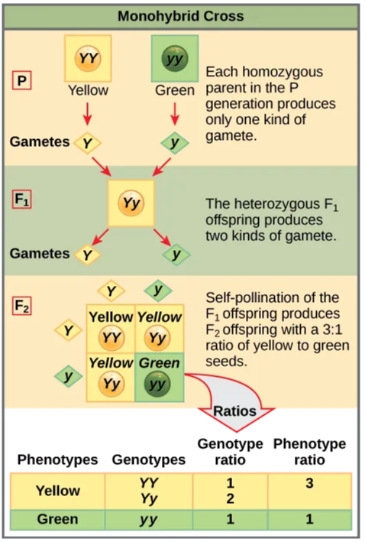
Test Cross
The dominant-expressing organism is crossed with an organism that is homozygous recessive for the same characteristic

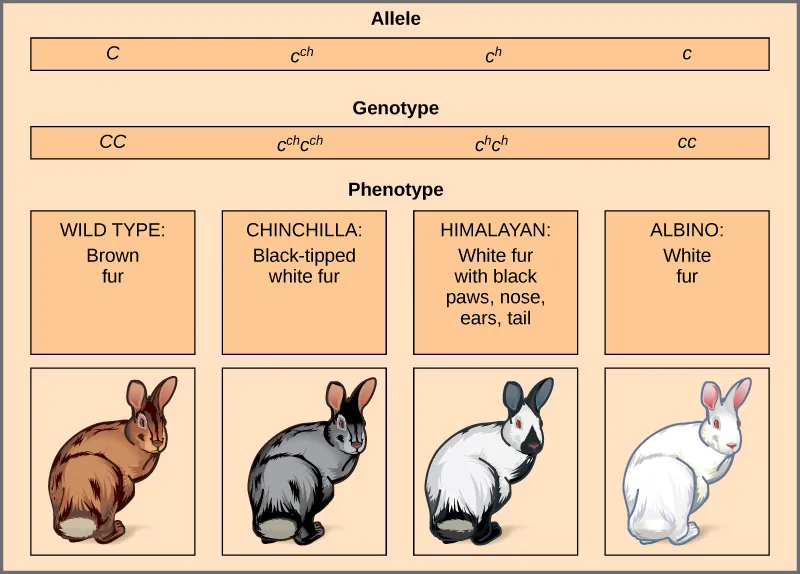
Incomplete Dominance
The expression of two contrasting alleles such that the individual displays an intermediate phenotype
Codominance
When both alleles for the same characteristic are simultaneously expressed in the heterozygote
Wild Type
The most common phenotype or genotype among wild animals (“+”)
X-Linked Traits
When a gene being examined is on the X chromosome but not on the Y chromosome

Hemizygous
When an organism only has one allele for any X-linked characteristic (males)
Recessive Lethal
An inheritance pattern in which an allele is only lethal in the homozygous form and in which the heterozygote may be normal or have some altered nonlethal phenotype
Dominant Lethal
An inheritance pattern in which an allele is lethal both in the homozygote and the heterozygote (can only be transmitted if the lethality phenotype occurs after reproductive age)
Dihybrid Cross
A cross between two true-breeding parents that express different traits for two characteristics

Rules for Multihybrid Fertilization
Count the number of genes segregating the two alleles (heterozygous gene pairs = n)
Epistasis
The interaction between genes is antagonistic (one gene masks or interferes with the expression of another)
Progeny
Offspring
Recombinants
The offspring that are less frequent than you would expect with no linkage
Interphase
§ Growing cells
§ No mitosis
§ DNA is unraveled called chromatin
§ DNA is duplicated (S-Phase)
Prophase
§ Centrosomes duplicate
§ Chromatins condense to chromosomes (meet in middle called centromere)
§ Nuclear envelope disintegrate
§ Spindle fibers start to form from the centrosomes
Prometaphase
§ Spindle fibers reach out to the kinetochores (centromere) of the sister chromatids from the centrosomes
Metaphase
§ The chromosomes line up on the metaphase plate in the middle of the cell
Anaphase
§ Motor proteins pull on the spindle fibers
§ These spindle fibers pull the chromosomes apart from one another so each chromatid goes to opposite sides of the cell (towards the centrosomes)
Telophase
§ Nucleus membrane reforms, organelles reform (2 mini cells inside of one larger cell)
§ The cell plate begins to form
Cytokinesis
§ Two nuclei split apart from one another
S-Phase
DNA replication can occur
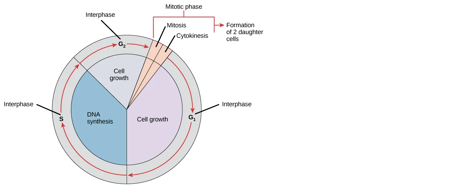
G2-Phase
Cell stores and replenishes energy along with duplicating some organelles to prepare for mitosis
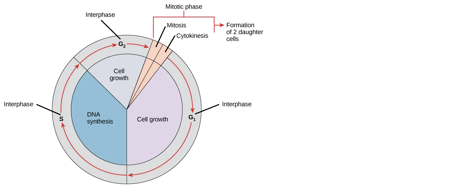
G1 Checkpoint
Checks for adequate cell size and reserves, and genomic DNA damage (if fails, the cell can halt the cycle to attempt to remedy the problematic condition before continuing; if all else fails, cell can go into “apoptosis” programmed cell death)
G2 Checkpoint
Checks for adequate cell size and reserves, ensures all chromosomes have been replicated and the replicated DNA is not damaged (if fails, the cell can halt the cell cycle and attempt to complete DNA replication or repair damaged DNA; if all else fails, cell can go into “apoptosis” programmed cell death)
M(etaphase) Checkpoint
Checks that all sister chromatids are correctly attached to the spindle fibers (if fails, the cell will halt mitosis and make sure the spindle fibers fully attach correctly before continuing; if all else fails, cell can go into “apoptosis” programmed cell death)
Chromosomal theory of inheritance
Identifies chromosomes as the genetic material responsible for Mendelian inheritance
Karyotypes
Number and appearance of chromosomes
Autosomes
Non-sex chromosomes that determine body traits and functions.
Nondisjunction
When homologous chromosome pairs or sister chromatids fail to separate during meiosis

Euploid
The appropriate number of chromosomes for their species
Aneuploid
An error in chromosome number
Monosomy
Losing one chromosome
Trisomy
Gaining an extraneous chromosome
Chromosome Inversions
The detachment, inversion, and reinsertion of a chromosome segment, which can disrupt gene function.
Pericentric Inversions
Inversion around the centromere (includes the centromere)

Paracentric Inversions
Inversion outside the centromere

Translocation
When a chromosome segment dissociates and reattaches to a different nonhomologous chromosome
Reciprocal Translocation
Result from exchanging chromosome segments between two nonhomologous chromosomes such that there is no genetic information gain or loss

G1 Checkpoint (positive regulation)
o A growth factor binds to receptors on the cell surface
o This is an external signal that the cell should divide
o The growth factor triggers the production of the G1/S cyclin, which triggers DNA replication
G1 Checkpoint (negative regulation)
o If DNA is damaged, p53 activated
o p53 inhibits Cyclin-CDK complex
o No progress to S phase until DNA is repaired (or cell goes into apoptosis)
G2 Checkpoint (positive regulation)
o M phase Cyclin concentration rises
o Cyclin binds to appropriate CDK
o Causes the formation of spindle fibers and the beginning of mitosis
G2 Checkpoint (negative regulation)
o If DNA replication is incomplete a group of proteins inhibit Cyclin-CDK complex
o Process stops until damage is fixed (or cell goes into apoptosis)
M Checkpoint (positive regulation)
o When all chromosomes are connected to the spindle and tension is correct, a signal activates the “anaphase promoting” (APP) protein complex
o APP destroys proteins keeping the two chromatids attached
M Checkpoint (negative regulation)
o If chromosomes are not properly attached to spindle, APP is inactivated by protein complex
o Prevents nondisjunction
Anaphase Promoting Protein (APP)
Destroys proteins keeping the two chromatids attached