BIO 202 Reproductive System
 Call Kai
 Learn
 Practice Test
 Spaced Repetition
 Match
 Flashcards
 Knowt Play
1/48

There's no tags or description
Looks like no tags are added yet.
49 Terms

glans
commonly called the head of the penis
male equivalent of the femaile clitoris

shaft/body
longer smooth portion of the penis
prepuce
commonly known as foreskin
folded portion of skin that covers the glans when penis is not erect
can be removed in circumcision
male equivalent of remale clitoral hood/prepuce
scrotum
a sac of skin and muscle that holds the male testis
testes
male gonads, site of sperm production and testosterone secretion
male equivalent of ovaries (primary sex organ)
housed in scrotum

pampiniform plexus
system of small veins that run along side the ductus deferens to cool the blood flowing to the testes
sperm require a temperature 2-3 degrees cooler than normal body temp to develop

cremaster muscle
muscle that covers the testes and serves to lower or raise them for thermal regulation
tunica albuginea
bluish white fibrous covering just superficial to the testis
tunica vaginalis
serous membrane that covers the tunica albuginea and is filled with serous fluid
epididymis
site of sperm maturation
connects the efferent ductules from the posterior testis to the vas deferens
vas deferens
bilateral ducts carrying sperm from epididymis to ejaculatory ducts
roughly 30 cm in length and surrounded by smooth muscle (sympathetic control - contraction/ejaculation)
spermatic cord
cord-like structure formed by the vas deferens and surrounding tissue (some from abdominal wall)
Contents include pampiniform plexus, cremaster muscle, gonadal artery and vein, vas deferens, nerves, and lymphatic vessels
corpus spongiosum
erectile tissue that runs along the inferior portion of the shaft of the penis (bulb of the penis)
surrounds the urethra and is the erectile tissue that makes up the glans of the penis
helps prevent the urethra from closing during an erection to allow sperms to flow through
corpus cavernosa
twin pair of erectile tissue that run along the superior portion of the shaft of the penis
What is the parasympathetic NS (S2-S4) responsible for?
Initiates and maintains erection by promoting relaxation of penile smooth muscle
increasing arterial blood flow and reducing venous outflow through compression of the draining veins
sympathetic activity (Tll-L2)
controls emission and contributes to ejaculation through contraction of the reproductive ducts and accessory glands

What is the blue arrow pointing to?
corpus cavernosum
spermatogenesis
occurs in testis
happens in seminiferous tubules that contain stem cells spermatogonium that divide and get committed to meiosis
cells move along to the lumen of the tubule as they undergo and complete meiosis and detach
then they move along to the rete testis, enter the epididymis to mature, get stored, and released during ejaculation

what are the yellow and pink histology arrows pointing to?
yellow - testis
pink - epididymis
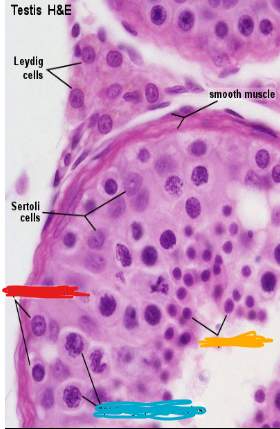
What is the red arrow in the testis H&E?
spermatogonia
What is the orange arrow in the testis H&E?
spermatids
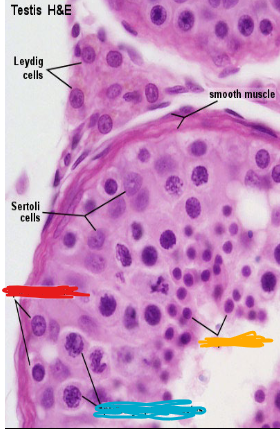
What is the blue arrow in the testis H&E?
primary spermatocytes
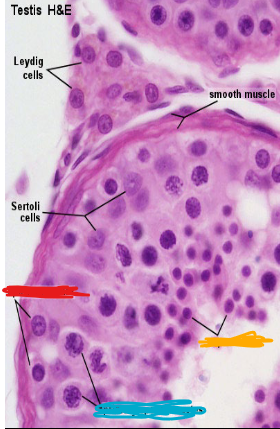
Which is the primary and secondary spermatocyte?
primary is blue
secondary is red
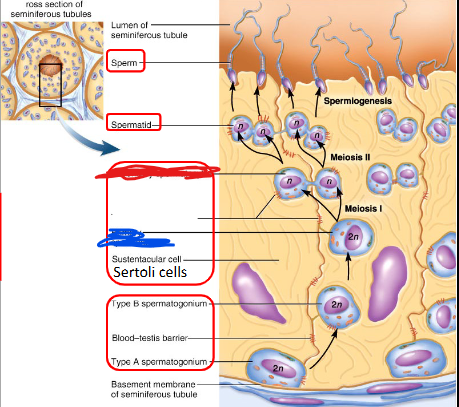
Inside each testis, there are the ____, where cells divide to form gametes that will eventually become sperm
seminiferous tubules
sperm life cycle
cell divides → spermatogonia → divides → spermatocytes → divides → spermatids → evolves → spermatozoa
What cells are known as the Leydig cells and are found in the testes?
Interstitial cells
make testosterone
Labeled sperm
in order from head to tail
head
acrosome
nucleus
basal body
midpiece (body)
microchondria
principal piece
axoneme
endpiece

ejaculation
immature sperm start at testes and move to the epididymis to mature
when mature, sperm travel through the ductus deferens or vas deferens
sperm are very sensitive to pH and temperature. Bulbourethral gland secretes fluids to lubricate the urinary canal as well as raise the pH to an alkaline level
once the pH is high enough, the sperm leave the ductus deferens and enter the Ejaculatory Ducts
At ejaculatory ducts, the sperm is fixed with fluid from the prostate which contains enzymes to help with pH and make sure to break down fluids in semen and in the vagina so sperm can swim
semen is thoroughly mixed and joins the urethra, where it is expelled
True or false: Sperm does not equal semen
True!
semen includes all the fluids from the various accessory glands plus the sperm
semen is 1% bulbourethral gland fluid, 4% sperm, 25% prostate fluid, 70% seminal vesicles fluid
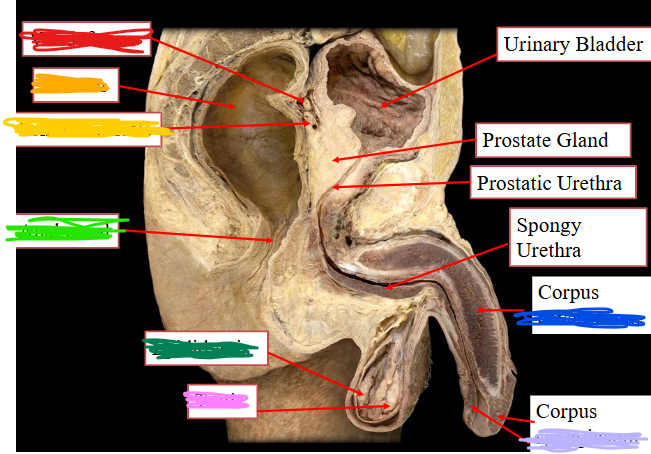
What is the red arrow in the cross sectional view?
vas deferens
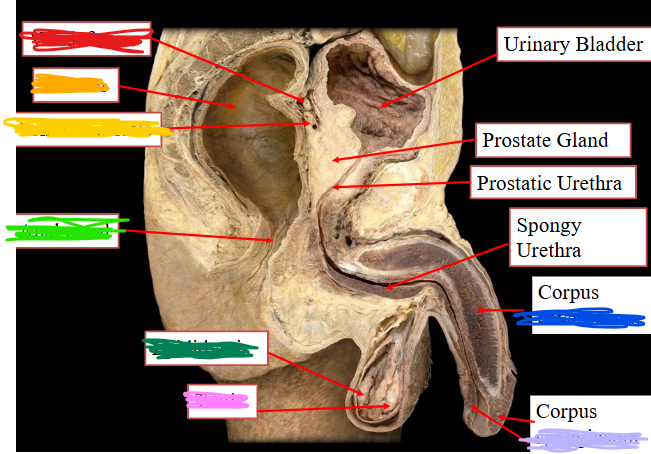
What is the orange arrow in the cross sectional view?
rectum

What is the yellow arrow in the cross sectional view?
seminal vesicle

What is the light green arrow in the cross sectional view?
anal canal

What is the dark green arrow in the cross sectional view?
epididymis
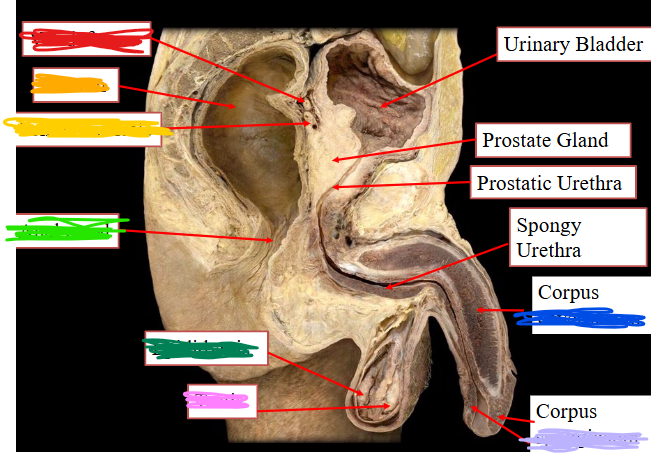
What is the pink arrow in the cross sectional view?
testis
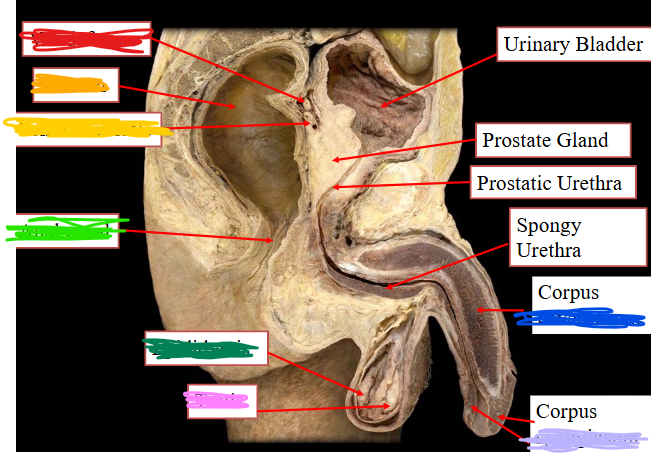
What is the blue arrow and purple arrow in the cross sectional view?
blue - corpus cavernosum
purple - corpus spongiosum
Female primary and accessory reproductive organs
primary
ovaries
accessory
breasts/mammary glands, uterine/fallopian tubes, uterus, vagina
True or false: mammary gland is all lobes
True!
lobes are larger than lobules
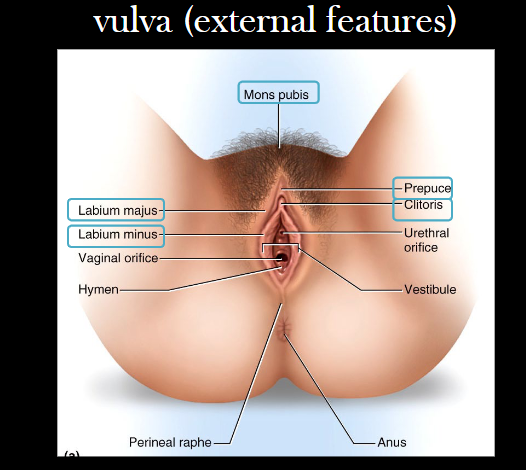
mons pubis
superficial to pubic symphysis
most of pubic hair
fatty layer beneath skin

labium majus/labia majora
inferior to mons pubis
thick folds of skin
pubic hair (laterally)
hairless medially

labium minus/labia minora
hairless
thin skin
most medial of the labia

clitoris
erectile organ of females (erectile tissue)
homologous to glans of penis
actual tissue = corppora cavernosa

prepuce
fold of skin covering the clitoris
homologous to the prepuce of the penis (covering the glans of the penis)
What glands in females, also known as Bartholin glands, produce lubricating fluid?
greater vestibular glands
vagina
elastic muscular, tubular tract
vulva → uterus (cervix)
pH 3.8-4.5
cervix
neck of the uterus
vulva → vaginal tract → cervix → uterus
protrudes into vagina
os = orifice
external os = opening from vagina to cervix
internal os = end of cervix - opening to uterus